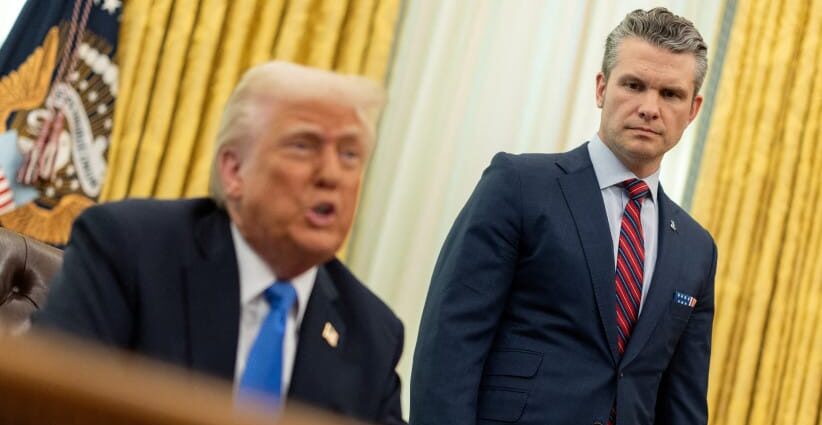
The Senate Armed Services Committee hearing on April 30, 2026, in which Defense Secretary Pete Hegseth faced sharp partisan attacks from Senator Kirsten Gillibrand and other Democrats, underscored a troubling reality: the politicization of national security.
Framing the Trump administration’s decisive action against Iran as “starting a war America doesn’t want” is not only inaccurate – it is reckless. America’s safety must never be reduced to a partisan talking point.
Against this backdrop, the tone of last week’s Senate hearing was deeply disappointing. Americans watching the hearing could not help but feel a sense of embarrassment, as it appeared clear that the attacks were driven more by partisan considerations than by the genuine interests of the American people or national security.
Instead of confronting the threat, critics chose to question the legitimacy of the response – risking the wrong signal not only at home, but to adversaries abroad who closely watch American resolve.
US President Donald Trump and Hegseth deserve recognition for demonstrating the kind of decisive leadership this moment required.
In late February 2026, they authorized Operation Epic Fury – targeted strikes on Iran’s nuclear infrastructure, ballistic missile production facilities, naval assets, air defense systems, and terrorist support networks.
This was not an escalation for its own sake, but a strategic move to confront a rapidly advancing threat before it reached a point of no return.
Since the 1979 Islamic Revolution, Iran’s regime has maintained a consistent posture of hostility toward the United States and Israel. Its leaders have repeatedly referred to America as the “Great Satan” and Israel as the “Little Satan,” while state-sponsored chants calling for the destruction of both nations have become routine.
Beyond rhetoric, the regime has taken American hostages, directed attacks that have killed US service members and civilians, and built one of the most extensive terrorist proxy networks in modern history – including Hezbollah, Hamas, Palestinian Islamic Jihad, the Houthis, and multiple Shia militias across Iraq, Syria, and Yemen.
Iran’s designation as the world’s leading state sponsor of terrorism is not symbolic – it is earned through decades of documented activity. From the 1983 Beirut barracks bombing that killed 241 American servicemen to continued attacks on US forces in the Middle East and Houthi assaults on international shipping in the Red Sea, the regime’s actions have consistently targeted American lives and global stability.
Israeli leaders have long warned that when a regime repeatedly declares its intent to destroy you, those words must be taken seriously. Iran has done so for more than four decades – clearly, consistently, and without ambiguity.
Warnings of weapons-grade uranium
Prior to the US strikes, Iran had amassed approximately 440 kilograms of uranium enriched to 60% purity, a level that experts warn could be advanced to weapons-grade in a short timeframe.
The situation took on added urgency as it became clear – catching many by surprise – that Iran had developed ballistic missile capabilities capable of reaching parts of Europe, raising the danger, God forbid, of such systems being paired with nuclear warheads.
Compounding this, reports from diplomatic channels indicated that Iranian officials conveyed to US envoy Steve Witkoff that they could achieve nuclear weapons capability within days. That was not a theoretical warning – it was a direct and immediate threat to the United States and its security.
Faced with such a reality, Trump made the decision not to test Iran’s intentions but to act decisively and proactively, using force to neutralize a growing and dangerous threat before it could fully materialize.
Trump and Hegseth recognized the urgency of this moment. Their decision to act reflected strategic foresight and a willingness to confront reality rather than defer it. By degrading Iran’s nuclear and military capabilities, the operation reduced immediate risks and forced the regime into a more constrained posture. This was a strength deployed to prevent a far more dangerous conflict.
As an American and a Jewish leader, I have worked extensively at the intersection of business, policy, and international relationships. The security of the United States and Israel is deeply interconnected. Iran’s threats are not abstract – they are reinforced by decades of support for terrorism targeting civilians and its continued calls for the destruction of a sovereign nation.
History is clear: ignoring determined enemies does not prevent conflict – it invites it. From the lessons of the 20th century to the fight against global terrorism, America has succeeded when it confronted threats with clarity and resolve, not hesitation.
This is not theoretical. The stakes involve real lives – American lives, Israeli lives, and the broader stability of the free world. The cost of inaction in the face of credible threats has always been far greater than the cost of confronting them early.
America’s safety should never be treated as a partisan issue. It demands unity, seriousness, and a shared commitment to defending the nation against those who openly call for its destruction.
At a moment of such consequence, leadership must rise above politics. The question is not whether the action will be criticized – it is whether it was necessary. In this case, the answer is clear.
The writer is the founder and CEO of the Orthodox Jewish Chamber of Commerce.