
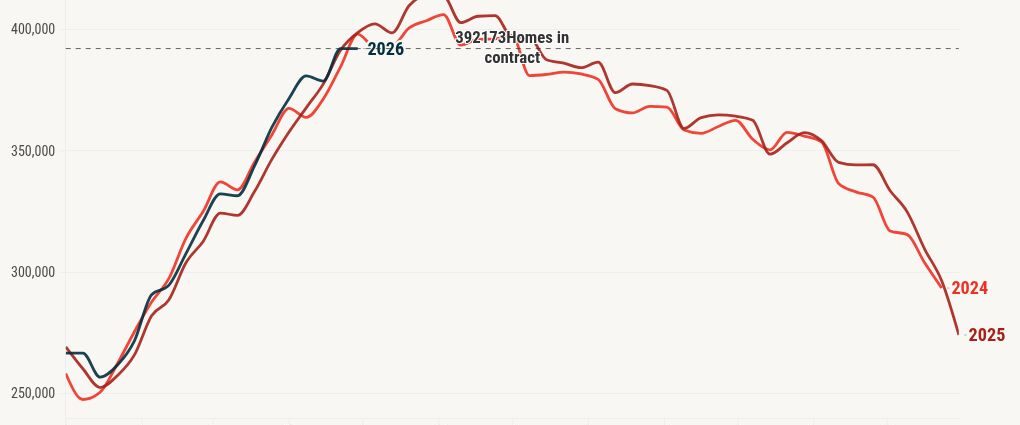
Pending home sales rose slightly in March, jumping 1.5% month-over-month, according to data released Tuesday by the National Association of Realtors (NAR).
In March, the Pending Home Sales Index came in at a reading of 73.7, up from February’s reading of 72.1, but down 1.1% annually.
An index reading of 100 is equal to the level of contract activity in 2001.
“Contract signings rose in March despite higher mortgage rates, pointing to pent-up housing demand,” Lawrence Yun, NAR’s chief economist, said in a statement. “A greater supply of inventory will help translate that demand into more home sales.”
HousingWire Data shows that during the last week of March 2026, there were 70,676 new pending home sales, up from 69,183 new pending home sales at the end of March 2025. During the week ending on April 16, there were 73,241 new pending home sales up from 71,775 new pending home sales a year ago. Overall, HW data shows that pending inventory as of mid-April is at 392,173, up 0.2% compared to a year ago.
Regionally, NAR’s data shows that pending home sales were up on a monthly basis in the Northeast (58.5) and South (91.6), jumping 4.4% and 3.9%, respectively, while dropping 1.3% and 2.6% in the Midwest (73.9) and West (56.9), respectively. Year-over-year, pending home sales were down in the Northeast (-6.5%), Midwest (-3.1%) and West (-1.7%), but up 2.3% in the South.
Among the 50 largest metro areas, Kansas City, MO-KS, reported the largest annual increase in pending home sales, jumping 14.9% compared to March of 2025. The Milwaukee–Waukesha, WI (+13.5%), Austin–Round Rock–San Marcos, TX (+12.8%), Phoenix–Mesa–Chandler, AZ (+12.1%) and Raleigh–Cary, NC (+10.0%) metro areas also posted double-digit year-over-year increases.
“A good number of markets in the South experienced price cuts over the past year but recorded the strongest job growth,” Yun added. “That combination should lead to stronger housing market activity in the South this year.”
Mike Miedler, the president and CEO of CENTURY 21 Real Estate, also warned that due to these regional differences, agents and consumers should not read national headlines and assume those statements apply to their neighborhood.
“Texas looks very different from Massachusetts right now. Dallas already has fewer single family homes for sale than this time last year,” Miedler said in a statement. “A buyer in Connecticut is in a completely different market than one in Houston or San Antonio. The national number tells you the weather. Your local agent tells you whether to bring an umbrella.”




