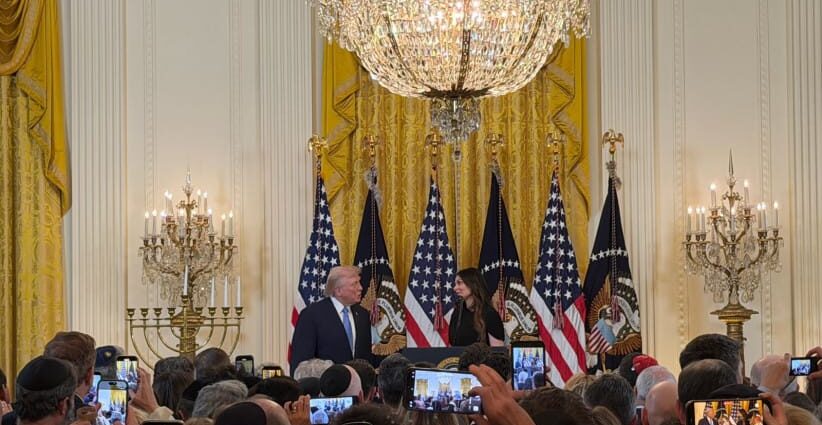
When Elizabeth Pipko speaks about politics, she sounds surprised by how quickly America has changed since she first entered the arena a decade ago.
The former Republican National Committee spokeswoman, who will appear at The Jerusalem Post Annual Conference in New York on June 1, has spent much of the last decade defending US President Donald Trump in television studios, campaign war rooms, and increasingly hostile public spaces. But during a wide-ranging interview with the Post ahead of the conference, Pipko repeatedly returned to something more personal: fear.
Not simply fear for American politics, or even for the future of US-Israel relations, but fear for herself, her family, and the world into which she has now brought her daughter.
“It’s a really, really scary time,” Pipko said. “Nobody asked for this. I don’t think anybody raised me assuming that I’d be facing these kinds of threats and that America would be at this point when I was just 30 years old.”
Born in New York to Soviet immigrant parents, Pipko grew up deeply conscious of both Jewish identity and American patriotism. She described herself as “one of the proudest Americans you’ll ever meet,” while also speaking openly about how her Jewish identity shapes the way she views politics, antisemitism, and Trump himself.
Pipko, who first volunteered for Trump’s 2016 campaign as a teenager, said she still believes he was “chosen for this time.”
“I think if you go back 10 or 11 years, nobody could have imagined where we’d be right now,” she told the Post. “And yet today, it all makes perfect sense. It’s almost as if he was chosen to open people’s eyes to so many different things.”
While critics often focus on Trump’s personality, Pipko argued that Americans frequently confuse personal perfection with leadership.
“When I looked for a husband, I was looking for very different qualities than when I look to cast a ballot for president of the United States,” she said. “I would argue my husband is not perfect to be president, but probably the most perfect person you could meet or marry. Donald Trump is the perfect person to lead the United States, especially at a time like this.”
Having spent years working around Trump and his political orbit, Pipko insisted the public version of him differs significantly from the man she has encountered privately.
“I think he’s a wonderful person,” she said. “But I understand most people don’t have the luxury of ever seeing that.”
Pipko speaks about violence, political extremism in America
The conversation repeatedly returned to violence and political extremism in America, particularly following the assassination attempts against Trump and the killing of conservative activist Charlie Kirk, with whom she had a personal relationship.
Pipko recalled watching the attempt on Trump’s life unfold live on Shabbat and believing, for several moments, that the former president had been killed.
“I was petrified,” she recalled.
But she said the killing of Kirk affected her differently because it suddenly made the danger feel personal.
“Charlie was a friend,” she said quietly. “And I just watched a friend get assassinated.”
At the time, Pipko had recently learned she was pregnant.
“I remember calling my husband hysterically crying and saying, ‘I don’t want to do this anymore,’” she said. “That was the first time that I actually felt this was going to impact me personally.”
Pipko said threats directed at her intensified significantly whenever she publicly defended Israel.
“When I sign off after defending Israel, the messages become actual threats,” she said. “People telling me I don’t deserve to live. People saying Hitler should have finished the job.”
She believes many Americans underestimate how much antisemitism has become intertwined with broader political polarization.
“A lot of what Donald Trump faces might not just be political polarization,” she argued. “It’s also his stance on Israel.”
According to Pipko, the media has played a major role in deepening those divisions. She described her own disillusionment with major American outlets as gradual rather than immediate, beginning after she started seeing stories written about herself that she said were factually incorrect.
“I remember reading articles about myself and thinking: none of this is true, and they can get away with it,” she said.
That experience, she said, changed the way she viewed reporting on Trump and eventually on Israel as well.
“They know they can issue a tiny correction after millions of people have already read the story,” she said. “And they know the damage has already been done.”
Pipko argued that the explosion of hostility toward Israel and Jewish students on American campuses after October 7 did not emerge overnight, but had been building for years inside elite academic institutions.
She recalled speaking to a Jewish student at the University of Pennsylvania before enrolling there herself in 2021.
“She told me, ‘Our fellow classmates would rather know you were at January 6 than know you’re a Zionist,’” Pipko said.
That conversation took place more than two years before Hamas’s October 7 massacre.
According to Pipko, many young Americans have spent years absorbing simplistic narratives that frame Israel as an oppressor within a wider ideological worldview rooted in anti-Americanism and Marxist thought.
“When you teach people from a very young age that Israel is the oppressor, just like the United States is the oppressor, then something like October 7 doesn’t change their worldview,” she said. “They just do mental gymnastics to justify it.”
Pipko reserved particular criticism for elite universities, arguing that many Jewish families ignored warning signs for years while continuing to financially support institutions hostile to Zionism.
“We turned a blind eye and we let it happen,” she said. “Shame on every single one of us for not paying attention to what our young people were being taught.”
Now, she said, Jewish parents routinely contact her asking where they can safely send their children to school.
“I never thought those would be the messages I’d get,” she admitted.
As president of a Jewish day school in New York, Pipko said she has watched attitudes among students and parents shift dramatically over the past decade.
“When I was graduating, everybody wanted to go to the best science and math schools in New York,” she said. “Now more than 95 percent of the kids are choosing Jewish schools because they no longer feel safe.”
Asked what advice she gives Jewish students entering university today, Pipko paused before offering an answer that clearly pains her.
“I hate to say it,” she said, “but I tell people to stay quiet, stay focused on your studies, and protect yourself.”
That advice, she acknowledged, runs against the values with which she herself was raised.
“My grandparents and parents always taught me to stand up for myself,” she said. “But I don’t feel safe giving that advice anymore.”
Despite her criticism of the American Left, Pipko does not believe Jewish voters are undergoing some immediate political realignment toward Republicans, although she expects gradual demographic changes over time.
“I think many liberal Jews feel politically homeless,” she said. “But they still aren’t comfortable publicly saying they voted Republican.”
Still, she believes support for Israel remains significantly stronger inside today’s Republican Party than among Democrats, even while acknowledging broader shifts in public opinion.
“The world is changing before our eyes,” she said. “I would be stupid to deny that.”
For Pipko, however, the debate over Israel ultimately extends beyond politics and into something far more fundamental about Western civilization itself.
“America cannot survive without Israel,” she said. “Not the current government of Israel, but the land of Israel, which inspired many of the values we hold near and dear in our country today.”
As she prepares to address a largely pro-Israel audience in New York next week, Pipko said her message inside the conference hall will likely be straightforward: “Don’t give up.”
At the same time, she said she hopes her words reach beyond the room itself.
“The people inside will probably already agree with me,” she said. “What matters more is whether people outside the room hear it too.”
And for all the political arguments surrounding Israel, Trump, campuses, and the future of America, Pipko ultimately returned to something deeply personal: the prospect of one day explaining antisemitism to her daughter.
“I didn’t expect that I’d have to prepare my child for this in America,” she said. “I’m sure my parents hoped they’d left that behind when they came here from the Soviet Union. But now I’m preparing myself to have the exact same conversation with my daughter.”
Elizabeth Pipko will speak at The Jerusalem Post Annual Conference in New York on June 1. For tickets, visit https://conferences.jpost.com/new-york-2026