
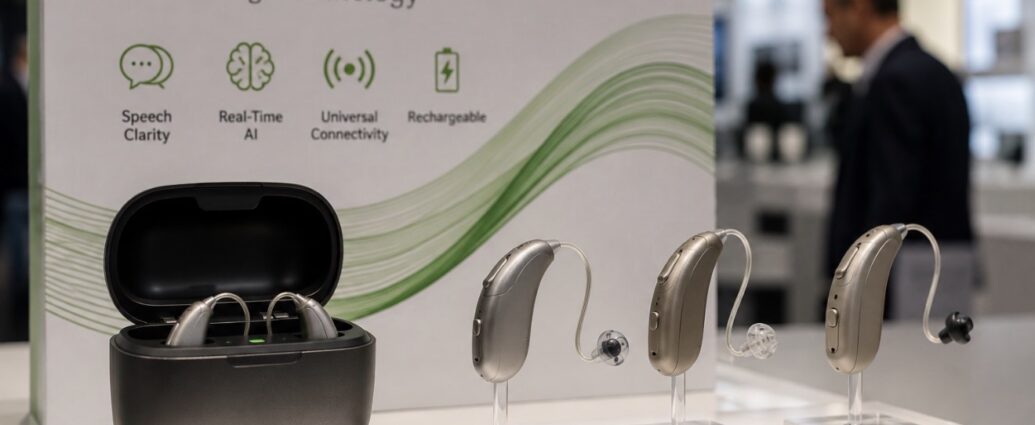
Hearing aids are moving deeper into artificial intelligence, and Phonak is betting that the biggest consumer benefit will not be louder sound. It will be making speech easier to understand when the room is noisy.
Phonak launched its new EON hearing-aid platform in the United States on Monday, introducing a new generation of devices built around real-time AI sound processing, automatic scene recognition and broader wireless connectivity.
The flagship model, Audéo EON Sphere, is designed to separate speech from surrounding noise in real time so conversations stand out more clearly in restaurants, family gatherings, public transportation and other environments where hearing-aid users often struggle most.
That problem has long been one of the industry’s hardest to solve.
Traditional hearing aids can amplify sound effectively, but amplification alone does not necessarily help when multiple voices, dishes, music and background noise are competing at the same time. Phonak’s approach is to use AI processing to identify speech and suppress distractions continuously rather than forcing the user to manually change programs.
The new platform is powered by Sonova’s HYPERSONIC chip and also includes AutoSense OS AI 8.0, which automatically adjusts the hearing aid as the wearer moves between different environments.
The EON lineup includes Audéo EON Sphere, Audéo EON R and CROS EON R, the latter designed for people with hearing loss primarily on one side.
Connectivity is also becoming a larger part of the product.
The devices support standard Bluetooth as well as Auracast, a newer broadcast-audio technology that can allow hearing aids to receive audio directly in places such as theaters, airports, conference rooms, gyms and other public spaces as Auracast adoption expands.
For consumers, that pushes hearing aids closer to the functionality people already expect from wireless earbuds while preserving the medical-grade processing designed for hearing loss.
Phonak says the new models are also smaller and lighter than previous generations, addressing another persistent complaint among users who wear the devices for most of the day.
The launch comes as hearing technology becomes increasingly competitive. Prescription hearing-aid manufacturers are adding AI processing, while consumer-electronics companies are introducing hearing-related features into earbuds and other devices.
That competition is changing expectations.
Consumers increasingly want hearing aids that do more than amplify sound. They expect automatic adjustment, phone connectivity, streaming, rechargeable batteries and better performance in noisy environments without constantly manipulating settings.
The United States is the first major launch market for EON, with additional European markets and Australia expected to follow in September.
The broader shift is easy to see.
For decades, hearing aids were essentially specialized amplifiers.
The next generation is becoming something closer to an AI-powered audio computer worn behind the ear.
JBizNews Desk | Stäfa, Switzerland
© JBizNews.com All Rights Reserved. Reproduction or distribution without written permission is prohibited.
:::




