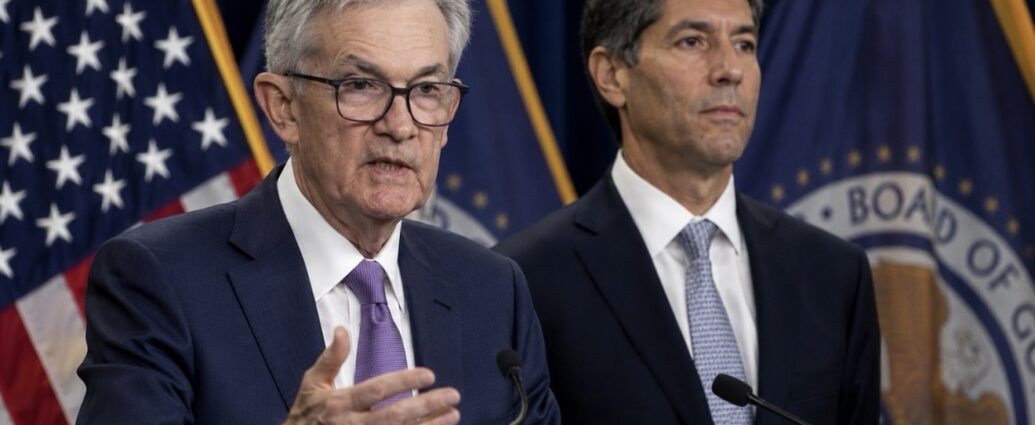
Jerome Powell’s eight-year run as chair of the Federal Reserve officially ends Friday, closing one of the most consequential and politically scrutinized tenures in modern central-banking history and handing the gavel to Kevin Warsh, a former Fed governor and avowed monetary hawk who has promised what he himself has called “regime change” at the world’s most important central bank.
Warsh, 56, was confirmed by the U.S. Senate on May 13 in a vote that fell largely along party lines, with Senate Majority Leader John Thune of South Dakota urging colleagues from the Senate floor to support a nominee he said understood “not only the macro” but also the “microeconomy” — what Thune described as “hardworking Americans, their jobs and their livelihoods.”
Warsh will become the 17th chair in Federal Reserve history, with a separately confirmed seat on the Federal Reserve Board running until 2040. Warsh previously served as a Fed governor from 2006 to 2011, helping coordinate the rescue of Bear Stearns during the 2008 financial crisis.
Mr. Powell, 72, who said last month he had “long planned to be retiring,” took the unusual step of announcing he will remain on the board as a sitting governor through the end of his separate 14-year term in January 2028. Most departing Fed chairs have left the central bank entirely.
Powell told reporters at his final press conference on April 29 that he intended to “keep a low profile as a governor,” adding: “There’s only ever one chair of the Federal Reserve Board. When Kevin Warsh is confirmed and sworn in, he will be that chair.”
Powell has tied his continued presence to the resolution of an investigation into the Fed’s headquarters renovation project, which he wants to see “well and truly over, with transparency and finality.”
Warsh’s arrival marks the most ideologically distinct shift in Fed leadership in at least a generation.
In his confirmation hearing, he openly criticized the central bank’s handling of the 2021-22 inflation surge — the worst in four decades — and called for a fundamental reset of how the Fed communicates with markets, the public and Congress.
He has indicated he may scale back the post-meeting press-conference cadence that Powell institutionalized, and he has questioned whether the Summary of Economic Projections — the quarterly “dot plot” showing where Fed officials expect rates to head — has helped or hindered the central bank’s ability to change course quickly.
“Looking at doing it in a different, better way is the most natural thing in the world,” Powell told reporters of the communications question, acknowledging the decision would be up to his successor.
The new chair is taking the helm at a particularly difficult moment.
The Federal Reserve Bank of Philadelphia’s Survey of Professional Forecasters, released Friday, lifted its projection for second-quarter CPI inflation to a 6% annualized rate, more than double the 2.7% pace economists had projected just three months ago before U.S. and Israeli strikes against Iran sent energy prices soaring.
April CPI rose 3.8% from a year earlier, the fastest annual pace in nearly three years, and April’s Producer Price Index climbed 6%, the highest reading since December 2022.
The University of Michigan’s preliminary May consumer-sentiment index also collapsed to a record-low 48.2.
The political pressure on the new chair is no less intense.
President Donald Trump, who has openly campaigned for lower interest rates throughout his second term, has placed an unusual public spotlight on the central bank.
Kevin Hassett, director of the White House National Economic Council, said in a Fox News interview earlier this month that markets were relieved Warsh would “help lower interest rates over time.”
Warsh, however, denied at his confirmation hearing that the President had ever pressured him on a specific rate decision.
“The President never once asked me to commit to any particular interest rate decision, period,” he testified. “Nor would I ever agree to do so if he had. I will be an independent actor if confirmed as chair of the Federal Reserve.”
Even with the gavel in hand, Warsh will not be able to move quickly.
Monetary policy at the Fed is made by the 12-member Federal Open Market Committee, comprising seven Washington-based governors and five regional Reserve Bank presidents on a rotating basis.
At the FOMC’s April 29-30 meeting — Powell’s last — three regional Fed presidents pushed back hard against any language suggesting the next move on rates would be a cut, leaving Warsh with a divided committee just as inflation accelerates.
Vice Chair Philip Jefferson, confirmed to a four-year term in September 2023, remains in place.
Stephen Miran, the Trump-appointed governor whose seat Warsh technically takes, has publicly downplayed concerns about overlapping influence between the outgoing and incoming chairs.
What “regime change” will look like in practice now becomes the central question for Wall Street.
Fewer press conferences, a more streamlined Summary of Economic Projections, a narrower communications mandate, and a willingness to hold rates steady — or move counter to White House preference — in the face of an inflation rate running three times the Fed’s 2% target would together amount to one of the most consequential institutional shifts in the central bank’s 113-year history.
With Powell remaining on the board as a moderating voice, and with the FOMC divided along clearly visible lines, Warsh’s opening months will be defined less by what he says he wants to do than by what the committee will let him do.
JBizNews Desk
© JBizNews.com. All rights reserved. This article is original reporting by JBizNews Desk. Unauthorized reproduction or redistribution is strictly prohibited.