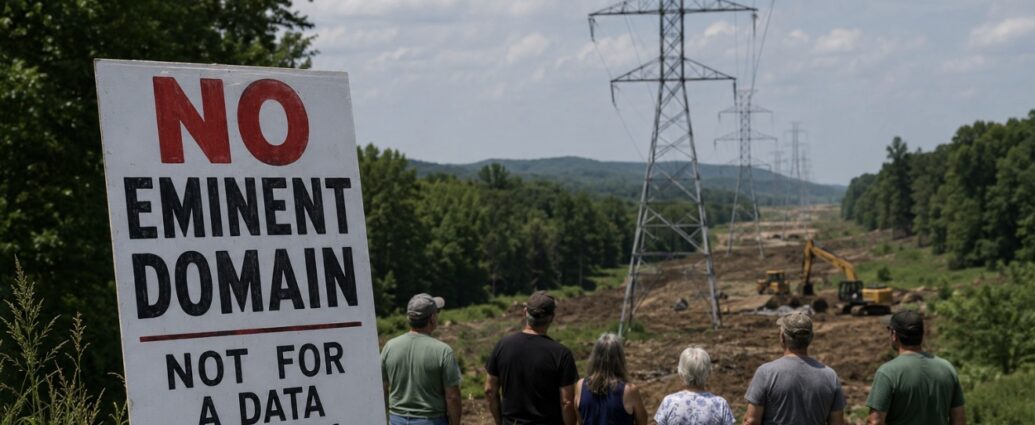
The Federal Energy Regulatory Commission (FERC) on June 18 launched one of its most significant efforts yet to accelerate the connection of AI data centers and other major electricity users to the nation’s power grid, directing regional transmission operators to justify or overhaul how they serve rapidly growing demand while protecting consumers from higher costs. The action comes as utilities across the country are increasingly seeking new transmission corridors, setting off a growing legal battle with landowners over the use of eminent domain to acquire private property for projects tied to the artificial intelligence boom.
The conflict highlights an emerging challenge facing America’s AI economy. While much of the public discussion has centered on semiconductor manufacturing and the race to build more computing capacity, another critical resource has quietly become scarce: land. Massive new data centers require enormous amounts of electricity, forcing utilities to expand transmission infrastructure at a pace not seen in decades.
Building those transmission lines often means crossing privately owned farms, residential neighborhoods and undeveloped property. When negotiations fail, many utilities have the legal authority under state law to pursue condemnation proceedings, allowing land to be taken through eminent domain while providing compensation determined under the law.
The rapid expansion of data centers is reshaping the nation’s electricity market. Federal regulators have warned that demand from AI facilities is arriving faster and at a much larger scale than previous industrial growth, requiring utilities and regional grid operators to rethink how new customers are connected without jeopardizing reliability or shifting costs onto existing ratepayers.
The property disputes are becoming especially visible in states experiencing heavy data-center investment, including Georgia, Pennsylvania, Virginia, and other fast-growing technology markets. Residents have increasingly organized against new transmission projects, arguing that private property should not be condemned primarily to benefit large technology companies.
At the center of many lawsuits is the meaning of “public use” under the Fifth Amendment to the U.S. Constitution. While governments may take private property for public use with just compensation, states establish their own standards governing when regulated utilities may exercise that authority on behalf of infrastructure projects.
The modern legal debate continues to be shaped by the 2005 U.S. Supreme Court decision in Kelo v. City of New London, which ruled that economic development could qualify as public use under certain circumstances. Although the Court upheld the taking in that case, the redevelopment project never materialized, fueling nationwide criticism and prompting dozens of states to strengthen protections for private property owners through legislation or constitutional amendments.
As a result, many property-rights challenges today are fought under state constitutions rather than federal law. Several state supreme courts have adopted narrower interpretations of public use than those permitted under the federal Constitution, particularly where private commercial interests receive the primary benefit of a project.
Even so, utilities have historically prevailed in many condemnation cases involving transmission infrastructure because electric transmission serves broader regional reliability needs beyond any individual customer. That legal distinction may become increasingly important as more lines are built to support clusters of AI facilities.
Meanwhile, FERC’s latest initiative reflects growing concern that the existing grid was never designed to accommodate the speed and scale of demand created by artificial intelligence. The Commission directed the nation’s six regional grid operators to improve large-load interconnection procedures, increase transparency regarding infrastructure costs, protect residential customers from subsidizing new projects, and ensure adequate generating capacity remains available as electricity demand accelerates.
Federal regulators have repeatedly emphasized that large electricity users should bear the costs associated with infrastructure built specifically to serve them. The Commission’s orders also encourage more efficient transmission planning, alternative technologies, and clearer cost-allocation rules designed to balance economic growth with affordability for households.
For technology companies, securing reliable electricity has become nearly as important as obtaining advanced computer chips. Delays in transmission construction can postpone data-center openings by months or years, directly affecting billions of dollars in investment and America’s ability to expand AI computing capacity.
For homeowners, however, the issue extends well beyond economics. Many families argue that compensation cannot replace farmland, family property or communities that have existed for generations. As more transmission proposals move forward, courts will increasingly determine where the balance lies between national infrastructure priorities and individual property rights.
The growing collision between America’s AI ambitions and longstanding constitutional protections is likely to shape both energy policy and property law for years to come. As electricity demand continues climbing, the outcome of these disputes may prove just as important to the future of artificial intelligence as advances in computing technology itself.
JBizNews Desk | Washington, D.C.
© JBizNews.com All Rights Reserved. Reproduction or distribution without written permission is prohibited.