
Paul Goldenberg remembers sounding alarms 20 years ago and warning the Jewish community, “The storm is coming.”
Unfortunately, at the time, most people didn’t listen to this decorated law enforcement and globally recognized security professional.
The Magazine spoke with Goldenberg over several months as he traveled through Sweden, Germany, Poland, and Canada. Interviews ended abruptly when Goldenberg was pulled away for security matters.
He had just returned from Belfast, where he was on the ground with his son, Alex Goldenberg, a social media threat expert, during the recent anti-immigration riots. Sounding calm and in control, it’s easy to forget the extreme danger of his occupation. Since his days walking the beat on the police force in Irvington, New Jersey, and going deep undercover in Miami, Goldenberg has always lived a life on the edge, battling crime and corruption to make the world safer.
Now the deputy director of the Rutgers University Miller Center on Policing, he reflected on his colorful past, dispersing serious topics with humor. He told of how he infiltrated a Jamaican posse in Miami and got them to sing “Hava Nagila,” and how his mother helped law enforcement translate a Russian mobster who spoke Yiddish, until she stopped out of guilt because he was Jewish. Goldenberg led the investigation of the mob family that The Sopranos was based on, and was a consultant for the television show.
His undercover identities as a long-haired gun-runner, and jewelry store and Jamaican bar owner taught him how people operate psychologically. Although these were different worlds, it was the “same human dynamics.” He said his work became “less about infiltrating criminal organizations and more about embedding myself within communities under threat.”
Regarding the current antisemitic protests across Europe and the United States, Goldenberg said that police on the front lines are “terrified by what they’re seeing,” and empathize with the Jewish community because they are also recipients of the hatred. “Many of the people at those protests who hate Jews hate the police just as much, because of the uniform they wear and the profession they chose… They’re dehumanizing police the same way the Nazis dehumanized the Jews,” he said.
For almost 30 years, Goldenberg has been on the ground in the US, Paris, Denmark, Sweden, Croatia, and other regions in the world within 24 hours of some of the worst targeted terror attacks.
To keep communities safer behind the scenes, Goldenberg has been working “quietly” with Israeli police for the last 40 years. He brought the first US counterterror policing unit to train on the ground in Israel, and since 2001, he has organized more than 15 police missions to Israel, and worked with Israeli intelligence to help secure Diaspora communities. He is currently collaborating with Israeli police on counter-UAS (Unmanned Aircraft System) drone technologies.
Building bridges with police
Three months before 9/11, David Harris, former CEO of the American Jewish Committee (AJC), accompanied Goldenberg to a clandestine meeting with CRIF, the official Jewish organization in Paris, with Jewish leaders. When Goldenberg discovered that their relationships with law enforcement were nonexistent, his mission became to build bridges between the Jewish and policing communities.
The United States Congress recognized Goldenberg for his work. In 1998, he was appointed head of the transnational policing program for the Office for Security Cooperation in Europe (OSCE), the world’s largest government security initiative, where he advised European governments and NGOs for four years.
In 2008, Goldenberg stood in front of a Jewish kindergarten in Paris surrounded by barbed wire, along with tanks and soldiers from a special brigade armed with automatic rifles. “They were not guarding some diplomat. They were guarding French Jewish children.” He remembers saying to himself, “We can never let this happen in the United States. Never.”
Goldenberg’s first security assessment of a Jewish community in the US was just before 9/11. As an adviser to the AJC, Harris asked him to go to Spokane, Washington, with Steven Pomerantz, a former FBI assistant director, to increase police involvement in protecting the Jewish community.
A remote synagogue was being threatened, and 26 years ago, police did not understand the repercussions of antisemitism like they do today, Goldenberg explained. The Jewish community in Spokane was in great peril, as it is located approximately 37 miles from Hayden Lake, Idaho, an area Goldenberg said used to be “the epicenter of neo-Nazis.”
Goldenberg and Pomerantz arranged for the Spokane police to meet with local Jewish leaders. “There was no organization at that time that really engaged or knew how to initiate a true security program, where you build capacity between the Jewish community and the police,” Goldenberg recalled.
Shortly after this trip, they met with Malcolm Hoenlein, former executive vice chairman of the Conference of Presidents of Major American Jewish Organizations, and Steve Hoffman, president emeritus of the Jewish Federation of Cleveland. They envisioned a national organization dedicated solely to protecting the Jewish community. The experience at Spokane, compounded with other national and international terrorism events, resulted in the 2004 founding of the Secure Community Network (SCN), North America’s largest security organization dedicated to keeping the Jewish community safe through intelligence and law-enforcement liaisons.
“In the shadow of hate, it was really the birth of security for the American Jewish community,” Goldenberg observed.
Today, SCN has grown to have a $35 million budget with over 130 full-time employees, including former FBI agents, SWAT commanders, and police chiefs, who work with Jewish Federations in the US and Canada.
Regardless of security measures in place for the Jewish community, Pomeranz emphasized the importance of protecting oneself. He worries for the future of his grandchildren in the US. “In retrospect, this is like my worst nightmare come true,” he stated.
Goldenberg doesn’t believe the term “antisemitism” is strong enough to convey the level of hate and violence it connotes. “We saw a transition in 2003,” Goldenberg explained. With the rising popularity of social media came a more dangerous virtual climate that has since translated into real life. “It went from graffiti on the sides of synagogues to armed assaults by people wearing camouflage and carrying AR-14s,” he said.
Developing prevention programs
While leading the SCN, Goldenberg worked across Europe as the chief police adviser to the OSCE, helping secure Jewish and other vulnerable communities. He developed hate-crime prevention programs, and created the first definition of antisemitism from a law enforcement context. He observed that in many European countries, the police viewed Jewish communities and their synagogues as extensions of the State of Israel, rather than part of their own country.
Jonathan Biermann, an attorney and deputy mayor of a district in Brussels, said that Goldenberg was one of the first law enforcement agents to raise awareness of the need for a trusted relationship between Jewish and other religious communities and the police. In 2015, Goldenberg invited him to a conference with the International Association of Chiefs of Police at FBI headquarters in Washington, DC, focused on protecting places of worship.
Biermann commented, “What was really fantastic was that he was able to put in the same room very high-ranking law enforcement officers with community, spiritual, and religious leaders from different faiths, saying, ‘We are sharing the same worries, we are facing the same enemies.’”
The security concerns Goldenberg has been telegraphing to the Jewish community are spreading to people of other faiths in Western countries. Goldenberg explained that while serving on the Department of Homeland Security Advisory Council, he led a subcommittee on targeted violence against religious communities.
“I had the opportunity to visit religious institutions that were attacked, where lives were lost. It’s not only Jewish institutions, but Sikh temples, mosques, and churches,” he said. Lessons from those conversations helped shape national homeland security policy. Goldenberg was named America’s Most Influential Person in Homeland Security in 2024 and 2021.
Biermann relayed how Goldenberg was instrumental in creating programs so that religious communities could safely express their faith and unite with allies. Animated films and campaigns like “If You See Something, Say Something” helped to educate the public and changed the perception of the Jewish community as being isolated.
“That became an opportunity for us to build bridges with other communities, saying ‘If you are not safe in your church, in your mosque, in your synagogue, then we are not safe in our place of worship,’” Biermann said.
On January 9, 2015, Goldenberg came to Paris when a kosher supermarket was sieged; four people were murdered, and 15 were taken hostage. John Farmer, founding director of the Miller Center on Policing and Community Resilience at Rutgers University and a former New Jersey attorney-general and the chief counsel of President George W. Bush’s 9/11 commission, said that thanks to Goldenberg’s connections, they were embedded with the Jewish community in Paris, and there was an amazing response time.
“Every Jewish-owned business in Paris was closed within an hour,” Farmer said.
After the March 22, 2015, ISIS terror attacks at the Brussels Airport and the Maelbeek metro, where 36 people were killed and over 300 injured, Goldenberg, Biermann, and Farmer were called in by the Brussels police to create dialogue, diffuse tension, and cultivate trust between Jewish and Muslim communities and police.
Regarding the future of Jewry in Brussels, Biermann said, “If we decide to leave, the society will collapse… if the society doesn’t want its Jews anymore, then it’s not a democratic and open-minded and liberal community, which is the essence of European democracies.”
Goldenberg added that if antisemitic attacks against Jews continue to increase, “the answer cannot be fear, retreat, or the surrender of identity… We have endured throughout history because we refused to disappear.” He said to remember that we have the State of Israel.
Remembering past tragedies
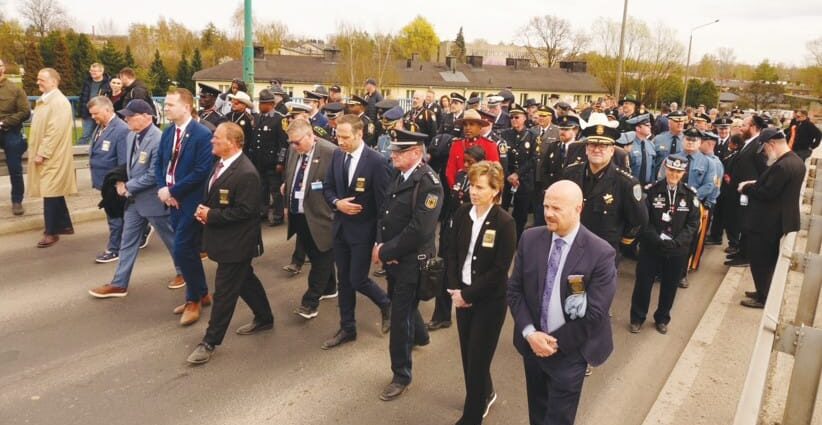
Farmer and Biermann have attended the International March of the Living (MOTL), an educational program that brings nearly 10,000 people from around the world, including Holocaust survivors and their families, to Auschwitz and Birkenau every year on Holocaust Remembrance Day. This year, more than 130 chiefs, sheriffs, commissioners, commanders, and law enforcement leaders participated in the 3-km. march.
Founded 35 years ago, MOTL is a three-day event where survivors share their stories and people from all backgrounds and religions walk arm in arm on the “Road of Death” to pay homage to those who were tragically murdered. Together, they take a powerful stand against antisemitism and Holocaust denial.
Goldenberg said that “one of his proudest moments” was when he stood with 130 police senior executives at Auschwitz this past Holocaust Remembrance Day. Since 2024, Goldenberg has been chair of the International Police Delegation of MOTL.
Last year, Rutgers University’s Miller Center, the University of Virginia’s Center for Public Safety and Justice, and the Global Consortium for Law Enforcement Training Executives launched a police educational program developed by Goldenberg and his team, “Operationalizing Never Again: The Role of Law Enforcement in the Holocaust and Contemporary Genocide.” As part of the program, police chiefs and officials on the march confront the horrors that resulted from the complicity of police in the past and vow never to allow it to happen again.
Goldenberg added, “Thanks to Paul Miller, who established the Rutgers University Miller Center on Policing. Without his support, we wouldn’t have been able to do any of the work that we do.”
Jochen Kopelke, president of the European Federation of Police Unions and the Federal Chairman of the German Police Union, opted not to wear his uniform on the march because of “personal insecurity… That’s where people from your police force in the past committed crimes as cruel as nobody could imagine.”
Although Kopelke was initially shy about talking with Holocaust survivors because he is German and the past weighs heavily on his shoulders, his hesitation soon dissipated. “When you say hello, and you tell them that you’re a German police officer and you regret [what happened], and you will support [them], they are so open,” Kopelke said.
He described how 26 police officers met with Auschwitz survivors of the recent terror attacks in Bondi Beach, Australia, Great Britain, and Washington, DC. “That makes it very emotional. They are so thankful and grateful… You see how essential it is to fight for Jewish life, to protect Jewish life,” Kopelke added, “They put a mission in my heart.”
Phyllis Heideman, president of the International March of the Living, marched with Kopelke and observed how he was “intellectually, professionally, and emotionally moved by the experience of walking along the path of death.”
Holding back tears, she described how survivors opened up to officers with heartbreaking honesty about how they were rounded up as teenagers by police officers they knew their entire lives, and acknowledged that now these officers are there to support and protect them.
Heideman recalled seeing survivors holding the officers’ hands, kissing and hugging them. She said they couldn’t thank the officers enough, “because they are the living witnesses of the complicity of law enforcement during the Holocaust.”
Commenting on the current climate of antisemitism in Germany, Kopelke observed: “Everything that we had in the past in Germany is coming back to European capitals.” He credits Goldenberg for bringing his mission to unite police with vulnerable communities to the people. He urges the Jewish community not to be afraid to develop relationships with law enforcement.
Heideman explained that police participation in the March of the Living has led to the formation of the Jewish Troopers Association of New Jersey, a nonprofit organization founded in 2024 that connects Jewish police officers with local Jewish communities. She said the experience of seeing gas chambers and a crematorium on the march strengthened the resolve of the officers to fight antisemitism.
“[They returned] to their jurisdictions with a greater commitment to their roles as protectors of all their constituents,” she said.
Heideman described how the powerful visual display of 130 officers on the march in “gorgeous, if not frightening” uniforms with medals of honor offered her solace and comfort. “They want to help us live safely and survive this current wave of antisemitism,” she said. “I cannot tell you the respect, the regard, and the love I have for each of these officers from every continent around the globe, who walk together with thousands of participants – both Jewish and not – from over 100 communities worldwide.”
She expressed her sincerest gratitude for Goldenberg and his Transnational Law Enforcement Delegation. “Paul Goldenberg has a higher place in heaven because of his devotion in organizing and orchestrating this incredible delegation to bear witness to the darkest chapter in history.
“He’s a great ally of humanity. He is impacting the global narrative, and he is certainly amassing goodwill for the Jewish people among international law enforcement – police chiefs, sheriffs, all people who now want to say, ‘You can’t get away with this rampant spire of hate. Enough is enough!’”
Goldenberg envisions hundreds of police executives walking side by side during the 2027 March of the Living. He wants to expand the “Operationalizing Never Again” initiative into an international professional development program for policing, to remind law enforcement how important they are to sustaining democratic values.
“When they fall, democracy falls,” he said.■