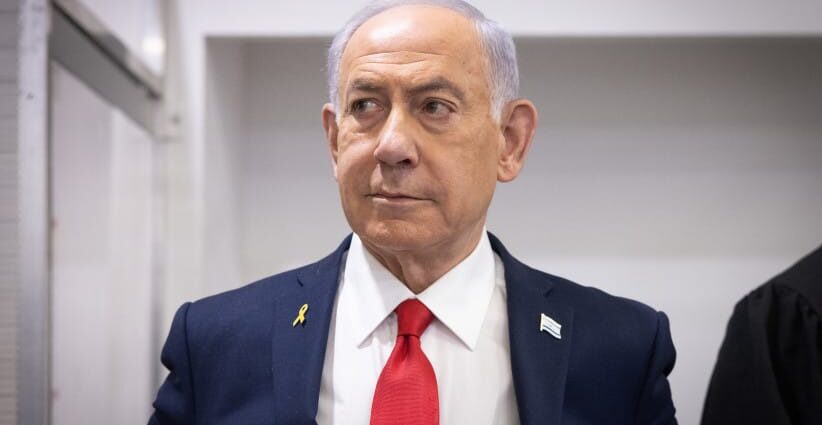
The prosecution is prepared to hold talks with Prime Minister Benjamin Netanyahu’s defense team toward a possible plea bargain in his criminal trial, provided that no preconditions are set and that the trial continues to advance, the Attorney-General’s Office told President Isaac Herzog’s legal adviser late Sunday night.
The response was sent in a letter signed by attorney Yonatan Kramer, an assistant to Attorney-General Gali Baharav-Miara. Kramer wrote that Baharav-Miara and State Attorney Amit Aisman had asked him to convey their position regarding Herzog’s effort to advance contacts in the so-called Cases 1000, 2000, and 4000. The letter was addressed to Michal Tsuk-Shafir, the president’s legal adviser, in response to her April 28 letter on the matter.
“The attorney-general and the state attorney appreciate the president’s efforts to bring the cases to an agreement,” Kramer wrote, adding that “the prosecution is prepared to hold dialogue with the defense toward formulating an appropriate plea bargain, provided that there are no preconditions to the dialogue and without harming the progress of the trial, as is customary.”
Kramer added that, “at this stage,” the Attorney-General’s Office would not address additional issues, “including the framework of the dialogue, the manner in which it will be conducted, and its location.”
The wording is narrower than an agreement to meet Netanyahu’s defense team at a specific time or place. Rather, the Attorney-General’s Office said the prosecution was prepared, in principle, to hold dialogue with the defense, while making clear that the trial itself must continue to move forward and that no preliminary conditions may be placed on such talks.
Herzog’s invitation was intended to begin preliminary contacts over the possibility of a plea bargain in Netanyahu’s criminal trial, which has continued for years and remains one of the most politically divisive legal proceedings in Israel.
Tsuk-Shafir wrote last week to both sides in the case, inviting them to begin a process aimed at examining whether an agreement could be reached. The president’s legal adviser framed the move as preliminary, and as an attempt to determine whether talks could be held in good faith, rather than as a substantive intervention in the trial itself.
Netanyahu denies all charges against him
Netanyahu was indicted in 2019 in three criminal cases. In Case 1000, he is charged with fraud and breach of trust over allegations that he received gifts from wealthy businessmen. In Case 2000, he is charged with fraud and breach of trust over alleged conversations with Yediot Aharonot publisher Arnon Mozes regarding favorable coverage. In Case 4000, he is charged with bribery, fraud, and breach of trust over allegations involving regulatory benefits for Bezeq in exchange for favorable coverage on Walla.
Netanyahu denies all charges against him.
His testimony began in December 2024, and cross-examination began in June 2025. The trial has continued alongside Netanyahu’s service as prime minister, with repeated disputes over the pace of the proceedings, the schedule of testimony, and the political implications of the case.
The Attorney-General’s Office’s response does not resolve whether plea bargain talks will in fact take place, how they would be conducted, or where such talks would be held. It also does not indicate any agreement by the prosecution to suspend or slow the trial while such contacts are explored.
Instead, the prosecution’s position, as conveyed to Herzog’s legal adviser, was that it is willing to hold talks only under conditions that preserve the continuation of the proceedings and leave the question of format for a later stage.