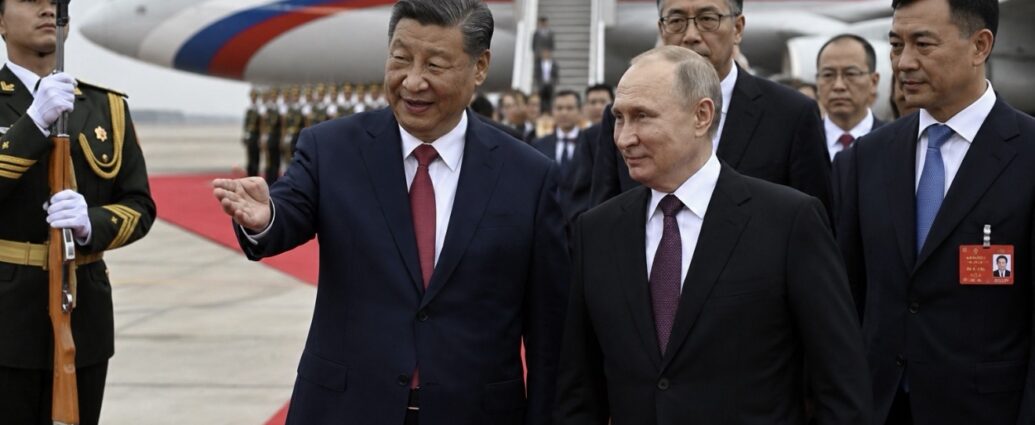
Russian President Vladimir Putin arrived in Beijing late Tuesday for a two-day state visit with Chinese President Xi Jinping, just one week after President Donald Trump wrapped his own high-stakes visit to the same capital — a back-to-back diplomatic sequence that has placed China at the center of competing efforts by Washington and Moscow to shape the post-Iran-war global order.
Putin was greeted at Beijing Capital Airport by Chinese Foreign Minister Wang Yi in a state-level ceremony that mirrored the diplomatic pomp Xi afforded Trump the previous week. China’s Foreign Ministry said it is Putin’s 25th visit to the country. The trip commemorates the 30th anniversary of the China-Russia strategic cooperative partnership and the 25th anniversary of the 2001 Sino-Russian Treaty of Friendship.
The timing itself has drawn global attention.
Within a span of days, Xi hosted both Trump and Putin in Beijing — reinforcing China’s increasingly central role in global diplomacy at a moment of growing geopolitical instability. Chinese state media portrayed the sequence as evidence Beijing has become an indispensable power broker between rival global blocs.
The core focus of Putin’s visit is energy.
At the top of the agenda is the long-delayed Power of Siberia 2 natural gas pipeline, a proposed project that would transport massive volumes of Russian gas into China. Moscow urgently needs new long-term buyers after losing much of its European energy business following the Ukraine war, while Beijing continues leveraging its position to negotiate favorable pricing and terms.
The Iran war has only increased the strategic importance of that relationship.
With instability disrupting Middle Eastern energy flows and pressure mounting around the Strait of Hormuz, China has relied increasingly on discounted Russian oil and gas imports. Russia has simultaneously become more dependent on Chinese trade, financing and industrial support as Western sanctions continue weighing on its economy.
Russian oil exports to China reportedly surged roughly 35% during the first quarter of 2026, according to Kremlin foreign policy adviser Yuri Ushakov.
Ahead of the trip, Putin praised what he called the “unprecedented level” of cooperation between Moscow and Beijing, saying the two countries support each other on issues involving sovereignty and strategic interests.
Chinese state media echoed the message, describing the partnership as “unshakable” despite mounting global tensions.
Beyond energy, analysts say Putin is also likely seeking insight into Trump’s recent discussions with Xi — particularly surrounding Ukraine and possible future negotiations involving Russia and the West.
The Trump administration has pursued intermittent diplomatic talks aimed at eventually ending the Ukraine war, though little concrete progress has emerged publicly.
“Putin may want to know Trump’s latest thinking on Ukraine and potential peace negotiations,” said Natasha Kuhrt, senior lecturer in war studies at King’s College London, in comments cited by NBC News.
Analysts say the visit also highlights a growing imbalance in the China-Russia relationship.
While Moscow still presents itself publicly as a global power equal to Beijing, many observers believe Russia now enters negotiations increasingly from a weaker position economically and diplomatically. China, meanwhile, has gained leverage by becoming one of the few major economies willing to maintain deep trade ties with Moscow despite Western sanctions.
Trump’s own Beijing visit last week produced limited public breakthroughs but avoided major escalation between Washington and Beijing. The two sides discussed trade, technology restrictions, Taiwan and critical minerals, while both governments signaled willingness to continue dialogue.
Xi warned during Trump’s visit that mishandling Taiwan could “push the two countries into conflict,” underscoring how fragile U.S.-China relations remain despite renewed diplomacy.
Putin’s visit is being framed differently.
Rather than negotiating a reset, Moscow and Beijing are portraying the trip as a reaffirmation of an already established strategic partnership — one built increasingly around energy, trade and mutual resistance to Western pressure.
Still, China continues walking a careful line.
Beijing has supported economic ties with Russia while trying to avoid becoming directly entangled in Western sanctions. Chinese banks and corporations have periodically limited certain Russian transactions to reduce exposure to secondary sanctions from the United States and Europe.
That balancing act reflects Beijing’s broader strategy: maintaining leverage and relationships with both Washington and Moscow without fully aligning with either side.
The back-to-back Trump and Putin visits underscore a larger reality emerging in global politics — nearly every major power now sees Beijing as a relationship it cannot afford to ignore.
Whether Xi ultimately positions China as a neutral mediator, a strategic partner to Russia, or a rival to the United States remains less clear.
For now, though, one image stands out above the rest:
Putin in Beijing days after Trump left — with Xi at the center of both meetings.
— JBizNews Desk
© JBizNews.com. All rights reserved. This article is original reporting by JBizNews Desk. Unauthorized reproduction or redistribution is strictly prohibited.