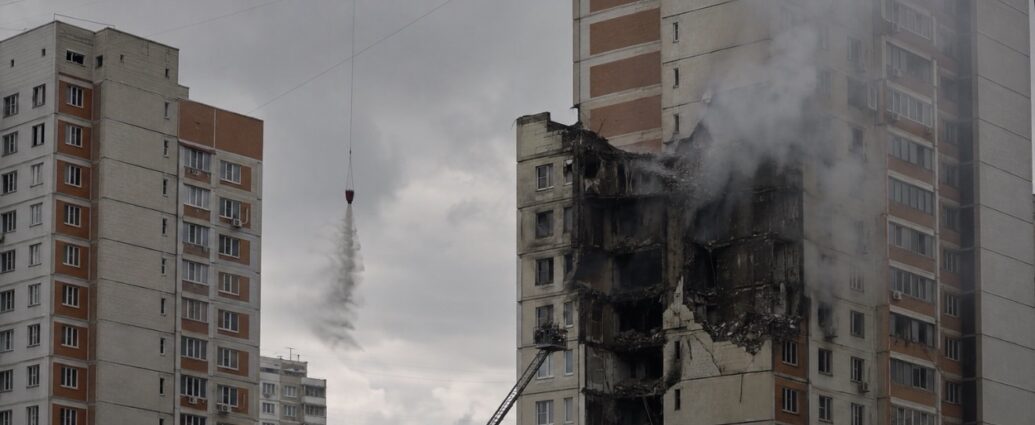
Russia’s GDP is shrinking, oil revenues have been cut in half, approval ratings are falling, and Ukrainian drones are striking Moscow apartment buildings days before Victory Day. The war Vladimir Putin once implied would end in weeks has now entered its fifth year — and the pressure is no longer confined to the battlefield.
For more than two decades, Russian President Vladimir Putin built his political identity around one core promise: strength. Strength against the West. Strength over neighboring states. Strength as the indispensable figure holding Russia together after the chaos of the Soviet collapse. That carefully cultivated image is now facing one of its most serious tests yet — squeezed between a battlefield that refuses to stabilize and an economy increasingly showing signs of exhaustion.
The Economy Is Cracking
Putin himself publicly acknowledged growing economic stress during a televised meeting with senior officials this week, demanding explanations after Russia’s economy underperformed even the Kremlin’s own expectations.
Russia’s GDP shrank by a combined 1.8% in January and February, according to figures discussed during the meeting, with manufacturing, industrial production, and construction all moving into negative territory.
“I expect to hear detailed reports today on the current economic situation and why the trajectory of macroeconomic indicators is currently below expectations,” Putin said during the session. “Moreover, below the expectations of not only experts and analysts, but also the forecasts of the government itself and the central bank.”
The unusually candid tone highlighted a growing reality facing Moscow: the war-driven economic model that temporarily insulated Russia from sanctions is beginning to lose momentum.
Massive wartime spending initially helped prop up economic growth. Russia’s economy expanded 4.1% in 2023 and 4.9% in 2024 as defense factories surged into overdrive. But economists increasingly warned that much of that growth was artificial — fueled almost entirely by military production, state borrowing, and emergency spending rather than sustainable private-sector expansion.
Now the cracks are widening.
GDP growth slowed sharply to roughly 1% last year, while the Kremlin projected only 1.3% growth for 2026 before the latest slowdown data emerged. At the same time, Russia’s budget deficit reportedly widened to nearly $58.6 billion in the first quarter as oil tax revenues in March fell roughly 50% compared to a year earlier.
That drop matters enormously for Moscow because energy exports remain the backbone of the Russian state budget.
The timing could not be worse for the Kremlin. The Iran war and broader Middle East instability pushed global oil prices higher, theoretically creating an opportunity for Russia to generate badly needed revenue. The Trump administration’s rollback of some sanctions on Russian oil further opened the door for increased exports.
But Ukraine’s expanding drone campaign has repeatedly targeted Russian export infrastructure, refineries, fuel depots, and logistics hubs — limiting Moscow’s ability to fully capitalize on higher energy prices.
Economists Warn of a “Death Zone”
Some analysts are now using alarmingly blunt language to describe Russia’s economic condition.
Alexandra Prokopenko, a fellow at the Carnegie Russia Eurasia Center and former adviser to Russia’s central bank, wrote that the Russian economy has entered what she called a “death zone” — borrowing a term from mountain climbing where the body begins consuming itself faster than it can recover.
“Russia’s economy is stuck in what might be described as negative equilibrium: holding itself together while steadily destroying its own future capacity,” she wrote.
According to Prokopenko and other economists, Russia is increasingly burning through reserves while suffering from labor shortages, declining productivity, and weakening long-term investment prospects.
Russia’s Economic Development Minister Maxim Reshetnikov publicly admitted conditions were becoming “substantially more difficult,” telling a business conference that wartime labor shortages have exhausted many remaining workforce reserves.
“Our current records show that these reserves have largely been used up,” Reshetnikov said. “This truly is the situation and the macroeconomic situation is substantially more difficult.”
The War Comes Home
The military picture has become equally troubling for the Kremlin.
Russian forces reportedly suffered a net territorial loss last month for the first time since 2024. More than four years after launching the invasion, Moscow still has not achieved full control over the Donetsk region — one of the original core objectives of the war.
“The overall mood is that’s enough already; you’ve been fighting for long enough,” a Russian official told The Washington Post anonymously. “It seems to everyone that it’s been going on for longer than World War II, the Great Patriotic War — and at the same time we can’t even take one region.”
The psychological impact inside Russia is growing as Ukrainian drone strikes increasingly reach deep into Russian territory.
Days before Russia’s annual Victory Day parade — one of Putin’s most symbolically important public events — a drone struck a residential high-rise building in Moscow just miles from the Kremlin.
Ukraine’s Foreign Intelligence Service claimed security preparations for Victory Day now resemble “a military lockdown more than a celebration,” with communication blackouts and heightened security measures across Moscow.
The annual parade itself has reportedly been scaled back significantly.
Heavy military hardware will reportedly be largely absent from Red Square. Russian authorities also reduced troop participation and removed cadets from several major military academies from the event. Kremlin spokesman Dmitry Peskov blamed threats of “terrorist activity” from Ukraine for the changes.
The optics are difficult for Moscow.
Victory Day has long served as Putin’s premier propaganda showcase — reinforcing the Kremlin narrative that modern Russia is continuing the legacy of defeating Nazi Germany during World War II. But the war in Ukraine has now dragged on longer than the Soviet Union’s war against Germany itself.
Approval Falling, Repression Rising
The economic strain and military stagnation are beginning to show up even in Russia’s tightly managed polling data.
A survey from Russia’s state-owned pollster showed Putin’s approval rating falling to 65.6%, down from 77.8% earlier this year and below the levels that once consistently exceeded 80%.
The Kremlin’s response has increasingly centered on tighter control.
Russian authorities recently launched another wave of political arrests and raids targeting critics, journalists, and publishers. Officials from Russia’s Investigative Committee raided one of the country’s largest publishing houses and detained staff members as part of what analysts describe as a broader crackdown on dissent.
Meanwhile, Moscow continues banning or restricting Western social media platforms including Facebook and Instagram while aggressively promoting state-controlled digital platforms and messaging systems.
Putin now faces a deeper structural dilemma.
Ending the war risks exposing how dependent the Russian economy has become on military spending. Wartime production has kept factories running and unemployment artificially low. A transition back to a peacetime economy could trigger major layoffs, falling wages, and public anger over declining living standards.
For now, the Kremlin appears trapped between two dangerous options: continue a grinding war with mounting costs, or stop fighting and confront the full economic consequences at home.
That balancing act helped sustain Putin’s image for years.
But as drones strike Moscow, oil revenues weaken, and economic pressure intensifies, the narrative of invincibility that once defined modern Russia is becoming increasingly difficult for the Kremlin to maintain.
— JBizNews Desk