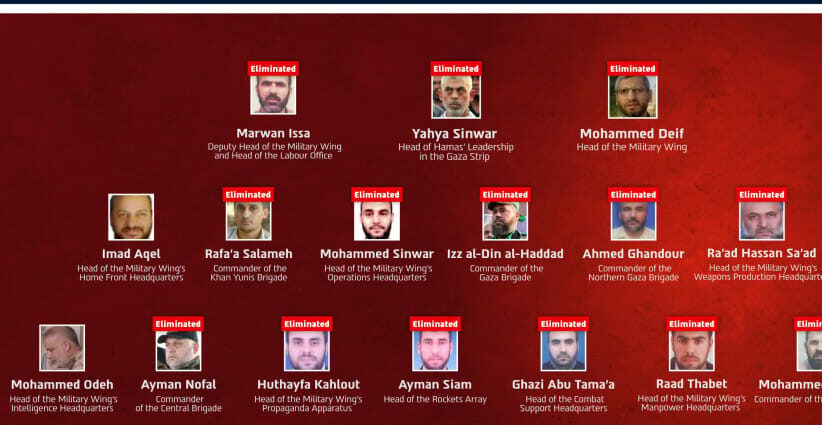
What is so shocking about Israel’s achievement of assassinating two Hamas military chiefs, Izz-al-Din al-Hadad, and his successor, Mohammed Ouda, within 11 days of each other, is that no one is even shocked anymore.
Depending on the country or area, from drones to fighter jets, to the navy, to satellites, to Mossad, Shin Bet, and IDF Unit 504 agents, Israel has its enemies’ leaders covered and in its crosshairs practically on demand, including: Iran, the Yemen Houthis, Hezbollah in Lebanon, Hamas in Gaza and the West Bank, and terrorists in Syria.
Israeli forces had already eliminated two Hezbollah chiefs – within days of each other in the fall of 2024 – namely Hassan Nasrallah and Hashem Safieddine.
They have killed successive chiefs of Iran’s military and Islamic Revolutionary Guard Corps in June 2025 and then again in February of this year – along with Ayatollah Ali Khamenei and many other top Iranian military officials.
In Gaza, these assassinations follow the prior killings of Yahya Sinwar, Mohammed Deif, Mohammed Sinwar, Ismail Haniyeh (killed during a visit to Tehran), and many others.
How is Israel pulling this off?
All of the Hamas high command planners of the October 7 massacre have now been killed.
The next Hamas leader would probably have been ranked below the top 30 Hamas officials if evaluated in 2023.
How is Israel pulling this off in general, and in particular in Gaza?
In general, Israel now has – or can achieve – air supremacy anywhere in the Middle East, either immediately or within 24 hours (as seen in Iran recently).
Its F-35 aircraft and other weapons systems have already eliminated, or can eliminate, any air defenses that can be mustered.
Once that is done, its drones can hover as long as needed anywhere in the region.
During the 12-day June 2025 war, Israel took a stunning 12,000 satellite photos of Iran.
After around a decade of having very few spies in Gaza, IDF Unit 504 returned to the Strip with a vengeance and has had tremendous results both in recruiting and interrogating arrested Hamas terrorists.
Meanwhile, a long line of books has been written about the Mossad and the Shin Bet’s prowess at locating and eliminating, or helping eliminate, top Israeli enemies in a wide variety of countries. Their success in this area has only increased in recent years.
Specifically in Gaza, Israel also has Hamas entirely surrounded on sea, land, and air, such that its control and surveillance capabilities go far beyond just minimal air supremacy.
If in Iran, Israel lost no fighter jets, but lost dozens of drones, in Gaza, Israeli aerial assets are now essentially unthreatened.
There are also not too many places to hide.
Whereas Sinwar avoided being caught for a full year after October 7 by moving back and forth through tunnels beneath Khan Yunis and Rafah, by April 2025, the last major strategic tunnel connecting those areas had been found and destroyed.
The same is true in large portions of northern Gaza, like Beit Hanoun, where the IDF noted it had completed the destruction of the tunnel network on Tuesday.
Other than some leftover parts of Gaza City and some leftover parts of central Gaza, there are just not so many places left to hide.
It may also be that Hamas’s leaders got careless since the October 2025 ceasefire, thinking that they had indefinite immunity.
In fact, they probably did have US-stipulated immunity for several months.
What will be the outcome of Hamas disarmament?
However, given that Hamas has dragged its feet for four to five months on making good on its initial partial disarmament “down payment” of handing over some heavy weapons like rockets and drones, it appears that the Trump administration green-lit Israel to start taking out Hamas’s top leaders again, with the hope of changing their tune.
It is far from clear that this will work.
At the end of the day, Hamas may just decide that its power to wait and say no – there are still too many members of Hamas that Israel can kill – can outlast the US and Israel’s ability to hold off from making partial Gaza withdrawals and allowing partial new Gaza building to entice Hamas into partial disarmament.
Israel has wanted partial or full disarmament first, and Hamas has wanted Israeli concessions first.
But regardless of whether these latest killings will change the strategic picture, they have once again left no doubt that if Israel is allowed by the US to pull the trigger, there is essentially no Middle East enemy leader that it cannot take down, given enough time and resources.