By JBizNews Desk
May 9, 2026 | JBizNews.com
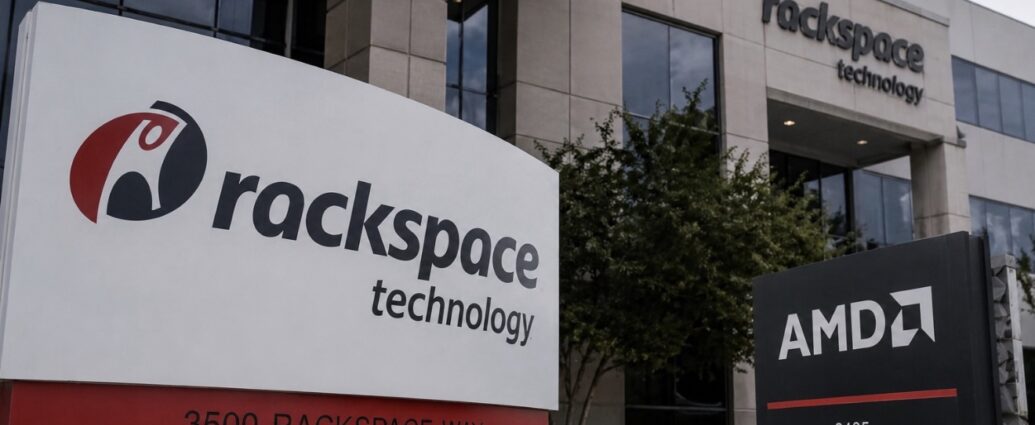
Rackspace Technology and Advanced Micro Devices are joining forces to build what they describe as an entirely new category of artificial intelligence infrastructure — one designed specifically for hospitals, financial institutions, government agencies, and other regulated businesses that have largely been left behind by the mainstream AI cloud boom. The two companies announced Wednesday the signing of a Memorandum of Understanding establishing a framework for a multiyear strategic partnership to create a governed Enterprise AI Cloud. The announcement, paired with a first-quarter earnings report that beat revenue expectations, sent Rackspace shares surging as much as 74 percent in pre-market trading before settling to a gain of roughly 12.5 percent on the day. AMD shares also rose, adding approximately 1.7 percent.
The deal addresses a gap that has grown increasingly visible as companies across sensitive industries attempt to adopt artificial intelligence tools but find that the standard public cloud model — where customers rent raw computing capacity from shared infrastructure — does not meet their requirements for data sovereignty, regulatory compliance, and operational accountability. Banks cannot afford model behavior that cannot be audited. Hospitals cannot risk patient data migrating beyond governed environments. Government agencies face strict rules about where data resides and who is responsible for it. The current market, Rackspace Chief Executive Gajen Kandiah said, has left those enterprises without a workable path to AI deployment.
“The market is moving in the direction we anticipated,” Kandiah said. “Regulated enterprises are making deliberate choices about where their AI runs, who operates it, and who is accountable for outcomes.”
The partnership with AMD is designed to answer those questions with a single, vertically integrated solution. Under the agreement, Rackspace would embed AMD Instinct graphics processing units and EPYC central processing units into a fully managed, governed technology stack — with Rackspace owning accountability for every layer, from the underlying silicon to the delivery of business outcomes. The model represents a deliberate inversion of the standard approach, where enterprises assemble and manage AI infrastructure themselves by renting individual components.
The planned stack would include four integrated capabilities: dedicated bare metal AMD Instinct compute for customers requiring physical isolation and direct hardware access; a private or hybrid governed Enterprise AI Cloud; an Enterprise Inference Engine for production-grade AI model deployment; and Inference as a Service with formally defined service level agreements. The result, according to both companies, is a system in which a single operator is accountable for availability, performance, compliance, and auditability across the entire environment — a feature that regulated industries have not previously been able to obtain from AI infrastructure providers.
Dan McNamara, senior vice president and general manager of Compute and Enterprise AI at AMD, said the collaboration brings AMD computing capacity into environments that until now have been unable to take full advantage of the company’s hardware.
“Our collaboration with Rackspace delivers AMD AI compute into managed, private, and governed environments so enterprises can deploy AI with the performance and flexibility their workloads demand,” McNamara said.
The timing is notable: AMD reported first-quarter earnings earlier this week that beat Wall Street forecasts, and the company is increasingly positioning itself as a credible alternative to Nvidia in the AI infrastructure market.
The AMD deal was announced alongside Rackspace’s first-quarter financial results, which showed revenue of $678 million — a 2 percent increase year over year and ahead of the analyst consensus forecast of approximately $675 million. Public cloud revenue grew 7 percent to $443 million, while private cloud revenue declined 6 percent to $235 million, a dip the company attributed to the timing of onboarding a large healthcare client rather than a structural trend.
Non-GAAP operating profit rose 20 percent year over year to $31 million, reflecting improved cost discipline. The company swung to a net income of $8 million from a net loss of $72 million in the same period last year, aided in part by a $55.8 million gain on debt extinguishment and lower administrative expenses. Rackspace maintained its full-year 2026 guidance, with Chief Financial Officer Mark Marino affirming the targets on the earnings call.
Kandiah also highlighted a joint deal closed with Palantir in just 41 days during the quarter — a signal, he said, of the kind of enterprise traction the company is building in the regulated AI segment. Palantir, whose software is deeply embedded in defense, intelligence, and healthcare analytics, represents exactly the category of customer that the AMD partnership is designed to serve at the infrastructure level.
The broader significance of the Rackspace-AMD announcement lies in what it implies for how the enterprise AI market is beginning to stratify. The first wave of AI adoption flowed primarily to technology companies and consumer-facing businesses that could deploy tools quickly on public cloud infrastructure with few constraints. The next wave — now beginning — involves the far larger universe of regulated businesses that need AI capabilities but cannot sacrifice governance for speed.
Both Rackspace and AMD are betting that serving that market with a purpose-built, accountable stack will define the next major chapter of enterprise technology. The stock market’s response on Thursday suggested investors, at least for now, agree.
— JBizNews Desk
© JBizNews.com. All rights reserved.