Rafael Advanced Defense Systems has introduced Hunter Eagle, a compact kinetic interceptor designed to counter the rapidly expanding threat of low‑altitude unmanned aircraft on the modern battlefield. First shown publicly at Defence Security and Equipment International (DSEI) 2025 and now presented in its serial configuration at ILA Berlin 2026, the system marks an expansion of Rafael’s layered counter‑UAS (C‑UAS) portfolio.
Low‑altitude drones (those that range from hobby‑class quadcopters to larger Group 3 platforms) have become one of the most disruptive technologies on the modern battlefield. Their ability to fly low, evade radar, and deliver precision‑guided or improvised munitions has forced militaries to rethink air defense from the ground up. The proliferation of cheap, expendable drones has also overwhelmed traditional point‑defense systems, creating demand for interceptors that are fast, precise, and cost‑effective.
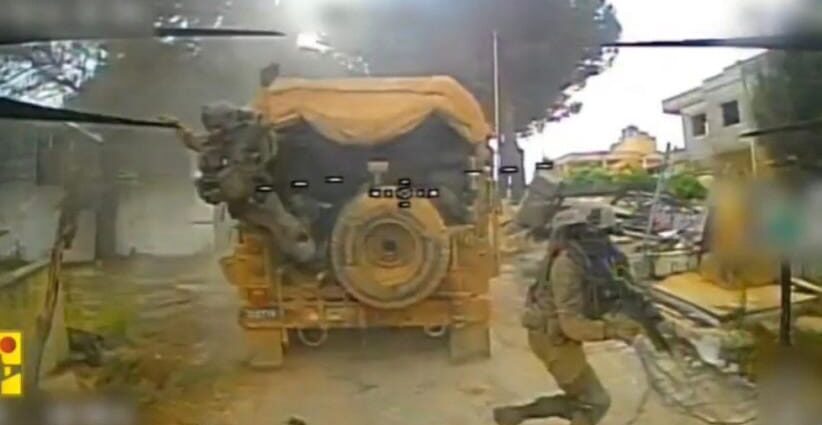
IDF troops operating in southern Lebanon have been facing low-altitude drones launched by the Lebanese Shia terror group Hezbollah, with over a dozen soldiers and reservists killed and numerous more wounded.
Israel’s Defense Ministry, through MAFAT and the defense-tech ecosystem, has been rushing to find solutions to the threat and Hunter Eagle is Rafael’s answer to that challenge.
A compact, reusable hard‑kill interceptor
The interceptor is a vertical‑takeoff‑and‑landing (VTOL) drone standing roughly 0.4 to 0.5 meters tall and weighing between 5 and 10 kilograms. Its cylindrical fuselage houses an electro‑optical seeker, while cruciform wings carry electric motors with three‑blade propellers at each tip. The design allows for rapid vertical launch from a four‑legged ground support unit, followed by autonomous terminal guidance once the seeker locks onto the target.
Unlike loitering munitions or explosive‑laden interceptors, Hunter Eagle uses a pure hit‑to‑kill mechanism. It carries no warhead, eliminating the risk of collateral damage-an increasingly important requirement as drone engagements shift closer to urban areas, critical infrastructure, and friendly forces. If it misses or the mission is aborted, the interceptor can return to its launch point and land vertically, ready for re‑tasking.
The system can be deployed as a single interceptor or launched in coordinated swarms to counter multiple simultaneous threats. It is engineered to engage Group 1 through Group 3 unmanned aerial systems, covering the spectrum from small quadcopters to larger fixed‑wing drones commonly used for reconnaissance, strike missions, and kamikaze attacks like those seen in Lebanon.
The system integrates into Rafael’s broader Drone Dome suite, extending the company’s detection‑classification‑neutralization chain into a hardened kinetic layer. Drone Dome includes electronic‑warfare and directed‑energy effectors, while Hunter Eagle adds a reusable hard‑kill option for drones that are resistant to jamming or require physical destruction.
A response to the low‑altitude threat environment
According to Rafael, the company developed Hunter Eagle under a new internal directorate focused specifically on low‑altitude threats – a domain that has grown in importance as state and non‑state actors adopt drones for surveillance, targeting, and precision attack. Conflicts in Eastern Europe, the Middle East, and the Caucasus have demonstrated that small UAS can strike armored vehicles, artillery positions, and logistics nodes with minimal warning.
Hezbollah’s fiber‑optic drones have emerged as one of the most challenging threats on the northern front. Unlike traditional UAVs, these systems are physically tethered to their operators, making them effectively immune to electronic warfare and jamming. Their low cost, often under $1,000, enables mass deployment by Hezbollah, and their onboard autonomy allows them to navigate and target with minimal external guidance.
The company positions Hunter Eagle as a mature, near‑term solution, with delivery readiness targeted for 2026.