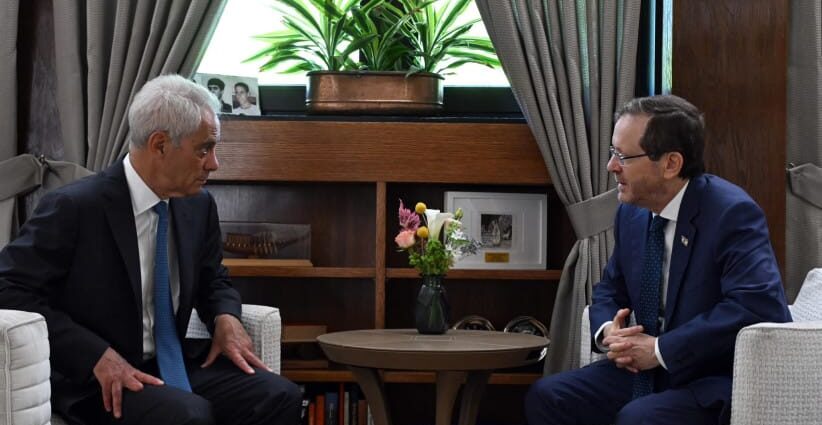
The pursuit of Greater Israel is a corrosive fantasy, veteran Democratic politician Rahm Emanuel is expected to tell a Tel Aviv audience on Wednesday, calling it “destructive and fanatical” as the chant “from the river to the sea.”
Emanuel, who has held multiple top roles in the Democratic Party, in Congress and in the Obama White House, is a potential 2028 presidential candidate.
He will warn that Prime Minister Benjamin Netanyahu is leading the country to a “dead-end” that has turned the country into a “pariah” and is threatening Israel’s historic alliance with the United States, according to an advance copy of his speech shared with the Jewish Telegraphic Agency on Tuesday.
He blamed as “our mistake” America’s assumption that “the best thing Washington could do for Jerusalem was to blindly and silently stand behind your government, without conditions, without demands, and without consequences.” That path has led to policies including Israeli extremists terrorizing West Bank Palestinians and Gazans suffering from a lack of food that means “Israel has never been so isolated,” a situation that he terms “a countdown clock” for Israel’s security.
Instead, his remarks state, “we need a fundamentally new and different approach to the alliance.”
Emanuel also criticized Palestinians for creating obstacles to peace
At the same time, he criticized the Palestinians for what he said were mistakes and obstacles to peace over the years. He lambasted their supporters in the US who support replacing Israel with a Palestinian state stretching from the Jordan River to the Mediterranean Sea.
“Those chanting ‘from the river to the sea’ need to hear this loud and clear: they will never have their way,” he declares in his prepared remarks. “But those calling for a greater Israel must also hear this loud and clear: you’re never going to have your way, either. Both are fantasies chanted by fanatics.”
Emanuel, who is a former US congressman from Illinois as well as a former Chicago Mayor and served as White House Chief of Staff under President Barack Obama, is considering a presidential run in 2028. His trip has garnered media attention given that his ideas on Israel could signal the direction of his party on the issue, particularly as they come from a Jewish politician with close ties to the country. Emanuel once volunteered as a civilian with the Israeli army and his father was an Israeli citizen.
His trip to Israel to underscore the importance of the Israeli-US alliance and to advocate for a new regional diplomatic initiative comes at a time when politicians in his Democratic Party are increasingly disavowing Israel to gain an edge in upcoming elections as the country’s reputation plummets.
A Pew Research Center Poll published in April found that 60% of Americans had an unfavorable view of Israel, but its standing was worse among Democrats and Democratic-leaning Independents, where 8 out of 10 had negative views about Israel.
Topics of Emanuels speech
According to his prepared speech, Emanuel is set to highlight his deep connection to the Jewish state and his family’s sacrifice in bringing about its creation, noting that his uncle, who was a member of the pre-state underground, is buried on Jerusalem’s Mt. of Olives. His father, Benjamin, was born in Jerusalem in 1927 and fought in Israel’s 1948 War of Independence before immigrating to the United States, where he raised his family in Chicago.
Emanuel plans to recount Israel’s history of overtures in the name of peace and in the face of Palestinian violence during the second intifada and the October 7, 2023, Hamas-led attack on southern Israel.
He will explain that he understands Israel’s cynicism regarding any future arrangement with the Palestinians since Israel’s past offers of Palestinian sovereignty in exchange for security were frequently met with violence.
“I understand why, even if you oppose the Netanyahu government, you’re so prone to dismiss criticism from the outside world,” Emanuel wrote, underscoring that a “corrupt Palestinian leadership has never lived up to the Palestinian people’s legitimate aspirations for sovereignty and self-determination.”
Still, he wrote, Israel’s future can’t be “held hostage to a past defined exclusively by recriminations,” warning that such a stance will endanger its “historic alliance with the US,” which is now “at a crossroads.” Israel must embark on a path that pairs military and diplomatic efforts, rather than relying solely on military prowess, he wrote.
Israel is isolating itself from international allies
“Israel will be alone if its leaders choose to attempt to annex the West Bank and pursue the fantasy of a greater Israel,” Emanuel plans to say.
“America will not and cannot be complicit or complacent in that endeavor,” he wrote, explaining that it has erred in the past by “blindly and silently” supporting Netanyahu’s government.
The speech calls for an end to the “American taxpayer’s subsidy of Israel’s defense budget,” maintaining that Israel should buy US arms with the same financial terms and restrictions as every other ally “that abides by our laws.”
The speech laid out a broad-based policy with regard to a two-state resolution to the Israeli-Palestinian conflict that rejects extremist Israeli violence against Palestinian civilians and illegal West Bank settlement building but does not spell out prescriptions for divisive issues such as the future of Jerusalem or using the pre-1967 lines for determining the borders of a Palestinian state.
Emanuel does not mention the US-based political advocacy group J Street in his speech, but the text picks up on the 23-state policy idea that J Street put forward last year, involving 21 Arab states, alongside Israeli and Palestinian ones, that would include recognition of Israel by the Arab League.
Such a regional integration would allow for Israel and the larger Middle East to become a technological and transit hub for trade between Europe and India, he plans to say.
A plan for regional peace
To achieve this regional peace, Emanuel continues, the Arab states would have to support a Palestinian governing entity that would accept the Jewish historic connection to Israel, stop teaching its children to hate Israel and end the “heinous practice” of financially rewarding terrorists who kill Jews.
Israel, he wrote, would have to halt unilateral actions in the West Bank, stop nurturing harmful organizations and support “real partners in pursuit of peace.”
This scenario rests on a three-part US policy in the region that would leverage the Arab world’s desire for stability, Israel’s need for security, and Palestinian demands for sovereignty.
“The political benefits for all parties would be far greater than a two-state solution could ever offer. But to get there, everyone would need to make good on their piece of the bargain,” he wrote in his speech.
The alternative path, he wrote, is one that has seen Israel isolated and turned it into a pariah state.
“Israel has failed to convert its military wins into strategic advantages,” Emanuel is expected to say, noting that the country has “lost Europe” and its support in the US is plummeting. US unconditional support for Israel without demands and consequences has been a mistake, he added in his speech, in which he blamed Israel’s poor global standing on Netanyahu’s policies.
A centrist Jewish Democrat embracing a policy promulgated by J Street, a group founded in 2008 to counter the influence of what was then the mainstream pro-Israel lobby AIPAC, illustrates the degree to which the American Israel Public Affairs Committee and its credo of creating a bipartisan consensus of support for Israel has eroded.
Emanuel plans to recall his own tensions with Netanyahu, who during his time as White House Chief of Staff labeled him a “self-loathing” Jew for opposing West Bank settlement construction.
Netanyahu, he wrote in his prepared remarks, “cannot fight indefinitely against a world that has stopped believing you have the right to fight. You must instead find a new sustainable path to peace, security, and prosperity.”
Alternatively, he wrote, the US would stand “shoulder-to-shoulder” with Israel as it pursued peace and security.