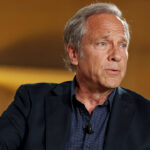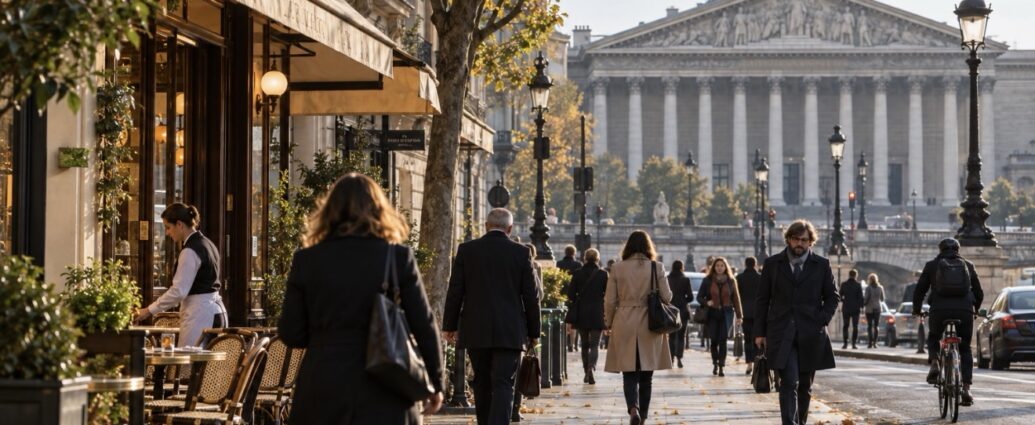
Raphaël Glucksmann won France’s center-left presidential primary Sunday, securing a platform to challenge the country’s economic direction as mounting debt and school unrest put pressure on businesses, households and public services.
The European Parliament member and leader of Place Publique received roughly 66% of the primary vote. His nomination gives the Socialists and their allies a candidate promising higher wages, renewed investment in education and stronger European defense. The financial challenge is substantial: France’s public debt reached €3.5955 trillion, or 119% of its annual economic output, at the end of June, according to national statistics agency INSEE.
Glucksmann also brings a distinctive personal history to the campaign. His Jewish paternal grandparents fled Nazi Germany. His partner, prominent French journalist Léa Salamé, survived the September 11 attacks near the World Trade Center.
Their experiences add a human dimension to questions about terrorism, antisemitism and democratic leadership. But the election will also test whether Glucksmann can offer a credible answer to France’s financial troubles—and attract enough voters to govern.
His primary victory must be understood in context. The 66% came from voters participating in the center-left nomination contest, rather than the French electorate as a whole. He won the backing of one political coalition, not the presidency or leadership of the entire left.
France elects its president through a two-round national vote. A candidate wins outright by receiving more than 50% of valid votes in the first round. Otherwise, the two highest finishers advance to a runoff, where the majority winner takes office. There is no fixed percentage needed to qualify for that final round; finishing among the top two is what matters.
Glucksmann would be seeking to succeed Emmanuel Macron, who cannot serve a third consecutive presidential term. He would compete against candidates from Macron’s political camp as well as rivals across the left and right.
Unlike America’s largely two-party presidential contest, France’s election features several competing political blocs. Glucksmann’s Place Publique and Socialist allies face Jean-Luc Mélenchon’s La France Insoumise on the radical left. Greens and Communists maintain separate organizations. Macron’s centrists, Édouard Philippe’s Horizons movement, the traditional right and National Rally compete for other parts of the electorate.
That fragmentation makes coalition-building essential. The Financial Times reported Glucksmann polling around 11% nationally, compared with 32% for Marine Le Pen, with Mélenchon and Philippe also ahead. Those figures are a snapshot, but they show how much further he must reach beyond his primary supporters.
His family history helps explain the convictions he brings to that effort. His father, philosopher André Glucksmann, was the son of Jewish refugees from Nazi Germany and became an influential critic of totalitarianism. Raphaël grew up around refugees and dissidents. He later described watching his father warn political leaders about Vladimir Putin and the frustration of seeing those warnings go unanswered.
Salamé encountered terror firsthand while studying in New York. A Le Monde profile reported that she lived three blocks from the World Trade Center and had gone out to buy a pastry on September 11, 2001. Caught in the dust and shock of the first tower’s collapse, she was knocked down, injured in the arm and ran north through Chinatown toward NYU at Washington Square.
That survival should not be presented as proof of her political views. It does establish that terrorism’s consequences are part of her lived experience.
France’s own security concerns remain acute. A government response published by the National Assembly recorded 1,320 antisemitic acts in 2025. The figure fell from 2024 but remained historically elevated.
Glucksmann has criticized failures to counter Islamist influence in neglected neighborhoods. His Jewish heritage does not mean blanket support for Israeli policy: he advocated suspending the EU’s association agreement with Israel over its conduct in Gaza in May 2025.
For employers and families, security and economic confidence intersect. Reuters reported that three Paris storefronts were damaged during October 6 school protests. Students’ complaints included deteriorating buildings and teacher shortages. Rights groups accused authorities of disproportionate force; the government said outsiders had hijacked parts of the movement.
Such disruption creates immediate costs, while interrupted education threatens the future workforce. Addressing those problems requires spending at a time when France’s debt burden limits its room to maneuver.
Glucksmann’s agenda includes higher workers’ pay, taxes on large inheritances, education investment and stronger European defense. Businesses will need to assess the eventual proposals for their effects on labor costs, taxation and investment. Households will judge whether wage gains and better services outweigh any additional burdens.
His primary victory opens a path to the presidency, but does not establish that France has found its economic or political answer. The next test is whether he can assemble a broader coalition and explain how his promises will be financed. Meanwhile, the government has ordered initial proposals to address students’ demands by the end of October—a nearer deadline for a country seeking tangible results.
JBizNews Desk | Paris
© JBizNews.com. All rights reserved. This article is original reporting by JBizNews Desk. Unauthorized reproduction or redistribution is strictly prohibited.