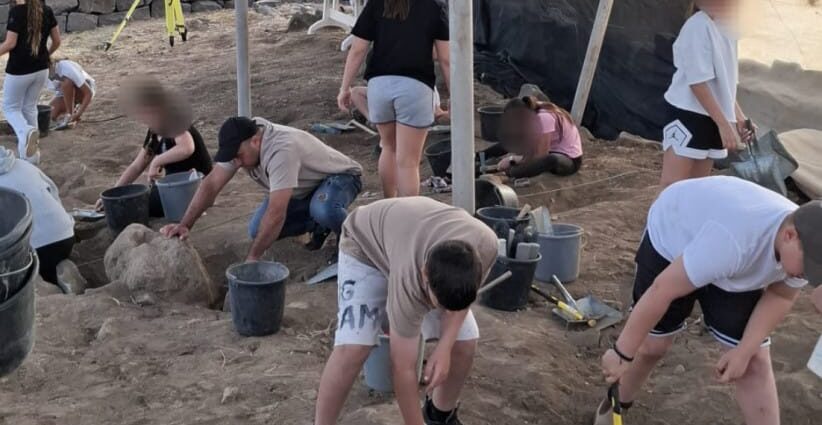
An approximately 1,500-year-old deep blue gemstone was found during an archaeological dig at the Korazim National Park in the Galilee, the Israel Nature and Parks Authority (INPA) announced on Sunday.
The dig took place as part of a joint project between the INPA and Ariel University to give students from the region the chance to learn about the history of where they live and to play an active role in uncovering the past.
Twelve-year-old Alon Horvitz, a sixth grader from Ramat Korazim elementary school, discovered the gem about 10 minutes before the digging ended for the day.
“After three days of digging, about ten minutes before we finished, I was digging with the trowel, and suddenly I saw something blue, round, and special,” Horvitz shared with INPA. “I picked it up and showed it to the archaeologist. When I understood it was something rare, I felt really happy and proud. I got a lot of praise from my friends, teachers, and family.”*
Dig director Dr. Achia Kohn-Tavorn from Ariel University identified the stone as a Nicolo, a type of agate stone often used in jewelry and signet rings by the Romans as a symbol of wealth and high social standing.
Gem provides a glimpse into everyday life
According to the INPA, discovering the gem at Korazim indicates that a rich culture of trade existed in the ancient city alongside the common, everyday life.
Tavor added that finding these types of smaller finds opens a window into the lives of the residents of ancient Korazim, “not only into the buildings and streets, but also into worlds of beauty, status, and human connections.”
“Finding a gemstone intended for setting in jewelry is an exceptional and particularly exciting event in the archaeology of the Land of Israel,” added Dr. Dror Ben-Yosef, an archaeologist and heritage officer for the INPA’s northern district. “The educational digs we lead in national parks and heritage sites are not only scientific work, but a central educational component aimed at creating a deep connection between the younger generation and the history and roots of us all.”
“Alon’s tangible encounter with a personal object left behind by someone who lived here 1,500 years ago is precisely the moment when heritage transforms from a story in a book into a living, connecting experience.”
What is Korazim?
Korazim, located on a basalt hill a few kilometers north of the Kinneret, was a Jewish village that existed from the Second Temple period to the 11th century CE.
Excavations of the site took place in 1905, the 1920s, mid-1960s, and 1980s, alongside more modern digs overseen by the Israel Antiquities Authority (IAA) and the INPA.
Today, the remains of the village include residential homes, ritual baths (mikvaot), an ancient olive press, and a magnificent synagogue.
The synagogue, standing in the center of the village, dates to the 4th and 5th centuries CE and is believed to have been destroyed and rebuilt during that time. It is known for its many stone carvings and the basalt “Seat of Moses” discovered within.
The village is also mentioned in the New Testament (Gospels of Matthew and Luke) as having been cursed by Jesus for rejecting his teachings.