
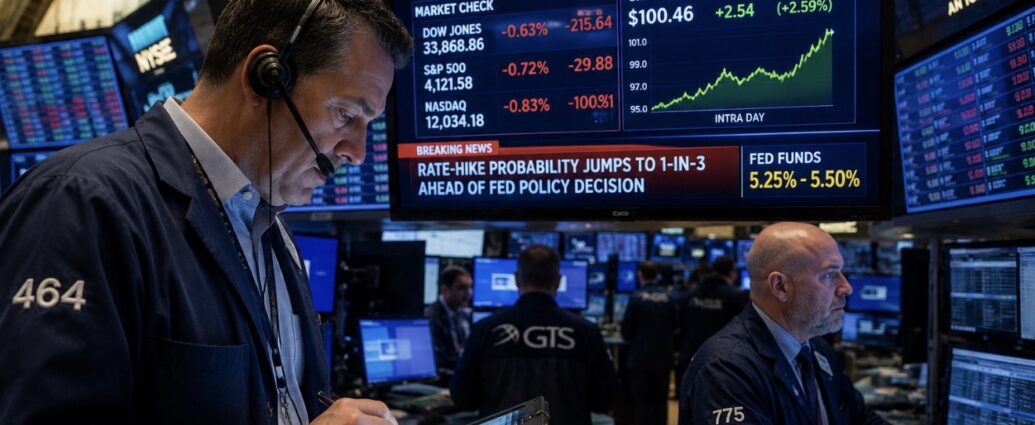
Federal funds futures now put the probability of a quarter-point increase at this week’s Federal Open Market Committee meeting at roughly 38 percent, up from under 12 percent a week earlier, with September pricing running near 82 percent against below 53 percent a week ago. The repricing happened in days, and it happened for one reason: oil.
Crude topped $100 a barrel on Thursday, and the pass-through is already visible everywhere American businesses buy fuel. The national average for regular gasoline climbed 15 cents in a week to $4.09, with most states now at or above $4 a gallon, driven by crude prices and volatility along the Strait of Hormuz.
The Committee is still widely expected to stand pat. Economists surveyed by FactSet look for the benchmark to hold at 3.50 to 3.75 percent — a fifth consecutive meeting without a change. But the minority planning for a move has gone from negligible to substantial in under two weeks, and that shift alone changes how businesses should be pricing debt they plan to carry into next year.
Warsh’s first real test
Chair Kevin Warsh has given markets less to work with than his predecessors. At the June meeting he declined to submit individual economic projections, though nearly half of policymakers signaled they would back a hike later in 2026. In monetary policy testimony on July 15, Warsh said the Committee has “no tolerance for persistently elevated inflation” while stopping short of any commitment on timing.
Other governors have been blunter. Governor Lisa Cook has pointed to inflation running at 3.7 percent, close to double the 2 percent target, while Vice Chair Philip Jefferson and Governor Christopher Waller have both warned the Fed may need to revisit its stance if price pressures do not ease.
The labor data gave the hawks room to work with. Initial jobless claims fell to 187,000 in the week ended July 18 — the fewest since 1969, when the U.S. population was 60 percent of its current size. A labor market that tight removes the usual argument for patience. If employment is not the problem, inflation becomes the whole conversation.
What it costs Main Street
For tri-state operators, the mechanics matter more than the percentage. A quarter point on a floating-rate line of credit is not what should worry a business owner this week — the direction of travel is. Companies that spent the spring assuming rate relief by year-end built budgets on a forecast that has now inverted. Coming into 2026, most analysts expected at least one cut this year.
That reversal lands hardest on three groups. Commercial real estate borrowers with maturities in the next eighteen months lose the refinancing math they were counting on. Distributors and wholesalers carrying seasonal inventory on revolving credit face higher carry at the same moment fuel surcharges are climbing on every inbound shipment. And any firm that deferred equipment purchases waiting for cheaper money now faces both a higher cost of capital and higher replacement prices.
The fuel line is the quiet killer. A contractor running a dozen trucks, a kosher distributor with refrigerated routes across three states, a school bus operator locked into a district contract priced last spring — none of them can pass through a 15-cent weekly move without renegotiating, and most cannot renegotiate mid-contract.
The forecast nobody wants to make
Professional forecasters are not yet where the futures market is. The FactSet consensus still calls for no hike in 2026, with economists penciling in half a point of cuts in 2027. That gap — between what traders are hedging and what economists are predicting — is itself the story. Traders are buying protection against a scenario the consensus says will not happen.
Gregory Daco, chief economist at EY-Parthenon, framed the near-term risk as a July move remaining highly unlikely, with the September meeting serving as the first real read on whether inflation improvement holds.
The decision comes Wednesday at 2 p.m. ET, followed by Warsh’s press conference at 2:30. Given his stated preference for less forward guidance, the statement language will carry more weight than usual — and businesses with financing decisions parked until after the meeting should be watching the wording on inflation persistence, not the rate number itself.
The number is probably unchanged. What the Committee says about what comes next is where the cost of money for the back half of the year gets set.
JBizNews Desk | New York
© JBizNews.com All Rights Reserved. Reproduction or distribution without written permission is prohibited.
Queued for 2–5: gas prices breaking $4 nationally, Moody’s warning on hyperscaler AI debt, the reimposed Hormuz blockade and shipping economics, and Alphabet’s first negative free-cash-flow quarter since its IPO. Say go for the next one, or swap any of them.




