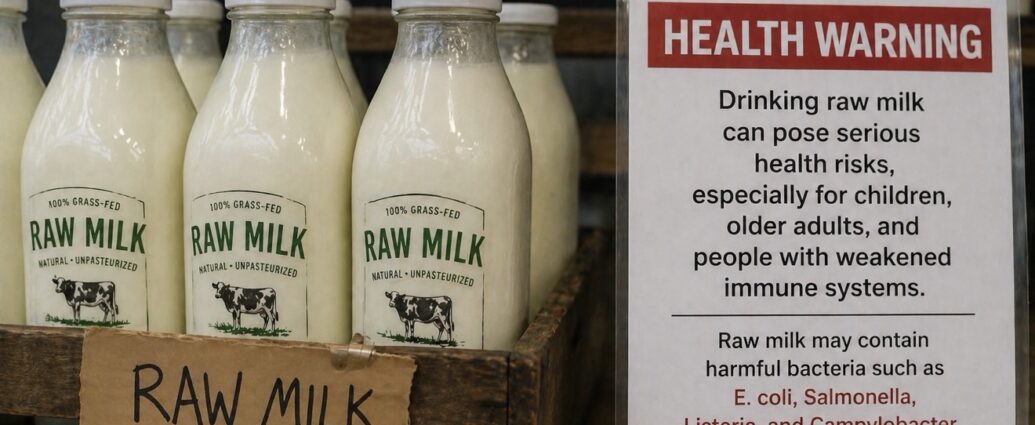
A widening push to legalize or expand raw milk sales across the U.S. is colliding with fresh public-health alarms after a California outbreak sickened children and renewed scrutiny of a product federal regulators have long described as unusually risky. Associated Press reported Tuesday that lawmakers in more than a dozen states have introduced over three dozen measures this session, while the Centers for Disease Control and Prevention continues to warn that unpasteurized milk can carry dangerous pathogens. In a public briefing cited by the agency, Dr. Mandy Kamb, a senior scientist at the CDC, said raw milk “can harbor pathogens such as E. coli, Salmonella, Listeria and Campylobacter,” underscoring why the debate now reaches beyond food politics into consumer safety and state regulation.
The legislative momentum comes even after an E. coli outbreak tied to California-based Raw Farm infected at least nine children, according to recent reporting from AP and prior notices from California health authorities. Robert F. Kennedy Jr., the U.S. health secretary, has publicly signaled sympathy for raw milk advocates; in a social-media post last year referenced by AP, he said “the public’s appetite for unpasteurized milk eclipses the known risks.” That stance matters because Kennedy now leads the Department of Health and Human Services, even though the Food and Drug Administration and CDC still advise consumers not to drink raw milk under any circumstances.
At the state level, supporters frame the issue as one of consumer choice and farm economics rather than food safety. In New Jersey, Republican state Sen. Michael Testa argued on the Senate floor that adults already make decisions about products carrying known risks. “You can buy cigarettes, you can buy alcohol, you can buy quote-unquote legalized marijuana,” Testa said, according to Reuters, as he backed a bill creating a permit system for raw milk sales. If enacted, New Jersey would join the 35 states that already allow retail sales of raw milk in some form, a patchwork that has turned dairy regulation into a growing interstate policy fight.
That fight now reaches Washington. A bipartisan bill in the House, the Interstate Milk Freedom Act, would limit federal interference with transporting raw milk across state lines when both states allow sales. Republican Rep. Thomas Massie of Kentucky said during a House briefing that the measure “protects consumers’ right to move legally produced products across state lines,” according to Bloomberg. Democratic Rep. Chellie Pingree of Maine joined as a co-sponsor, giving the effort unusual cross-party backing at a time when food regulation rarely attracts bipartisan energy unless it touches broader themes of personal liberty, local agriculture or federal overreach.
Public-health officials say the historical record leaves little ambiguity. In a fact sheet and outbreak review cited by the Financial Times, the CDC said raw milk and raw milk products linked to more than 200 outbreaks from 1998 through 2018 sickened over 2,600 people and sent 225 to hospitals. The agency’s summary said “the risk profile for raw milk far exceeds that of pasteurized products,” a conclusion echoed by the FDA, which states on its website that pasteurization kills bacteria responsible for serious illness. Those warnings carry particular weight for children, pregnant women, older adults and immunocompromised consumers, groups regulators repeatedly identify as most vulnerable.
Scientists and food-safety advocates argue that expanding legal access almost certainly increases case counts. Donald Schaffner, a food science professor at Rutgers University, told CNBC that “if legislation opens new channels, we expect a rise in outbreaks,” pointing to prior research linking broader availability with more illnesses. Petra Anne Levin, a biology professor at Washington University in St. Louis, put the microbiology case more bluntly in comments to AP: “If you wouldn’t lick a cow’s underneath, why would you drink raw milk? There’s a reason pasteurization exists.” Their argument reflects a long-standing scientific consensus that contamination risks begin at the farm level and cannot be fully engineered away.
Producers and industry advocates counter that modern testing, herd management and refrigeration can sharply reduce those risks, and they say consumers should decide for themselves. Ben Beichler, owner of Creambrook Farm in Virginia, told Fortune that “my family and my wife, who’s currently pregnant, drink about a gallon of our own raw milk every single day,” adding that the farm relies on weekly laboratory testing and veterinary oversight. Tony Huffstutter of Missouri’s Twisted Ash Farm & Dairy told Associated Press, “You can’t just go out there, throw a bucket under the cow and start milking it,” describing daily bacterial testing in an on-site lab. Their message to lawmakers is that regulation and standards, not bans, offer the more realistic path.
That argument also sits at the center of the industry’s lobbying strategy. Mark McAfee, founder of the Raw Milk Institute and owner of Raw Farm, said in a statement on the institute’s website, later quoted by Fortune, that “high standards and testing should be part of that.” Critics note that Raw Farm has faced repeated scrutiny tied to prior outbreaks and recalls, a history that weakens the industry’s claim that voluntary safeguards alone can solve the problem. Mary McGonigle-Martin, co-chair of Stop Foodborne Illness, told media outlets including MarketWatch that “people want access, but public health has lost the battle on raw milk,” arguing that demand has begun to outpace risk awareness.
For business, the stakes extend beyond niche dairy sales. Expanded legalization could open new revenue streams for small farms, specialty grocers and direct-to-consumer agriculture businesses, while also raising liability exposure, insurance costs and compliance demands for producers and retailers. The next test comes in statehouses and congressional committees over the next several months, where lawmakers will decide whether consumer demand outweighs the warnings from the CDC and FDA. As Bloomberg and Reuters have both noted in recent coverage, the raw milk debate now sits at the intersection of health policy, deregulation and rural commerce, and the outcome will determine whether the product remains a tightly constrained specialty item or moves closer to the mainstream despite the risks regulators keep emphasizing.
JBizNews Desk