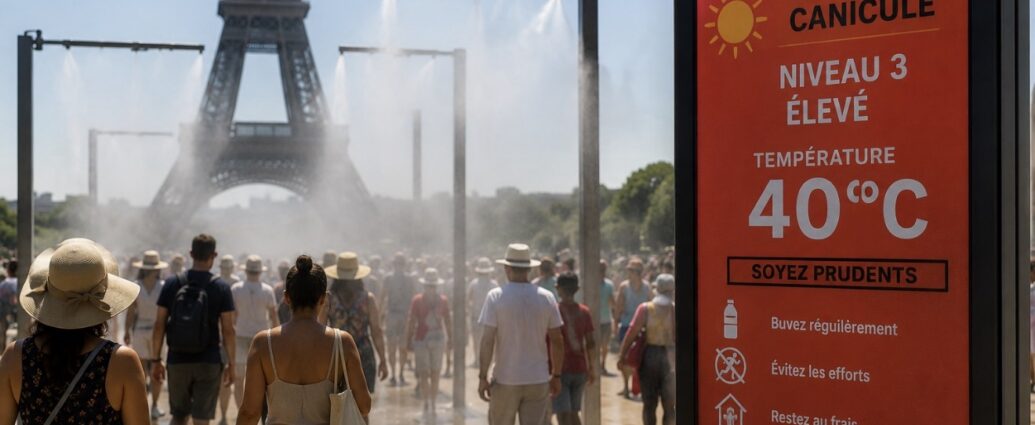
French Prime Minister Sébastien Lecornu activated the country’s highest public-health emergency level this week as a record-breaking heat wave gripped Western Europe, killing dozens, closing schools, knocking out power and forcing farmers to harvest grain at night. National weather agencies reported the hottest readings on record across France, Spain and the United Kingdom.
The numbers are extraordinary. Météo-France said the country recorded its hottest June day since records began, with Paris reaching 40.9 degrees Celsius, a new June high. The UK Met Office also confirmed Britain’s hottest June day on record, with temperatures climbing above 36 degrees Celsius on consecutive days.
The human toll mounted quickly. At least 18 people died in France from heat-related causes, including young children, while dozens of additional drowning deaths were reported as people sought relief in rivers, lakes and coastal waters. Spain also recorded its highest average daily temperature since national records began in 1950.
The economic disruption spread across multiple industries. In Paris, officials ordered early closures of the Eiffel Tower and the Louvre Museum, reducing visitor access during one of the busiest tourism periods of the year. Schools throughout several European countries either closed or shortened classroom hours, forcing many parents to remain home from work.
Power systems came under increasing strain. In Belgium, electricity prices briefly surged above one euro per kilowatt-hour during the evening peak on June 24 as conventional power plants struggled to satisfy soaring air-conditioning demand. In France, grid operator Enedis reported approximately 50,000 customers without electricity while wholesale day-ahead power prices rose sharply.
Agriculture also felt the impact. Farmers across parts of France shifted grain harvesting to overnight hours to avoid dangerous daytime temperatures, increasing labor costs while disrupting harvesting schedules throughout the agricultural supply chain.
The heat wave exposed long-standing infrastructure challenges. Much of Europe’s housing, transportation network and commercial buildings were designed for historically moderate summer temperatures rather than prolonged periods of extreme heat. Many homes, hotels and rail systems lack widespread air conditioning, creating additional pressure on the tourism and hospitality industries as temperatures continue climbing.
Scientists and weather agencies say the pattern has become increasingly common. Météo-France reports that nearly two-thirds of all French heat waves recorded since 1947 have occurred after 2000, while the UK Met Office says the number of extremely hot days has more than tripled during recent decades. This June also became the first time since 1911 that Britain experienced record-breaking temperatures during two consecutive months.
The broader economic implications extend well beyond a single week of extreme weather. Repeated heat waves contribute to higher electricity costs, lower worker productivity, reduced tourism activity, increased healthcare expenses and mounting pressure on public infrastructure. France’s activation of ORSAN Level 3 requires hospitals to increase staffing and emergency preparedness as heat-related illnesses continue rising.
European governments increasingly view extreme heat as a recurring infrastructure challenge rather than an isolated weather event. Repeated strain on electric grids, transportation systems and major tourist attractions highlights the growing investment needed to adapt cities and public services to hotter summers becoming more common across the continent.
Forecasters warned that little immediate relief remained in sight. Red heat alerts continued across much of France, while unusually warm overnight temperatures prevented buildings from cooling after sunset. For a continent whose infrastructure was largely built around milder summers, the week underscored the growing economic and human cost of adapting to a changing climate.
JBizNews Desk
© JBizNews.com All Rights Reserved. Reproduction or distribution without written permission is prohibited.