By JBizNews Desk | May 8, 2026 — 4:30 PM ET
I. CLOSING BELL: THE NUMBERS
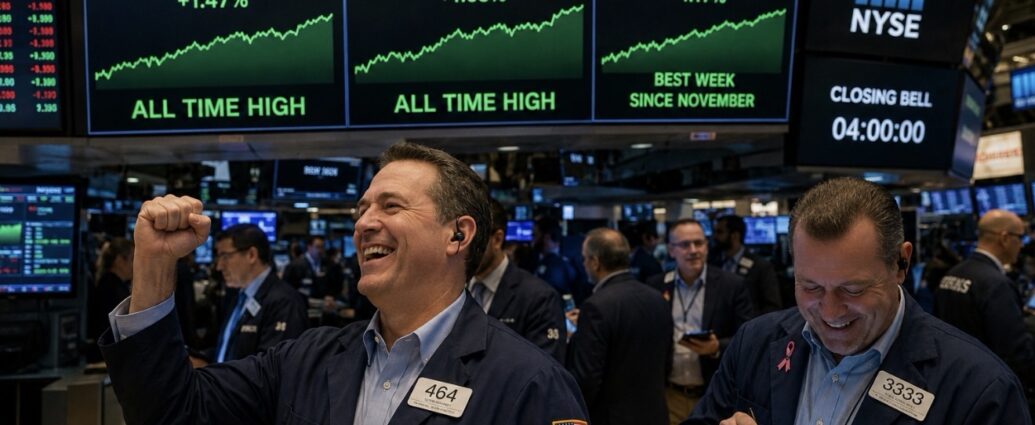
Wall Street ended a remarkable week on a high note — literally. The S&P 500 advanced 0.84%, closing at a record 7,398.93, while the Nasdaq Composite surged 1.71% to finish at a record 26,247.08. Both indexes hit new all-time intraday highs during the session and closed at records. The Dow Jones Industrial Average added just 12 points to settle at 49,609.16.
All three major averages posted weekly gains, propelled by strong earnings. The Nasdaq climbed approximately 4% on the week, while the S&P 500 secured its sixth consecutive winning week with a gain of roughly 2%. The Dow lagged with a week-to-date gain of 0.2%.
The catalyst that lit Friday’s fuse was a labor market that again refused to cooperate with recession forecasts. The Bureau of Labor Statistics reported that the U.S. added 115,000 jobs in April — well above expectations for 55,000 — while unemployment held steady at 4.3%. The stronger-than-expected report immediately lifted futures before the opening bell and carried momentum throughout the trading session.
II. MOVERS AND SHAKERS
The day’s biggest stories were written in the semiconductor sector.
Intel surged approximately 15% after the Wall Street Journal reported a preliminary chip-manufacturing agreement with Apple. The rally fueled broader gains across the AI and semiconductor trade, with Micron, Nvidia, Broadcom, and AMD collectively adding more than $400 billion in market value.
Micron Technology marked its seventh consecutive intraday record high Friday, pushing its weekly gain above 30%. Since bottoming in late March, shares have surged 120%, making it one of the market’s most explosive AI-related momentum trades. The company has now added roughly $437 billion in market value this year and ranks among the largest semiconductor firms globally.
Oracle jumped 13.56% while SanDisk soared 14.27%, extending what CNBC’s Jim Cramer described as the defining “tells of this market” — relentless investor appetite for AI infrastructure, hyperscaler cloud spending, and high-performance memory demand.
Tesla shares gained 2% to close at $420.17 after the company secured a record $100 million contract to deliver 370 Tesla Semi trucks to a California fleet operator, marking a major milestone for its commercial EV business.
Not every AI stock participated in the rally.
CoreWeave fell roughly 7% after second-quarter revenue guidance came in below Wall Street expectations. The AI cloud infrastructure company projected revenue between $2.45 billion and $2.6 billion, short of the $2.69 billion consensus estimate, while simultaneously raising its projected 2026 capital expenditures to between $31 billion and $35 billion.
MercadoLibre dropped 11.7% after missing earnings expectations despite strong revenue growth, while Nike slipped 1.1% following a downgrade from Wells Fargo analyst Ike Boruchow, who reduced his price target to $45 from $55.
III. GLOBAL MARKETS AND WAR IMPACT
While U.S. markets celebrated, overseas markets reflected a far more cautious tone.
European indexes closed broadly lower. Germany’s DAX fell 1.32%, France’s CAC 40 dropped 1.09%, and the Euro Stoxx 50 declined 1.02%. Britain’s FTSE 100 slipped 0.43%. Asian markets also weakened, with Hong Kong’s Hang Seng down 0.87% and Japan’s Nikkei 225 losing 0.19%.
The divergence highlighted how heavily concentrated the global rally has become around American technology and AI-related equities.
Meanwhile, the Iran conflict remained the dominant geopolitical variable hanging over global markets.
U.S. Central Command confirmed that American forces targeted Iranian military facilities allegedly responsible for launching missile, drone, and small boat attacks against U.S. warships operating near the Strait of Hormuz. Iran separately seized a Barbados-flagged oil tanker in the Gulf of Oman, while explosions were reported near Bandar Abbas in southern Iran.
Yet remarkably, markets barely reacted.
Traders increasingly appear conditioned to the conflict’s daily rhythm of military escalation followed by diplomatic signaling and ceasefire speculation.
Behind the scenes, negotiators are reportedly closer than at any point since the war began to a framework agreement. A proposed 14-point memorandum of understanding is currently being negotiated between Trump envoys Steve Witkoff and Jared Kushner and Iranian officials, both directly and through Pakistani intermediaries.
The proposed agreement would formally pause hostilities and launch a 30-day negotiating framework covering the Strait of Hormuz, Iran’s nuclear program, sanctions relief, and regional security arrangements.
Even if a deal materializes, analysts increasingly believe interest rates may remain structurally elevated due to the inflationary consequences already embedded throughout energy, shipping, and commodity markets.
IV. POLITICAL, CORPORATE, AND THE WEEK THAT WAS
One of the week’s most consequential developments came not from Wall Street but from the federal judiciary.
A split 2-1 panel of the U.S. Court of International Trade ruled that President Trump’s sweeping 10% global tariffs exceeded executive authority under the Trade Act of 1974. The administration is expected to appeal immediately, but the ruling introduced fresh uncertainty into tariff policies that many multinational companies have spent years restructuring supply chains around.
Corporate earnings season meanwhile continued to demonstrate the extraordinary divide between strong operating results and unforgiving investor expectations.
Roughly two-thirds of S&P 500 companies have now reported earnings, with approximately 83% beating analyst estimates by an average of 11%. Average year-over-year earnings growth currently stands near 8%, while full-year 2026 earnings estimates have continued rising — an unusually bullish pattern during periods of elevated geopolitical uncertainty.
Still, strong results have not guaranteed market rewards.
ServiceNow delivered standout quarterly earnings only to see its stock plunge 17% in its worst single-day decline ever, as investors focused on delayed Middle East deal closings and integration costs tied to its acquisition of cybersecurity company Armis.
Palantir delivered one of the strongest earnings reports of the quarter — including 85% revenue growth and a 133% surge in U.S. commercial sales — yet shares remained under pressure throughout much of the week amid concerns over valuation levels.
V. WHAT TO WATCH NEXT WEEK
The single most important event next week may have nothing to do with corporate earnings.
The United States is expecting Iranian responses within the next 48 hours on several critical negotiating points, with officials privately describing the current moment as the closest the parties have come to a deal since the conflict began.
If a memorandum of understanding is finalized, oil prices could fall sharply while fertilizer, freight, and shipping insurance markets stabilize. Equity markets would likely respond aggressively to any credible peace announcement.
On the economic front, investors will closely watch April CPI data expected midweek. Economists currently forecast headline inflation rising to 3.8% year-over-year and core CPI at 2.7%.
A hotter-than-expected inflation reading would reinforce the Federal Reserve’s hawkish stance and further delay rate-cut expectations. A softer print could provide markets with badly needed relief.
The earnings calendar remains active with Alibaba, Cisco, Applied Materials, JD.com, Robinhood Markets, Under Armour, On Holding, and Figma all scheduled to report.
But the market’s true focal point remains Nvidia, set to release earnings on May 20.
With AI infrastructure spending now serving as the primary engine driving global equity gains, Nvidia’s report will likely function as a referendum on whether the AI boom still has room to run — or whether markets have already priced in years of future optimism.
As one senior portfolio manager summarized this week:
“The market is trading valuations that don’t indicate the risks we see out there. It’s the AI spending cycle and the ripple effects from it that are carrying an economy that otherwise probably looks pretty lackluster.”
Sixth straight winning week. Records on the board. A possible Iran framework deal within days. And an inflation report that could reshape expectations entirely.
Next week will not be quiet.
© JBizNews.com. All rights reserved.