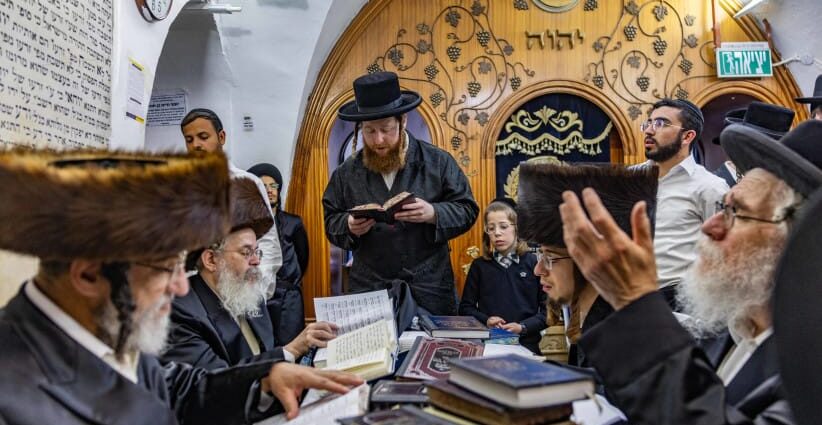
Religious protesters were seen in video recordings cutting the fences around Mount Meron on Sunday, saying they plan to defy police orders to avoid the area amid safety concerns.
“We will cut all the fences,” one activist was heard saying. “Transfer us money in Bit.”
Israel Police announced on Sunday morning that Israel’s annual Lag Ba’omer pilgrimage at Mount Meron will not take place as originally planned, adding that routes leading to the tomb of Rabbi Shimon Bar Yochai would be blocked starting today, with additional routes closing on Monday. These routes will be closed until Wednesday, May 6.
The change came just after Prime Minister Benjamin Netanyahu signed updated restrictions barring outdoor gatherings of more than 200 people and capped indoor gatherings at 600 in affected areas, including Mount Meron and nearby communities in the Merom HaGalil Regional Council.
Police have warned members of the public who do not have authorization to be in the area to refrain from attempting to enter the community and the tomb compound, stating that entry will be permitted only upon presentation of identification. Anyone attempting to enter Meron without authorization or proof of residence will not be allowed in.
Additionally, Border Police have been deployed to prevent attempts to reach the tomb on foot.
“Amid the security threats in northern Israel, avoiding blocked routes is the right way to preserve Jewish tradition joyfully and safely,” the police stated.
IDF Northern District Commander: ‘Obeying instructions saves lives’
Later on Sunday, the Israel Police Spokesperson released a statement which included a message from IDF Northern District Commander Maj.-Gen. Meir Eliyahu, asking the public to obey police instructions, as doing so “saves lives.”
The statement emphasized that police are already in the area “preventing unauthorized vehicles and pedestrians from entering the area of Meron.”
Israel Police asked the public to exercise “personal responsibility” and celebrate Lag Ba’omer in their own communities.
The statement added that the police “will not allow extremist elements to turn the holy place into a scene of violence, and will work to bring to justice anyone who incites violence or acts against police officers performing their duties.”
Until the latest update, preparations for one of Israel’s largest annual mass gatherings had been moving forward under a different framework. Israel Police Commissioner Daniel Levi had approved an operational plan after security consultations, including dividing the mountain into separate zones, tightly regulating crowd movement, and allowing roughly 10,000 people in the area at any given time.
The plan had already changed several times in recent days before its ultimate cancellation.
Officials first considered a sharply reduced symbolic event before approving a broader format that would have allowed gatherings of up to 1,500 people in each compound, two-hour entry rotations, and separate focal points at the tomb of Rabbi Shimon Bar Yochai, the Bnei Akiva compound, Moshav Meron, and Compound 89.
The original framework, led by the Jerusalem Affairs and Jewish Tradition Ministry, included a limited public transportation ticketing system on a first-come, first-served basis at 11 locations across Israel, along with limited bonfire-lighting ceremonies and gatherings throughout the day.
Communications Minister Shlomo Karhi said earlier that “Meron will be open to the people of Israel, subject to security restrictions.”
Government ministries had also been at odds over transportation arrangements and control over public access to the mountain. The main concern was that without full regulation of arrivals, even a limited event could quickly lead to overcrowding, independent attempts to reach the site, public disorder, and safety risks.
The pilgrimage to Mount Meron, held on Lag Ba’omer at the tomb of Rabbi Shimon Bar Yochai, has remained under heightened scrutiny since the 2021 disaster, when 45 people were killed in a crowd crush at the site.