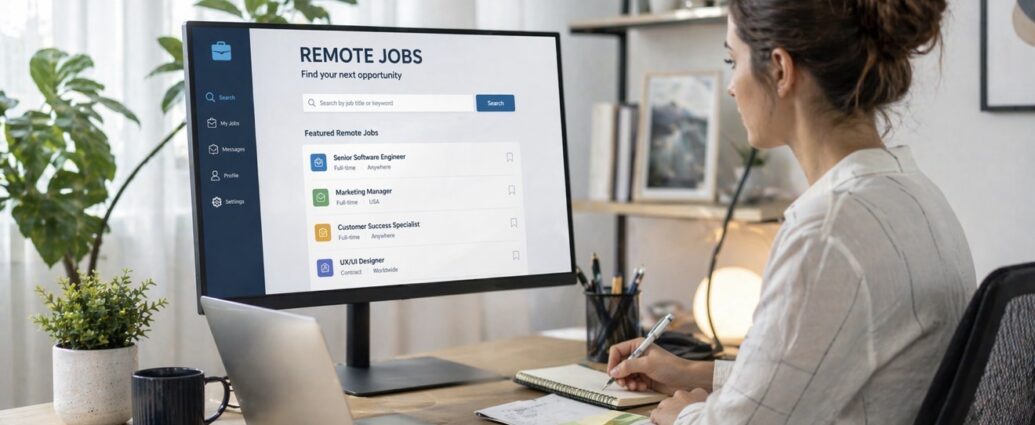
Remote hiring in the U.S. picked up at the start of 2026 even as many large employers kept pressing workers back into offices, underscoring how flexible work remains embedded in parts of the labor market. In its first-quarter report, **FlexJobs** said remote-job postings rose 20% from the fourth quarter of 2025, adding that “the remote-job market continues to evolve” as employers and candidates adjust to “flexibility, compensation, and long-term career growth,” according to the company’s latest release.
The increase matters because it arrives amid a louder corporate return-to-office push from some of the country’s biggest employers. **Amazon** Chief Executive **Andy Jassy** said in a company message last year that employees should expect to be in the office more regularly because “we believe that the advantages of being together in the office are significant,” a position widely reported by **Reuters** and other outlets, while **JPMorgan Chase** CEO **Jamie Dimon** has repeatedly argued, in remarks covered by **CNBC**, that in-person work improves management and collaboration. Against that backdrop, **FlexJobs** said the latest quarter showed remote work “holding steady in key sectors,” suggesting the market has narrowed rather than disappeared.
The composition of those listings also points to a more selective remote economy. **FlexJobs** said 65% of remote openings in the first quarter targeted mid-career professionals, with project management, sales, computer and information technology, business development and operations ranking among the top fields. That aligns with broader labor-market evidence from **LinkedIn**, whose chief economist **Karin Kimbrough** said in prior company research that remote and hybrid roles continue to attract “significantly more applications per job” than fully on-site postings, highlighting persistent worker demand even as the share of such listings cooled from pandemic peaks.
The broader backdrop remains a labor market that has slowed but not cracked. **U.S. Bureau of Labor Statistics** data showed job openings have eased from the extremes of 2022, while unemployment remained relatively low by historical standards through early 2026. **Federal Reserve** Chair **Jerome Powell** said in recent public remarks that the labor market has “come into better balance,” according to transcripts and statements published by the central bank, a shift that helps explain why employers now hold more leverage over workplace rules than they did during the hiring frenzy that followed the pandemic.
Still, economists say remote work has settled into a durable, if smaller, share of overall hiring. Researchers at **WFH Research**, including **Nicholas Bloom**, have said in published survey work that work-from-home levels stabilized well above pre-pandemic norms, with hybrid arrangements proving especially resilient. **Bloom**, a Stanford economist, has argued in public presentations and interviews that fully remote roles remain concentrated in digital, professional and knowledge-based occupations, a pattern that fits **FlexJobs’** first-quarter ranking of technology, project management and business functions among the strongest categories.
Corporate policy, however, remains uneven and often contentious. **AT&T**, **Dell Technologies** and **Amazon** have all faced scrutiny over office-attendance mandates, according to reporting from **Bloomberg**, **Reuters** and **The Wall Street Journal**, while other employers continue to advertise flexibility as a recruiting tool. In a report on workplace trends, **Gallup** said employee engagement tends to be strongest when job design matches the work itself, and researcher **Jim Harter** wrote that “the most productive workplaces are those that maximize flexibility where possible,” a finding that helps explain why companies still use remote roles to compete for specialized talent.
For workers, the rebound in listings does not necessarily mean a return to the broad remote boom of 2020 and 2021. **LinkedIn** and **Indeed** have both shown that remote-job postings as a share of total openings sit below their pandemic highs, even though applicant interest remains elevated. **Indeed Hiring Lab** economist **Cory Stahle** said in prior labor-market commentary that remote work has become “a permanent feature” of the market, but one that increasingly concentrates in certain occupations and seniority bands rather than across the economy as a whole.
That distinction carries real implications for pay, retention and geographic competition. **ZipRecruiter** Chief Economist **Julia Pollak** has said in company research and public commentary that remote work expands the talent pool for employers while also widening the field for applicants, creating more competition for coveted flexible roles. **FlexJobs** similarly indicated that experienced professionals dominate current remote hiring, suggesting employers increasingly reserve location flexibility for workers with proven skills, management experience or hard-to-fill technical expertise.
What comes next will depend on whether the economy slows further and whether employers decide flexibility still offers an edge in recruiting. If hiring weakens materially, companies may feel less pressure to offer remote options; if skilled labor remains scarce in technology, sales and project-based roles, flexible postings could keep growing from a smaller but stable base. For executives, the message from **FlexJobs**, labor economists and major workplace surveys looks increasingly consistent: remote work no longer defines the job market, but it still shapes how companies attract talent, control costs and organize teams in 2026.
JBizNews Desk