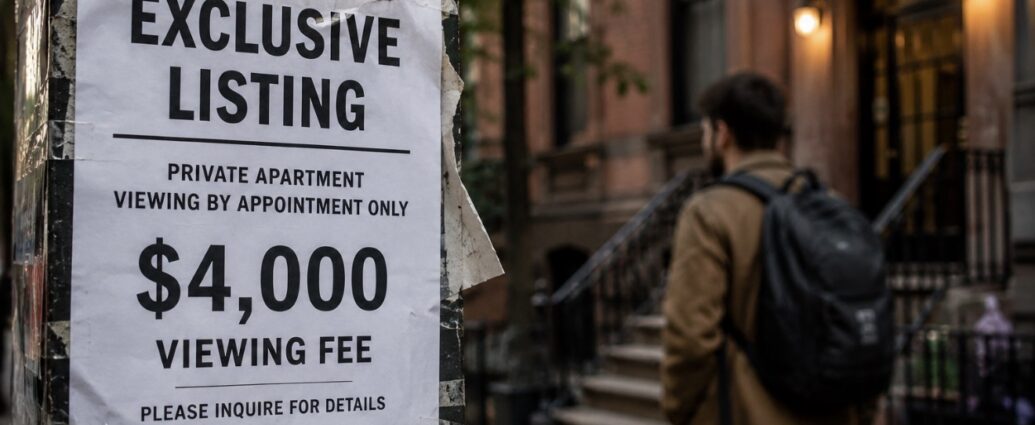
New York City told landlords a year ago that they could no longer make tenants pay for the broker the landlord hired. Landlords responded by pulling apartments off the public listing sites altogether and filling them through brokers’ private networks. The result is that a renter who wants to see those apartments now has to hire the broker herself — and pay him one to two months’ rent for the privilege of finding out what is available.
Alexandra Dye, a 29-year-old advertising professional, landed a two-bedroom in prime Brooklyn at 60% below market rent. Getting in front of the listing cost her $4,000. She had inquired about an apartment on StreetEasy; the broker told her it was gone but offered to show her others if she agreed to pay him at least a month’s rent on whatever she leased. After two months of fake listings and a landlord who walked away at the last minute, she took the deal and ended up paying more than twice her monthly rent. “It feels like a lot of listings are being hoarded,” she said.
The Fairness in Apartment Rental Expenses Act took effect June 11, 2025, barring brokers who represent landlords from billing tenants. On its own terms it worked. The share of renters paying a broker fee has fallen from 31% to 15%, according to rental platform Openigloo. Average upfront move-in costs dropped from $12,942 to $7,537, a decline of nearly 42%.
What the law did not anticipate is that it left one door open. A renter is still free to hire and pay a broker of her own choosing. Brokers now stand on the other side of that door with an inventory the public cannot see.
The supply figures show the shift. Apartment inventory has been lower than the year-earlier level every month since the law took effect, including a 31% drop in June, the opening of New York’s busiest rental season, according to appraiser Miller Samuel and The Real Deal. June inventory normally rises 5.9% from the prior year. That is a swing of nearly 37 percentage points in the wrong direction during the month when the most apartments are supposed to hit the market.
The city now effectively runs two rental markets. Publicly listed rent-regulated apartments command an 18% premium over comparable off-market units, up from a 3% gap before the law. Apartments that used to sit online for 13 days now lease in eight, and more than a quarter of Manhattan leases signed in June involved bidding wars. Renters who stay in the public market pay more and move faster. Renters who want the better deals pay a broker for the map.
None of this is happening in a soft market. Citywide median asking rent reached $4,199 in May, up 7.3% from a year earlier and the highest StreetEasy has recorded since it began tracking in 2010. Manhattan hit $4,927 and Brooklyn $3,895, both records. StreetEasy’s own analysis attributes the acceleration primarily to a long-running shortage of housing rather than to the fee law itself, and citywide vacancy remains near 1.4%.
Brokers defend the arrangement on straightforward economic grounds. Landlords, they say, would rather fill units through referrals and private networks than pay advertising costs or broker fees out of their own pockets. Once the landlord stops paying, someone has to, and the only party left is the tenant.
Enforcement is running, but it is aimed at a different violation. The Department of Consumer and Worker Protection had issued 79 summonses as of July and returned $15,475 to renters who were charged unlawfully. Penalties run up to $2,000 per violation plus restitution, and tenants can sue on their own. The mayor’s office released a “Rental Ripoff” report last month detailing its crackdown on illegal fees. But a broker a renter genuinely hires is not charging an illegal fee. The paywall is lawful as the statute is written, which means no summons reaches it.
The real estate industry’s legal challenge has fared no better: a federal judge denied an injunction in June 2025, rejected a second request in July, and the Second Circuit turned down another bid that fall, leaving the law in force while the case proceeds.
That leaves two possible fixes. The Council can amend the statute to cover the new arrangement, which invites the same problem to reappear in another form. Or the city can add enough apartments that landlords have to advertise them to find tenants. Only one of those addresses why brokers can charge $4,000 for a phone number in the first place.
JBizNews Desk | New York
© JBizNews.com All Rights Reserved. Reproduction or distribution without written permission is prohibited.