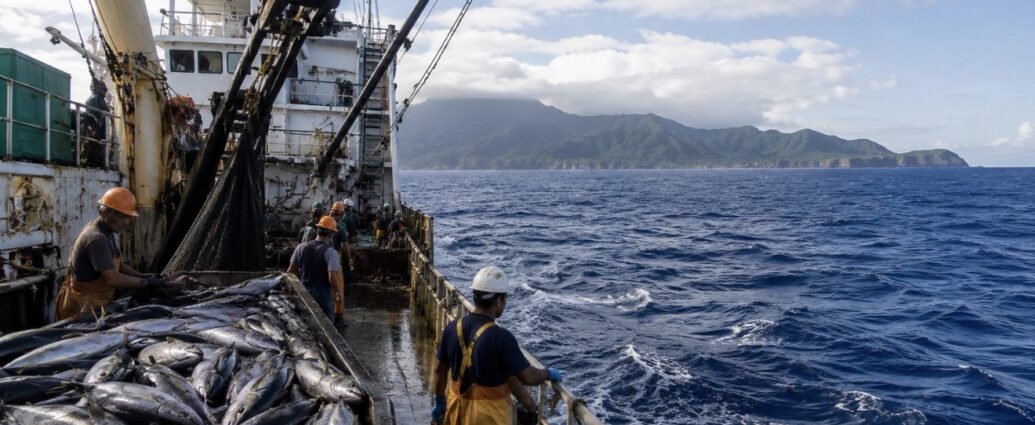
WASHINGTON— President Donald J. Trump signed a proclamation on Thursday, June 11, 2026, restoring commercial fishing access to nearly half a million square miles of the Pacific Ocean and opening three additional marine national monuments to U.S. commercial fleets as part of what the White House calls its America First Fishing Policy.
The proclamation reopens the Mau and Ho‘omalu Zones of the Papahānaumokuākea Marine National Monument, the Islands Unit of the Mariana Trench Marine National Monument, and the Rose Atoll Marine National Monument — vast Pacific waters that have been closed to commercial fishing since their creation.
The White House said the move is intended to increase domestic seafood production, support American jobs, strengthen food and national security, and help lower seafood prices for consumers.
Building on Earlier Fishing Actions
Thursday’s proclamation completes a broader series of actions taken by the administration to expand commercial fishing access in federally protected waters.
In April 2025, Trump signed an executive order creating the America First Seafood Strategy, along with a proclamation reopening portions of the Pacific Remote Islands Marine National Monument to U.S.-flagged vessels operating between 50 and 200 nautical miles offshore.
In February 2026, the administration reopened the Northeast Canyons and Seamounts Marine National Monument off New England.
The latest action follows a recommendation approved on March 24, 2026, by the Western Pacific Regional Fishery Management Council (Wespac), which urged reopening the remaining Pacific monuments.
American Samoa Stands to Benefit
The economic impact may be felt most strongly in American Samoa, where fishing remains the backbone of the private-sector economy.
According to administration figures, more than 80% of the territory’s private economy depends on fishing.
American Samoa is home to the nation’s only “Buy American”-compliant tuna cannery supplying U.S. military rations and school lunch programs. The facility employs approximately 5,000 workers, accounts for roughly 99.5% of the territory’s exports, and supports about 84% of private-sector employment.
American tuna purse-seine vessels and longline fleets are expected to be among the biggest beneficiaries of the newly reopened fishing grounds.
Supply Chain and Food Security
The White House argued that the benefits extend well beyond fishermen.
Commercial fishing supports jobs across harvesting, processing, transportation, shipbuilding, equipment manufacturing, distribution, sales, and marine services.
Administration officials said expanding domestic seafood production could strengthen the U.S. seafood supply chain and reduce dependence on imports, which currently account for the majority of seafood consumed in the United States.
The White House also linked the policy to household budgets, arguing that limiting domestic supply contributed to higher seafood prices for consumers.
Conservation Debate Continues
The administration maintained that many targeted species, including tuna, are highly migratory and do not remain permanently within monument boundaries.
Officials argued those fisheries are already managed under federal law, including the Magnuson-Stevens Fishery Conservation and Management Act, making broad monument-wide fishing prohibitions unnecessary.
Under that view, the administration says the closures imposed economic costs while providing limited conservation benefits.
Legal Challenges Expected
Opponents strongly disagree.
In August 2025, Judge Micah W. J. Smith of the U.S. District Court for the District of Hawaii vacated an earlier NOAA Fisheries authorization that would have allowed fishing in the Pacific Islands Heritage monument, ruling that required public procedures had not been followed.
That lawsuit was brought by Earthjustice, the Conservation Council for Hawai‘i, and the Center for Biological Diversity, which argued the administration’s actions violated protections established under the Antiquities Act.
Hawaii Governor Josh Green has publicly supported maintaining monument protections, while conservation organizations and some Native Hawaiian leaders have warned that reopening areas such as Papahānaumokuākea — one of the largest marine conservation regions in the world and an area of profound cultural significance — could cause lasting environmental damage.
Legal challenges to Thursday’s proclamation are widely expected.
What Comes Next
The administration described the proclamation as part of a broader effort to reduce regulatory barriers at NOAA, expand access to fisheries, and increase catch opportunities based on what it calls the best available science.
Commerce Secretary Howard Lutnick and NOAA Administrator Neil Jacobs have repeatedly argued that increasing access to domestic fisheries will help strengthen coastal economies and put more American-caught seafood on American tables.
The White House said the administration’s combined fisheries actions have unlocked billions of dollars in potential economic value.
For the U.S. fishing industry, Thursday’s proclamation represents one of the most significant expansions of commercial access in years.
For American Samoa’s tuna fleet, its canneries, and the thousands of jobs tied to them, it opens the door to fishing grounds that have largely been off limits for more than a decade.
The next chapter will depend on how NOAA implements the policy and whether the courts ultimately allow the expanded access to remain in place.
JBizNews Desk — Washington
© JBizNews.com All Rights Reserved. Reproduction or distribution without written permission is prohibited.