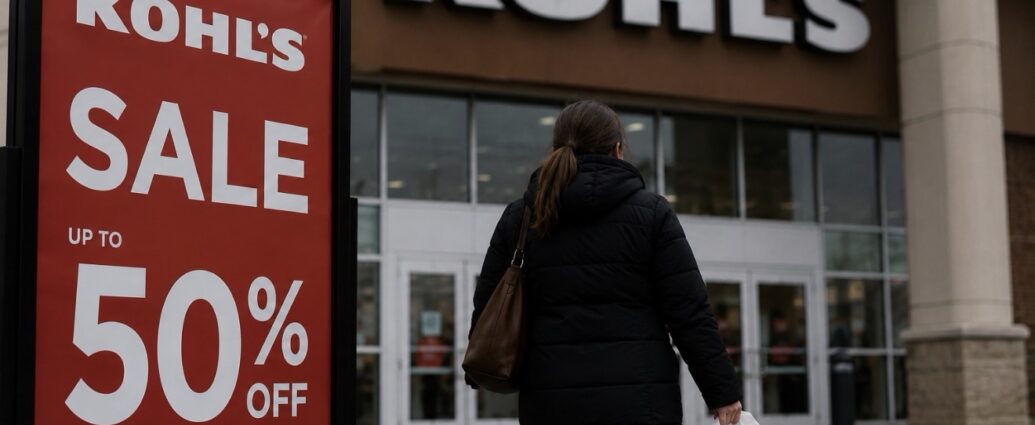
The State Street SPDR S&P Retail ETF, the most widely tracked retail equity benchmark, fell more than 3% Monday in its worst single-day decline since early April 2025, with Kohl’s Corporation and Caleres, parent of Famous Footwear and Sam Edelman, both tumbling more than 9% — a sectoral selloff that has now extended into Tuesday’s session as the consumer-discretionary complex absorbs a hot April Consumer Price Index print, persistent tariff pressure, and softening household spending data ahead of the May earnings reports from the largest U.S. retailers.
The SPDR S&P Retail ETF (NYSEARCA: XRT) dropped more than 3% in afternoon Monday trading, the largest one-day decline for the fund since the early-April 2025 tariff-shock selloff. Kohl’s led the broader department-store group lower with a fall of more than 9%, while Caleres, parent of Famous Footwear and Sam Edelman, tumbled a similar amount on signs of slowing footwear demand and concerns about back-to-school positioning. A handful of stocks bucked the move higher, including electric-vehicle charging provider EVgo, which rose roughly 3%, and Casey’s General Stores and Sonic Automotive, each adding roughly 1%.
The Monday selloff carried into Tuesday after the Bureau of Labor Statistics reported April Consumer Price Index growth of 3.8% year over year — the highest annual reading since May 2023 — with the apparel category up 0.6% on the month and household furnishings and operations up 0.7%. Wolfe Research analyst Tobin Marcus wrote Monday that the Iran war ceasefire remained “elusive” with President Trump “reluctant to resume the war,” a backdrop that has kept oil prices above $100 a barrel, gasoline averaging $4.50 per gallon nationally, and discretionary household budgets compressed.
The macro setup heading into retail earnings season is the most challenging of the post-pandemic cycle. The National Retail Federation projects 2026 holiday-equivalent spending to slow meaningfully from prior-year levels, Visa and Mastercard spending data for April showed the weakest discretionary print since mid-2023, and the Federal Reserve Bank of New York’s May Survey of Consumer Expectations showed a rising share of households reporting plans to cut spending on non-essentials. The combination has placed structural pressure on the department-store and softlines segments — the part of retail with the highest exposure to discretionary household spending — even as off-price and grocery retailers continue to show resilience.
Kohl’s has been the most consistently pressured legacy department store. The company entered Q1 2026 with weaker positioning across active wear, beauty, and home categories, and is expected to report further comp-sales declines when it discloses Q1 earnings May 27. Macy’s reports May 28, Nordstrom in late May, Dillard’s May 14, and Target Corporation May 20. Walmart’s Q1 earnings May 15 are widely expected to outperform the broader retail complex given the company’s grocery mix and trade-down beneficiary status. Amazon.com has already reported and provided guidance that flagged tariff-related cost pressure on its third-party sellers.
Caleres’s 9% Monday decline reflects compounding pressure on the footwear segment. Nike has been navigating a multi-quarter turnaround under chief executive Elliott Hill, with the most recent quarter showing wholesale weakness and direct-to-consumer softness. Under Armour has reported similar pressure. Foot Locker, recently acquired by Dick’s Sporting Goods, is integrating against a softening sneaker market. Skechers, taken private last year by 3G Capital, removed one of the segment’s public benchmarks. The Sam Edelman and Famous Footwear businesses inside Caleres sit at the heart of the discretionary-footwear category that has shown the sharpest demand compression.
The analyst calls reflect the macro pressure. Citi reiterated a Buy on Lowe’s Companies Monday with a $285 price target heading into earnings May 21, telling clients home-improvement “should beat 1Q street estimates and continue to outperform the industry in 2026.” Bank of America cut its 2026 same-store-sales forecasts for Best Buy, Tractor Supply Company, and Five Below earlier in the month, citing the tariff and inflation backdrop. Morgan Stanley has held an Equal-Weight rating on Target since the holiday season, with concerns about the company’s exit from diversity-and-inclusion programs and reactive customer behavior.
For the discretionary group as a whole, the structural problem is that the tariff pass-through has not fully arrived. Several retailers have absorbed first-round tariff costs at the cost of gross margins, with second-round price increases planned for the back-to-school and holiday cycles. The compounding effect — tariff-driven price increases on top of shelter inflation running at 3.0% year over year and energy still elevated — is the central concern across the analyst community.
The next test is the Census Bureau April Retail Sales report Thursday, Walmart Q1 earnings Friday, and the start of department-store earnings the week after. Whether the selloff that began Monday and extended Tuesday represents a near-term capitulation or the start of a deeper repricing of consumer-discretionary multiples now depends on whether the May earnings cycle confirms the demand compression the macro data have been signaling.
JBizNews Desk
© JBizNews.com. All rights reserved. This article is original reporting by JBizNews Desk. Unauthorized reproduction or redistribution is strictly prohibited.