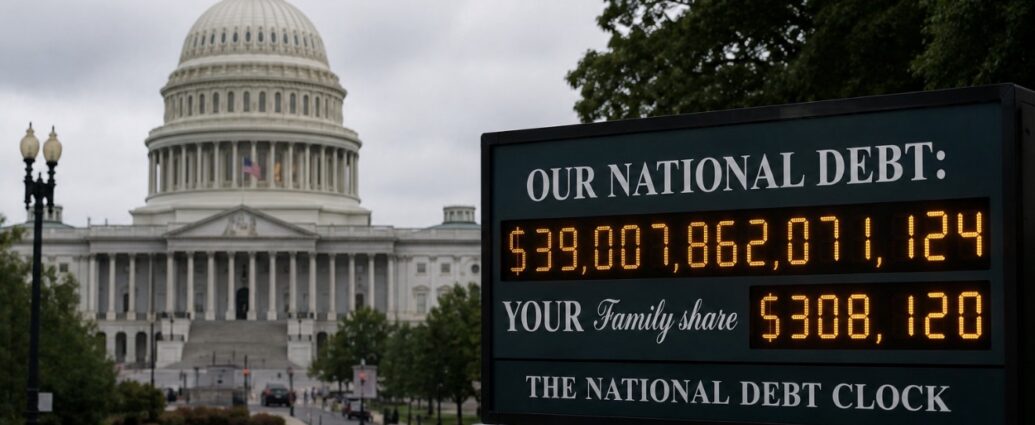
The nation’s rapidly growing debt could leave today’s young Americans facing fewer job opportunities, slower wage growth and a weaker economy for decades to come, according to a report released Monday by the Peter G. Peterson Foundation, which argues that Washington’s current fiscal path increasingly shifts the burden onto future generations.
The nonpartisan fiscal policy organization, citing new economic modeling conducted by the QUEST practice at accounting firm EY, found that if current debt trends continue, the United States could have 1.2 million fewer jobs by 2035 than under a scenario in which federal debt is stabilized. The report projects the employment gap would widen to 2.7 million fewer jobs by 2055 and 3.6 million fewer jobs by 2075, meaning much of the economic impact would fall on today’s members of Generation Z and younger Americans who have not yet entered the workforce.
The report concludes that federal borrowing affects far more than government finances.
According to the EY analysis, wages would also gradually fall behind as higher debt slows long-term economic growth. Average annual earnings would be approximately 0.6% lower by 2035, widening to 3% below a stabilized-debt scenario by 2055 and 5.3% lower by 2075. Economists say the reason is straightforward: as government borrowing consumes a larger share of available capital, businesses face higher financing costs, private investment declines, productivity slows and wage growth weakens over time.
The warning comes as federal debt continues climbing at a historic pace.
The gross national debt surpassed $39 trillion on March 17, 2026, after increasing by roughly $4.5 trillion in only two years. Budget analysts expect total debt to move beyond $40 trillion before the end of the year if current spending and borrowing trends continue.
Servicing that debt has become one of Washington’s fastest-growing expenses.
According to the Congressional Budget Office, net interest payments reached approximately $857 billion during the fiscal year, or nearly $24 billion every week. Interest costs now consume more federal resources than many major government departments, limiting policymakers’ ability to finance infrastructure, education, research, defense and other long-term investments without additional borrowing.
Young workers historically experience the greatest impact during periods of slower economic growth.
Research from the Economic Policy Institute found that a one-percentage-point increase in unemployment is associated with a 0.86 percentage-point decline in annual wage growth for younger workers—more than double the effect experienced by workers age 25 and older. Economists say graduates entering the labor market during weak hiring periods often experience lower earnings for years because delayed career advancement compounds over time.
History illustrates the long-lasting consequences of entering the workforce during periods of economic stress.
Workers who graduated during the Great Recession frequently experienced years of reduced earnings compared with peers who entered stronger labor markets. Many accepted lower-paying jobs, delayed homeownership, accumulated less retirement savings and required years to catch up professionally. Economists warn that persistent fiscal imbalances could create similar long-term headwinds if slower economic growth becomes entrenched.
Not everyone agrees that debt alone determines future economic performance. Some economists argue that borrowing can support stronger growth when used for productive investments such as infrastructure, education and research, particularly during recessions. Others contend the greater risk comes when borrowing consistently finances routine government operations rather than investments that expand the nation’s productive capacity.
Even so, fiscal experts broadly agree that rapidly rising interest costs reduce budget flexibility.
Every additional dollar spent paying interest cannot be invested elsewhere, leaving future lawmakers with fewer options when confronting recessions, national emergencies or demographic challenges associated with an aging population.
For businesses, slower economic growth typically translates into weaker consumer demand, reduced business investment and fewer employment opportunities. Employers become more cautious about expansion, venture capital becomes more expensive and entrepreneurial activity often slows when financing costs remain elevated.
For Generation Z, the report’s central message is that today’s fiscal decisions will shape tomorrow’s economic opportunities.
Whether Congress ultimately chooses spending reductions, tax increases, faster economic growth or some combination of reforms, the Peterson Foundation argues that delaying action increases the eventual cost of restoring fiscal stability.
As policymakers continue debating taxes, spending priorities and entitlement programs, the report concludes that the consequences of inaction are likely to be felt most by younger Americans who will spend the largest share of their working lives in the economy created by today’s borrowing decisions.
JBizNews Desk | Washington
© JBizNews.com All Rights Reserved. Reproduction or distribution without written permission is prohibited.