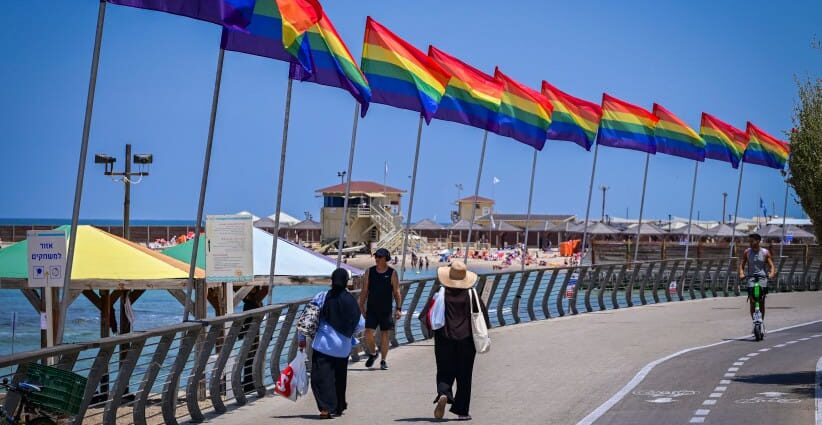
Making aliyah is sometimes more of a challenge than people openly admit, but finding a community can really help make people feel welcome and settle in. British-born Roy Freeman aims to help create such a community for those anywhere on the LGBT+ spectrum.
Freeman grew up in Luton, north of London, in a community that he describes as “small and dwindling.” He spent a month in Israel when he was 18 on a visit that he says strengthened his Zionism. He had not come out yet, in terms of being open about his sexuality, and returned a few years later to work on a kibbutz in the North.
He planned to make aliyah in the late 1990s and visited Israel on a pilot trip, but felt the time was wrong, noting that before trans singer Dana International won the Eurovision Song Contest in 1998, the LGBT community in Israel was a very different place and implying that he did not feel as comfortable in Israel during that time period as he would later come to feel.
However, by the following year, he was out to most of his friends and had entered his first long-term relationship by the age of 25. Together, he and his then-partner moved to Sydney, Australia.
Freeman recalls how, in both London and Sydney, he joined LGBT Jewish community groups, as he says he felt more comfortable with other LGBT Jews. He managed the website of the London-based Jewish Gay and Lesbian Group and became president and Mardi Gras Parade float organizer of Sydney’s Dayenu during his time in the respective cities.
However, after 11 years in Sydney, he met an Israeli man who eventually wanted to return to Israel. Freeman came with him – in his words: “I made aliyah so that we could stay together.” The couple settled together in the Tel Aviv area, where Freeman still lives.
In 2011, while seeking a community for himself in Israel, he found a group for LGBT English-speakers in Tel Aviv and began attending their events, later attending his first Tel Aviv Pride in June 2012.
“It was fun, but after 11 years participating in Mardi Gras parades in Sydney, it felt unorganized and unstructured,” Freeman recalls.
“There were a handful of LGBT groups marching, but everyone else was just milling around. It was a very different experience,” he says.
He notes how most of his attempts to join LGBT organizations within his first year in Israel were “ignored,” and that he saw ads and flyers for LGBT parties and bars, but they did not interest him.
“I found nothing else that was inclusive of non-Hebrew-speakers. It became obvious that we olim were expected to be fluent in Hebrew as we touched down at Ben-Gurion Airport,” he says.
Freeman also notes how many Israeli-born LGBT people that he met could not understand why anyone would consider moving to “what they considered to be a hopeless hellhole.”
“No matter how many times I tried to explain how bad antisemitism was elsewhere, not to mention the institutionalized homophobia, I heard the same opinion time and time again,” he recounts.
Social media became a tool to connect with other LGBT community members
This led Freeman to found LGBT Olim’s Facebook page in April 2013. He notes that Facebook was the most widely used social media at the time, and he aimed to find other LGBT olim across Israel.
“I knew I wasn’t the only one, and I believed that many were looking for community. I bought a banner, and by June that year, there was a group of LGBT olim marching together at Tel Aviv Pride.”
He was surprised by the positive response to the Facebook page.
“I discovered that there were LGBT olim in cities, towns, kibbutzim, and moshavim all over the country,” he says.
He then launched a monthly newsletter to inform people of events that would be of interest to LGBT English-speakers across Israel, as he realized that the core of the group risked becoming “too Tel Aviv-centric.”
Making contact with interested people in Jerusalem, Haifa, and Beersheba, he started to organize meet-ups for LGBT English-speakers in those cities, too.
“I also tried getting a few local LGBT organizations on-side, but with limited success,” he says.
His organization received “a lot of good publicity” around Tel Aviv Pride 2013 and since, including in The Jerusalem Post, The Jewish Chronicle, and other media outlets.
He recalls that the organization also received negative comments, including hateful and threatening responses. Freeman says that he considers member security to be of the “utmost importance.”
Before somebody can join events, he talks with them in order to check their intentions.
“There’s a very fine line between being welcoming and being intrusive, and I unfortunately haven’t always got the balance right, but most olim understand the need for our security questions,” he says.
Despite these challenges, Freeman says that he “likes to think that we’ve built a welcoming community over the years.”
“We try to give LGBT new olim a soft landing, providing a place where they can build a social network without first being fluent in Hebrew,” he adds.
Freeman works to create events for his community
Freeman also lists a variety of social events he organizes via LGBT Olim that are held on a regular basis, including Shabbat potluck dinners and brunches, LGBT-themed movie nights, karaoke events, board games sessions, trivia quizzes, and picnics, as well as special events around Jewish festivals, including Passover Seders, and parties at Shavuot, Sukkot, Purim, and Hanukkah.
By doing so, he hopes to provide various ways that LGBT olim can feel comfortable being part of a community in Israel.
“Our events are mostly free – we don’t want to exclude anyone based on cost,” Freeman says.
“We are fully aware that many new olim are unemployed for months after arrival and many struggle to find work. So even when we meet at cafés, restaurants, etc., I want people to know they can come along just for the social aspect, without any pressure to order anything,” he added.
A large number of the events were only face-to-face, until the 2020 COVID-19 pandemic, when LGBT Olim started running online events. These events have since continued, largely aimed at being inclusive for those LGBT olim who live outside of major cities, Freeman clarifies.
In order to help LGBT olim settle in Israel, Freeman arranges for free Hebrew classes, called Qulpan, a portmanteau of queer and ulpan, both online and in Tel Aviv.
The online events have a further benefit of providing a space for LGBT future olim in the process of moving to Israel to build a community before their arrival, he highlights.
However, there are several changes that Freeman wishes to make.
One change includes wanting to work closer with aliyah agencies, including the Jewish Agency and Nefesh B’Nefesh. He says both have been “very welcoming and supportive” working with LGBT Olim on an informal level, but are “still unwilling to tell prospective olim about LGBT Olim.”
“I think I could count on one hand the number of people who have told me they heard about us through their aliyah adviser,” Freeman says, noting that he wishes the organization could market itself more widely, as he still finds “LGBT olim who have not heard of us.”
He also highlights how he would “love to hear from people who are LGBT and passionate about community building.”
Roy Freeman, 52, from London to Tel Aviv via Sydney, 2011