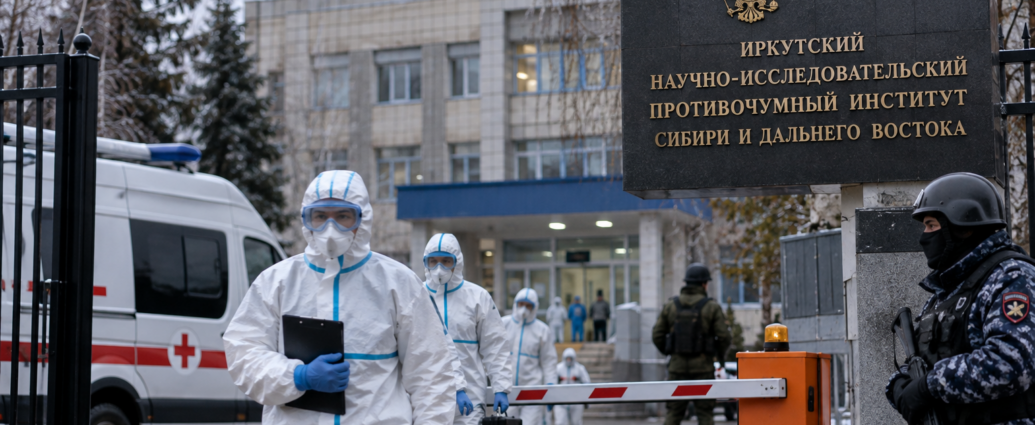
WASHINGTON — An unexplained health incident at a Russian laboratory that studies dangerous pathogens is putting the world’s pandemic safeguards back under scrutiny — not because another global outbreak is underway, but because businesses and governments learned during COVID-19 how quickly uncertainty about a disease can become an economic crisis.
For investors, companies and consumers, the most important fact right now is reassuring:
There is no evidence of a new pandemic.
No international spread has been reported, no sustained person-to-person transmission has been identified, and Russian authorities say testing of people connected to the incident has not uncovered plague infections.
The World Health Organization’s initial assessment puts the broader international risk at very low levels.
That means there is currently little reason for businesses to change operations, travelers to alter plans or financial markets to price in another pandemic shock.
But Washington wants more information from Moscow — and the economic reason for demanding transparency is straightforward.
The world has already seen what happens when governments cannot quickly determine whether an unusual disease event is contained.
The Real Business Risk Is Uncertainty
COVID-19 demonstrated that a health emergency does not have to remain a health story.
It can become a supply-chain story, an airline story, a labor story, an inflation story and eventually a global recession story.
Factories close.
Flights are canceled.
Ports slow down.
Workers stay home.
Consumers change their spending.
Companies scramble for inventory.
Governments impose emergency restrictions.
Financial markets attempt to calculate the damage before scientists even understand the disease.
That is why what happens next in Russia matters beyond public health.
The immediate economic threat is not plague spreading around the world. Based on current evidence, that scenario appears highly unlikely.
The issue is whether Russia can provide enough reliable information for other governments to confidently conclude that the situation has been contained.
Why Another Plague Pandemic Is Unlikely
Even if plague were eventually connected to the incident, today’s medical system has advantages that did not exist during historic plague epidemics.
Plague is caused by a known bacterium, Yersinia pestis.
Doctors know how it spreads.
They know how to test for it.
And, crucially, they have antibiotics capable of treating it when detected early.
People who have been exposed can also receive preventive antibiotics.
That gives health authorities tools to break transmission chains before they become large outbreaks.
The situation is therefore fundamentally different from the opening months of COVID-19, when governments were confronting a new virus without vaccines, established treatments or a clear understanding of how widely it was already spreading.
What Businesses Should Watch
Three developments would change the economic calculation.
The first would be evidence of infections among people outside the original circle of contacts.
The second would be unexplained respiratory illnesses appearing elsewhere without direct links to the laboratory.
The third — and potentially most significant — would be evidence that the pathogen involved behaves differently from ordinary plague bacteria, including unusual resistance to antibiotics.
None has been established.
Without those warning signs, there is little reason to expect meaningful disruption to international commerce.
Why Washington Wants Answers
The United States is nevertheless pressing Russia for greater disclosure because early information can prevent governments from overreacting later.
If health authorities know exactly what happened, they can target their response.
If they do not, governments may eventually resort to broader precautions involving travel, transportation or trade.
Those measures carry economic costs.
Reliable information therefore functions almost like economic insurance: the faster countries can determine the true risk, the less likely they are to impose unnecessary restrictions.
The Supply-Chain Lesson From COVID
For American companies, the larger lesson reaches far beyond Russia.
Modern supply chains are extraordinarily interconnected.
A health emergency thousands of miles away can eventually affect American manufacturers that depend on foreign components, retailers waiting for imported products and transportation companies moving those goods.
COVID exposed how little redundancy existed in many global supply chains.
Shortages of semiconductors disrupted automobile production. Shipping bottlenecks pushed freight costs sharply higher. Labor shortages affected factories and ports. Consumers encountered shortages and eventually higher prices.
Companies have spent years since then diversifying suppliers and building greater resilience.
An incident like the one in Russia is therefore a reminder that pandemic preparedness is also business-continuity planning.
What Is Being Done Now
Health authorities are using the first line of defense against any potential outbreak: identifying contacts, testing them and watching for symptoms.
WHO is communicating with Russian authorities and seeking additional information.
If plague were confirmed, antibiotics could be administered rapidly to patients and exposed individuals while suspected cases were isolated.
International surveillance systems could simultaneously look for unusual infections outside the affected region.
Those measures are designed to stop a small outbreak before businesses ever need to worry about border restrictions, transportation disruptions or supply shortages.
Current Business Threat: Very Low
For businesses and investors, the situation can currently be summarized simply:
Global economic threat: Very low.
There is no evidence supporting widespread travel restrictions, trade disruptions, factory shutdowns or changes to corporate operations.
There is also no indication that consumers should alter their behavior.
What deserves attention is whether that assessment changes.
If Russia identifies the pathogen, provides convincing laboratory results and contacts remain healthy, the economic significance of the incident should diminish quickly.
If unexplained infections begin appearing elsewhere, the calculation changes.
That is the line businesses should watch — not alarming speculation surrounding an isolated event.
Prevention Is Cheaper Than Another Shutdown
The larger economic lesson is one governments learned at extraordinary cost during COVID-19.
Stopping an outbreak while it involves a handful of people costs relatively little.
Managing one after it crosses borders can cost trillions.
That makes rapid testing, transparent reporting, disease surveillance and international cooperation more than public-health investments.
They are protections for global commerce.
For now, there is no evidence that the Russian incident threatens the world economy.
The job for health authorities is to make sure it stays that way.
JBizNews Desk | Washington
© JBizNews.com All Rights Reserved. Reproduction or distribution without written permission is prohibited.