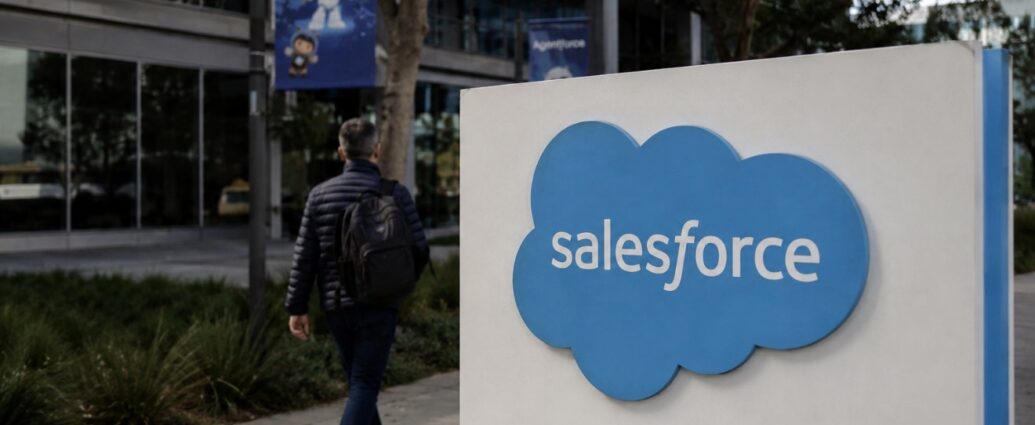
In a layoff notice filed with the state of California on Wednesday, June 10, 2026, cloud software giant Salesforce disclosed a fresh round of job cuts that reached the very teams building the artificial intelligence products it sells to the rest of corporate America. The filing, submitted under the state’s Worker Adjustment and Retraining Notification (WARN) Act, lists 86 eliminated roles across sales, general administration, and technology and product functions.
The cuts are notable for where they landed. According to the California notice and reporting by Business Insider, which first revealed the round, the 86 roles spanned Agentforce — the company’s flagship platform for deploying autonomous AI agents — along with the MuleSoft integration tool and Marketing Cloud software. People familiar with the decisions said the core Agentforce engineering team was not directly hit; the cuts struck adjacent roles. Workers in Washington state and internationally were also affected, and those laid off in California will remain on payroll until August 7.
In plain terms, the company that tells customers AI agents will transform their workforces is now running that experiment on its own staff.
This is the third major round of layoffs at Salesforce in nine months. A September 2025 cut affected 262 positions in San Francisco, an early-2026 round eliminated close to 1,000 roles, and the June notice adds another 86 jobs. An SEC filing placed Salesforce’s total headcount above 80,000 employees as of late January.
Separately, last fall the company sharply reduced its customer-support staff. Chief Executive Officer Marc Benioff said in September 2025 that Salesforce had shrunk support headcount from roughly 9,000 employees to 5,000, eliminating approximately 4,000 positions, as AI agents increasingly handled routine customer-service conversations.
That support reduction is tied directly to Agentforce’s growth. At its most recent earnings report, Salesforce said Agentforce had surpassed $1 billion in annualized revenue, representing a 205% increase from a year earlier. The platform now handles a significant share of the company’s own customer-service workload — tasks that thousands of human employees previously performed.
By using its own operations as a testing ground, Salesforce is effectively demonstrating to corporate customers how AI can replace routine work at scale. At the same time, Benioff told investors during the company’s May earnings call that engineering staffing remained steady at approximately 15,000 employees, suggesting the latest reductions are targeted rather than broad-based.
The cuts arrive against an awkward backdrop. Just weeks earlier, Benioff publicly downplayed fears of widespread white-collar layoffs, telling CNBC that he did not foresee mass job losses across corporate America. The June filing, which reached teams connected to Salesforce’s own AI initiatives, complicates that message.
The move reflects a broader trend unfolding across the technology industry. Layoff trackers covering 2026 show that a growing share of tech workforce reductions cite artificial intelligence, automation, or machine learning as contributing factors. Companies are increasingly trimming support, testing, and engineering functions while redirecting resources toward AI infrastructure, data centers, advanced chips, and software development tools.
For technology workers, the Salesforce cuts send a clear signal: even highly skilled engineering, integration, and software-related positions are no longer entirely insulated from automation pressures. Affected U.S. employees are eligible for severance packages of up to 30 weeks of pay, based on factors including age, tenure, and position.
At the same time, broader labor-market data paints a more nuanced picture.
A Gallup study released this month, based on a first-quarter survey of more than 23,000 U.S. workers, found that only 1% of unemployed workers who had recently lost jobs identified AI or automation as the primary cause of their layoff. Most instead cited restructuring, cost-cutting measures, or elimination of their position — explanations that may indirectly reflect AI adoption even when employers do not explicitly say so.
Gallup also found that workforce reductions remained relatively stable during early 2026, with more workers reporting that their employers were hiring than cutting staff.
One finding stood out inside the technology sector itself. The survey found that tech workers who used AI tools less than once a month faced roughly three times the layoff risk of peers who used AI at least monthly. The result suggests that familiarity with AI tools is rapidly becoming a competitive advantage — and, increasingly, a form of job security.
For Salesforce, the strategic direction appears clear. Benioff has repeatedly said the company is evaluating every business function for opportunities to automate work, and management has indicated it will continue directing investment toward autonomous AI systems while offering support and transition assistance to affected employees.
Rather than conducting a single massive workforce reduction, Salesforce appears to be reshaping its organization through a series of smaller, targeted cuts. The approach allows the company to gradually align its workforce with the AI-driven future it is actively selling to customers.
JBizNews Desk | San Francisco
© JBizNews.com All Rights Reserved. Reproduction or distribution without written permission is prohibited.