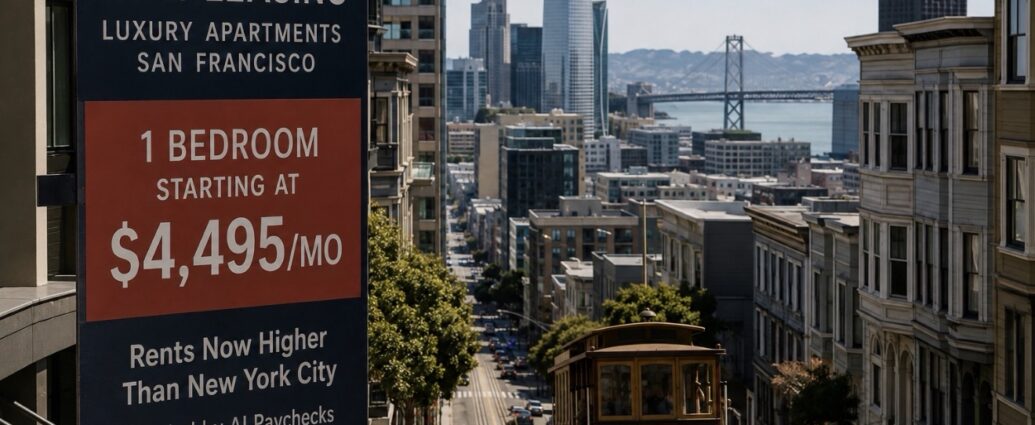
For the first time, it costs more to rent an apartment in San Francisco than in New York City — and the reason is a few thousand people working at companies that have not gone public yet.
Average asking rents in San Francisco have reached roughly $3,728 a month, up about 18% in under two years, putting the city ahead of New York as the most expensive major rental market in the country, according to a Wall Street Journal report drawing on CoStar data. Citywide vacancy has fallen to about 3.7%. On CoStar’s measure of average apartment rent actually being paid, the figure is $3,827 — also above New York.
“It’s a pressure cooker, and it’s heated up really fast,” said Nigel Hughes, a senior researcher at CoStar. In the most sought-after neighborhoods — the Marina District, Pacific Heights and South of Market — vacancy has collapsed to roughly 3%, down from about 13% in 2020. New construction has stalled.
What renters are doing to compete
The behavior on the ground tells the story faster than the averages do. In some neighborhoods, prospective tenants are offering well above the asking rent, paying several months up front, and putting together personal biographies to make themselves more appealing to landlords.
Six-figure salaries no longer settle it. Katrine Razniak, 27, leads a team of account managers at the software company Rippling and earns $180,000 a year. She and her partner, Adam Woodbury, bring in a combined $365,000 — and still could not secure a one-bedroom. “I feel a little bit like I’m not good enough to live here anymore because I don’t work at an AI company,” Woodbury said.
That is the sorting mechanism. OpenAI and Anthropic are both headquartered in San Francisco and both moving toward public offerings, creating a tier of employees and investors whose equity stakes let them bid far above what a well-paid engineer or product manager can. Together with the newly public SpaceX, those three companies alone could produce more than 20 new billionaires from current and former staff, according to an analysis by the private markets research firm Sacra.
The rest of the bill
Housing does the most damage, but it does not travel alone. San Francisco’s overall cost of living now runs 65.6% above the national average, according to the Council for Community and Economic Research. Utilities run about 41% above the national average, transportation about 43% above, and groceries about 19% above. The median home price topped $1.7 million in April, against a national median around $450,000.
The comparison that makes the cause hard to dispute: national rents are roughly flat to falling, while San Francisco rents have climbed at the steepest rate in the country. The increases concentrate where the AI offices are — SoMa and Mission Bay posted rent growth above 10% year over year in late 2025, while other parts of the city moved far less. San Jose has stayed comparatively stable; the new money is staying in the city rather than spreading to the suburbs the way it did in the last technology boom.
Why New York readers should care
This pattern is familiar here. It is what New York went through when Wall Street rebuilt itself around hedge funds in the 2000s — money concentrates in a handful of zip codes, and everything around those zip codes gets pulled up with it.
For employers, the number that matters is what it now costs to put a person in a seat. A company hiring in San Francisco is not competing on salary against other software firms; it is competing against equity packages at pre-IPO AI companies that do not need to be justified against a profit-and-loss statement. That prices out startups, nonprofits, and any business whose margins are real.
For New York, losing the most-expensive-city title is not a victory so much as a data point. It means the premium employers pay to keep talent here has, for the moment, stopped rising as fast as the premium on the West Coast — which is exactly the condition that has drawn firms and workers back to the tri-state area in past cycles.
For landlords in San Francisco, the current market offers extraordinary pricing power, and for developers the shortage represents a substantial opportunity. For everyone else in that city, the arithmetic is a good deal simpler, and it does not work.
JBizNews Desk | San Francisco
© JBizNews.com All Rights Reserved. Reproduction or distribution without written permission is prohibited.