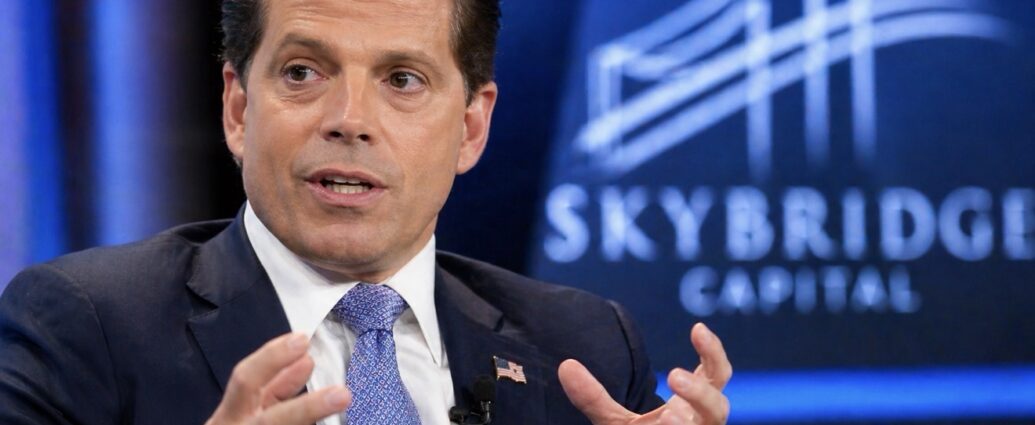
NEW YORK — April 27, 2026 — In a candid reflection that is resonating across Wall Street, Anthony Scaramucci, founder of SkyBridge Capital and former White House communications director, has distilled decades of market experience into a hard-earned conclusion: the biggest investing mistake is not what you buy — it’s selling too soon.
In a social media post that quickly circulated among investors, Scaramucci said the most expensive habit of his career has been exiting positions prematurely, leaving massive long-term gains unrealized. His advice to investors is deliberately simple: own the S&P 500 and stay invested.
“The index does the work for you,” Scaramucci explained, describing the S&P 500 as a built-in upgrade system that continuously replaces underperforming companies with stronger ones based on market value, earnings, and growth. He noted that he bought his first index investment roughly 30 years ago — and still holds it today.
The lesson is rooted in one of the most painful missed opportunities of his career. In 1999, Scaramucci attended a presentation by Jeff Bezos, where the Amazon founder laid out a long-term vision centered on logistics and scale. Scaramucci said he left convinced he should invest — but reversed course after hearing Warren Buffett question Amazon’s valuation at the time.
He walked away from the investment.
Looking back, the cost is staggering. A $10,000 investment in Amazon at that moment would be worth approximately $16.5 million today, a return exceeding 165,000%.
But the path to those gains would not have been easy. Scaramucci emphasized that holding Amazon over that period would have required enduring multiple drawdowns of 50% or more, including at least one collapse approaching 90%. The takeaway, he said, is not about stock selection — it is about staying power.
“You have to survive the volatility,” Scaramucci has said in prior interviews, reinforcing that long-term success depends less on timing the market and more on remaining invested through extreme swings.
He is now applying that same mindset to artificial intelligence, comparing today’s environment to the early days of the internet in the mid-1990s — a period marked by uncertainty, volatility, and skepticism. Rather than waiting for clarity, Scaramucci said he is investing through the noise, determined not to repeat his Amazon misstep.
Market performance is reinforcing his view. Despite geopolitical shocks — including U.S.-Iran tensions, disruptions in global shipping lanes, and sharp oil price swings — the S&P 500 recently closed at a record 7,041.28, climbing 2.9% year to date and rebounding strongly from earlier volatility. Investors who exited during moments of panic have once again been left behind.
Scaramucci’s perspective is echoed by Mike Novogratz, CEO of Galaxy Digital, who has been advising everyday investors to avoid chasing high-risk trades. According to Scaramucci, Novogratz recommends that individuals with portfolios in the $50,000 to $200,000 range focus on diversified index exposure rather than attempting to consistently outperform the market.
“Nihilism is not a strategy,” Scaramucci said, emphasizing that fear-driven decisions often lead to missed opportunity rather than protection.
He has also pointed to a growing feedback loop between markets and policy, noting that President Donald Trump’s economic positioning can influence market sentiment — and vice versa — creating scenarios where policy decisions and market rallies reinforce each other.
But beneath the headlines and market commentary, Scaramucci’s message is strikingly simple.
After navigating multiple market cycles, bear markets, and periods of extreme volatility, he argues that the greatest risk investors face is not losing money on a bad trade — it is abandoning a winning investment before it has time to compound.
In an era defined by constant noise, rapid headlines, and short-term thinking, that lesson may prove more valuable than any individual stock pick.
JBizNews Desk