By JBizNews Staff
May 4, 2026
WASHINGTON — Senate Minority Leader Chuck Schumer (D-NY) is intensifying calls for a comprehensive nationwide ban on prediction markets trading by lawmakers, congressional staff, and executive branch officials, just days after the U.S. Senate unanimously approved a sweeping self-imposed prohibition on its own members and personnel.
The Senate’s action on April 30, 2026, marked a rare moment of bipartisan unity as senators passed a resolution by voice vote that immediately bars senators, their staff, Senate officers, and other chamber officials from participating in prediction markets such as Polymarket and Kalshi. The measure amends Senate rules and took effect without delay, addressing growing concerns over insider trading and conflicts of interest in the rapidly expanding sector.
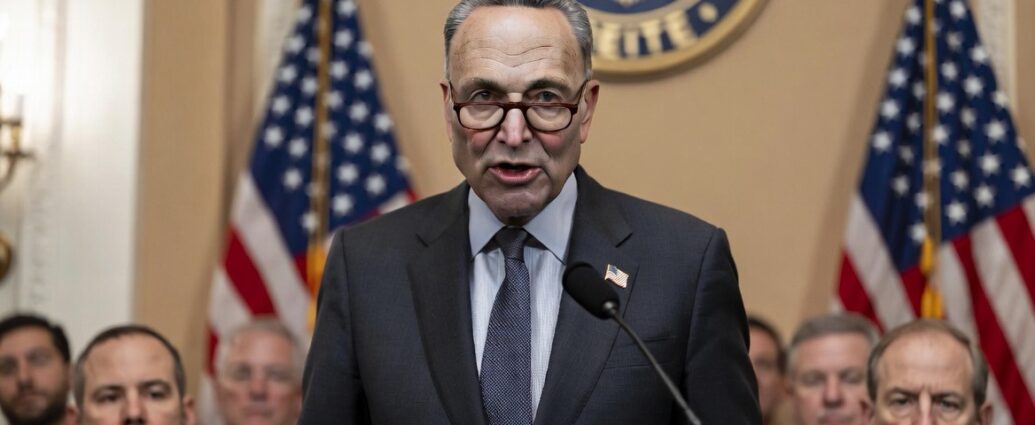
Chuck Schumer, who strongly supported the resolution, described the move as a “no-brainer” during floor remarks and urged House Speaker Mike Johnson and the Trump administration to follow suit without hesitation. “We must never allow Congress to turn into a casino where members representing the public can gamble on wars or economic crises or elections,” Schumer declared. “That would destroy the very principle of representative government. Just the possibility that members could have their votes influenced because of betting is reason enough to prohibit members from meddling in the prediction markets.”
The resolution was introduced by Sen. Bernie Moreno (R-OH) and amended by Sen. Alex Padilla (D-CA). It specifically prohibits any agreement, contract, or transaction that provides for purchase, sale, payment, or delivery based on the outcome of future events — language directly targeting event contracts on platforms like Polymarket and Kalshi.
Prediction markets have experienced explosive growth in recent years, with trading volumes reaching billions of dollars annually. These platforms allow users to bet on a wide array of outcomes, including U.S. elections, Federal Reserve interest rate decisions, legislative votes, corporate earnings reports, and even geopolitical events such as international conflicts. Proponents argue that prediction markets serve as efficient tools for aggregating information and forecasting real-world probabilities. However, critics — including many in Congress — warn that government insiders with access to non-public or classified information could exploit these markets for personal gain, eroding public trust and potentially distorting market integrity.
Recent high-profile incidents have fueled the urgency. Reports emerged of users profiting hundreds of thousands of dollars by accurately predicting U.S. military actions, prompting suspicions of insider trading. One notable case involved a U.S. soldier allegedly using classified intelligence related to operations in Venezuela to win nearly $410,000 on Polymarket. Such episodes have drawn scrutiny from regulators and lawmakers alike, highlighting the thin line between legitimate forecasting and unethical advantage-taking.
Chuck Schumer’s push extends beyond the Senate. In a statement issued Sunday, May 3, he explicitly called on the House of Representatives and the Trump administration to enact identical restrictions for House members, staff, and executive branch officials. “Speaker Johnson should immediately do the same thing in the House and prohibit House members from playing around in prediction markets as well,” Schumer said. He further emphasized that the administration — particularly one he described as showing an “affinity to corruption and self-dealing” — must apply the same standards to prevent any perception of impropriety.
The Senate ban aligns with broader bipartisan efforts already underway. Senators including Todd Young (R-IN) and Elissa Slotkin (D-MI) have introduced legislation aimed at restricting the use of insider information by all federally elected officials and government employees in prediction markets. These proposals go further than the current Senate rule, seeking to impose federal-level prohibitions and enhance oversight by the Commodity Futures Trading Commission (CFTC).
Industry players have responded positively to the Senate’s decision. Both Polymarket and Kalshi publicly praised the resolution, with Kalshi CEO Tarek Mansour stating support for the ban and noting that his platform had already taken proactive steps to restrict certain congressional accounts. Polymarket similarly expressed willingness to assist in enforcement efforts, signaling a cooperative stance as the sector faces increasing regulatory pressure.
This development echoes ongoing debates over congressional stock trading. While the STOCK Act of 2012 imposed disclosure requirements and insider trading prohibitions on lawmakers’ securities transactions, prediction markets present unique challenges due to their event-driven nature and potential for rapid, high-stakes bets on policy outcomes. Unlike traditional stocks, prediction market contracts can directly tie to legislative or executive actions that lawmakers help shape.
Critics of broader bans argue that overly restrictive rules could stifle innovation in financial derivatives and reduce the informational value these markets provide to the public. Supporters, however, maintain that protecting the integrity of representative government outweighs such concerns. With prediction markets now a multi-billion-dollar industry influencing everything from election betting to economic forecasting, the Senate’s move could set a precedent for wider regulatory reforms.
Analysts predict that if the House and executive branch adopt similar prohibitions, it could significantly impact market liquidity on politically sensitive contracts while prompting platforms to strengthen self-regulation and compliance measures. The CFTC continues to monitor the space closely, with ongoing discussions about whether certain event contracts involving elections, wars, or death should face outright bans.
As momentum builds for expanded restrictions, the fast-growing event-contracts sector faces a pivotal moment. JBizNews will continue monitoring this story for its implications on market liquidity, regulatory oversight in financial derivatives, platform operations, and the evolving relationship between Washington insiders and emerging betting technologies.
— JBizNews Desk