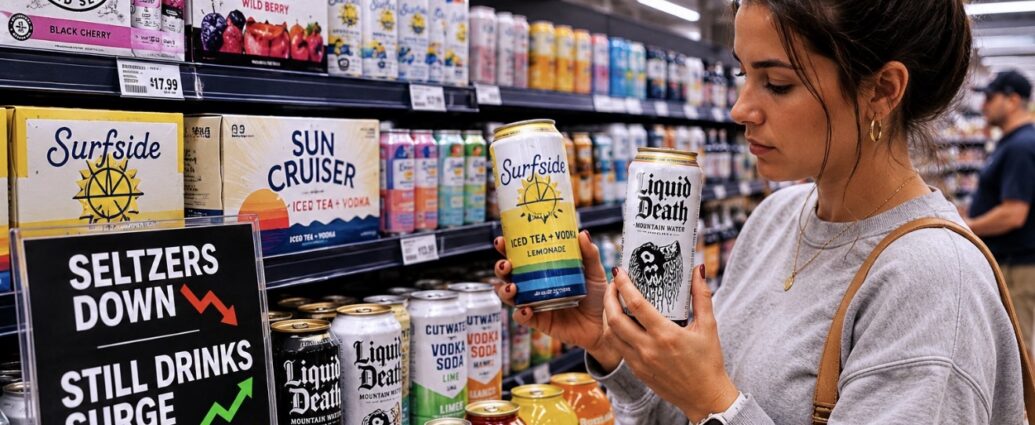
The decade-long hard seltzer boom that reshaped the American beverage aisle is losing momentum, and beverage executives, distributors and consumer-data firms increasingly believe the industry’s next major growth wave will come from still, non-carbonated drinks — from ready-to-drink teas and flat cocktails to functional waters and healthier energy beverages.
New data from Circana for the 52 weeks ended April 26 show malt-based hard seltzers — the category dominated by White Claw and Boston Beer Co.’s Truly — declining 1.1% in volume year over year, even as ready-to-drink premixed cocktails surged 46.4%, fueled by rapid growth from brands including Surfside, Sun Cruiser, BuzzBallz and Cutwater Spirits.
The shift is increasingly being driven by Generation Z consumers, whose beverage preferences are diverging sharply from the millennial-driven drinking trends that powered the seltzer explosion between 2018 and 2021.
“We’re seeing a lot of promiscuity within consumption and alcohol around new products,” Scott Scanlon, executive vice president of alcoholic beverages at Circana, said in remarks reported Sunday. “White Claw and Truly were the breakout brands eight years ago. Now you’re seeing Surfside and Sun Cruiser capturing that rotation.”
Industry consultants say the trend extends well beyond alcohol.
Randy Burt, Americas director of consumer products at AlixPartners, said consumer demand has decisively shifted toward still beverages across both alcoholic and non-alcoholic categories as younger consumers increasingly prioritize variety, tea-based drinks, lower carbonation and “better-for-you” positioning.
“Gen Z is a lot more likely to order tea-based beverages at happy hour,” Burt said. “They’re moving away from carbonated seltzers as the default healthier option.”
The growth differential is already beginning to reshape corporate strategy across the nearly $400 billion U.S. beverage industry.
According to BrewBound industry data, Stateside Brands’ Surfside and Boston Beer’s Sun Cruiser both posted triple-digit growth during the latest reporting period. Anheuser-Busch InBev’s Cutwater Spirits, which sells both sparkling and still cocktails, recorded strong double-digit gains, while BuzzBallz — acquired by Sazerac in 2024 — continues rapidly expanding into grocery and convenience-store distribution.
The non-alcoholic market is moving in the same direction.
Liquid Death, the fast-growing canned-water and iced-tea company valued above $1.4 billion in its latest funding round, has aggressively expanded its still-drink portfolio while preparing to enter the better-for-you energy category in 2026. The company said its ready-to-drink tea business is now growing roughly 20 times faster than the broader tea category itself.
Even within Liquid Death’s own lineup, still beverages are increasingly outpacing sparkling offerings.
The shift reflects a broader generational change in how younger consumers approach beverages altogether.
Gen Z consumers grew up during a period when soda consumption steadily declined from its late-1990s peak, reusable water bottles became lifestyle accessories and beverage shelves fragmented into hundreds of specialized categories built around wellness, functionality, caffeine, hydration and flavor experimentation.
Rather than locking into a single category the way prior generations often did, younger consumers increasingly rotate between teas, flavored waters, mocktails, energy drinks, cocktails and functional beverages depending on the occasion.
That fragmentation is forcing beverage companies to rethink product development, marketing and shelf allocation.
PepsiCo, which acquired prebiotic soda maker Poppi for nearly $2 billion last year, has been rapidly expanding its presence across healthier soda alternatives, hydration drinks and still functional beverages. The Coca-Cola Co. continues pouring investment into brands including Fairlife, BodyArmor and its broader still-water portfolio as growth in traditional carbonated soft drinks moderates.
Industry reports from Mintel, Circana and Tastewise have consistently shown younger consumers favoring beverages positioned around wellness, lower sugar, functionality and ingredient transparency. Tastewise data cited by industry analysts pointed to roughly 42% year-over-year growth in consumer interest surrounding “healthy soda” products.
The result is an increasingly crowded battle for what beverage executives call “share of throat” — the portion of consumer consumption captured by any given category.
Hard seltzer is not disappearing. But its role inside the industry appears to be changing from explosive-growth engine to mature category.
That transition carries major implications for retailers, distributors and investors.
Boston Beer Co., which rode Truly’s meteoric growth to record valuations before suffering through the seltzer slowdown, has increasingly leaned into Twisted Tea and Sun Cruiser, both positioned more directly around tea-based consumption trends. Molson Coors, after scaling back efforts tied to Vizzy and Topo Chico Hard Seltzer, is reallocating attention toward non-alcoholic and still-adult beverage categories.
Meanwhile, major spirits companies including Diageo, Brown-Forman and Constellation Brands are expanding ready-to-drink lineups centered around spirit-forward still formats rather than sparkling seltzer imitators.
For beverage executives, the message emerging from the latest sales data is increasingly difficult to ignore: the next era of category growth may belong less to bubbles and more to hydration, tea, wellness and flavor experimentation.
The bubble era is not over.
But the leadership of the bubble era increasingly appears to be changing.
JBizNews Desk
© 2026 JBizNews. All Rights Reserved. Reproduction or distribution without written permission is prohibited.