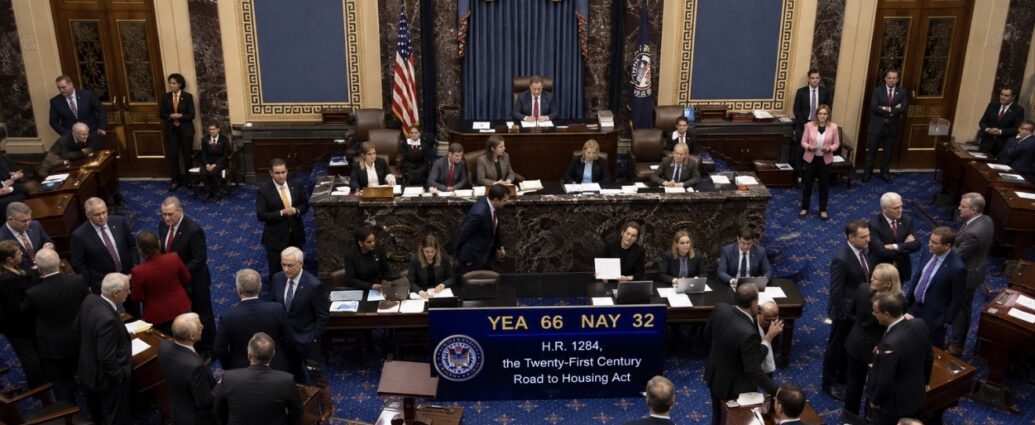
In a rare bipartisan move on affordability, the U.S. Senate on Monday, June 22, passed sweeping housing legislation that would, for the first time, place a federal limit on how many single-family homes large investors can buy. The 21st Century ROAD to Housing Act, shepherded by Senate Banking Committee Chairman Tim Scott, a South Carolina Republican, and ranking member Elizabeth Warren, a Massachusetts Democrat, would cap big institutional investors at 350 single-family homes. The House is expected to vote on the measure later this week, and President Donald Trump has signaled his support, putting the bill within reach of becoming law.
The centerpiece is the cap itself. The provision would bar large institutional investors — the private-equity-backed firms that have bought up tens of thousands of houses to rent out — from acquiring single-family homes beyond the 350-home limit, with penalties for violators. Money collected from those fines would be redirected toward new housing construction and assistance for first-time buyers, including help with down payments and closing costs. Lawmakers dropped a more contentious earlier provision that would have forced investors to sell certain newly built units within seven years, settling instead on the ownership cap. Exceptions remain for build-to-rent homes constructed specifically as rentals and for houses that need major renovation to meet code.
The investor cap is one piece of a much larger package — what supporters call the biggest federal housing bill in roughly 30 years, with more than 45 provisions aimed at boosting supply and lowering costs. Among them are streamlined reviews for affordable-housing development, changes to manufactured-housing rules that could cut as much as $10,000 off the price of a new factory-built home, preservation of rural housing for some 400,000 families, and incentives for communities that build more. The bill also carries a separate measure temporarily barring the Federal Reserve from issuing a central bank digital currency.
The timing is no accident. Both parties are racing to show progress on affordability and the cost of living ahead of the 2026 midterm elections, with housing consistently ranking among voters’ top concerns. Warren framed the bill as a matter of principle, arguing that private equity should not be allowed to dominate the housing market, while Scott emphasized reducing red tape and increasing supply. Trump has also backed efforts to curb large-scale Wall Street ownership of homes.
For the housing and investment industries, the stakes are significant. The cap would directly affect large single-family rental operators and the private-equity firms behind them, companies that expanded aggressively after the 2008 financial crisis. Yet research on their impact remains mixed. The Urban Institute has found that large investors operating in multiple markets own roughly 3% of single-family rentals nationwide, while Freddie Mac has concluded that institutional investors play a relatively small role in housing-price increases compared with broader factors such as limited construction, zoning restrictions and migration patterns.
That debate has fueled industry pushback. The National Association of Home Builders, the Mortgage Bankers Association and dozens of other groups have warned that investor restrictions could discourage build-to-rent development and reduce housing supply. The National Association of Realtors, however, has supported the legislation, saying it shares the goal of expanding access to homeownership. The carveout preserving build-to-rent projects was included largely in response to those concerns.
Beyond housing, the legislation marks a notable moment in federal policy. Supporters argue it represents one of the first direct congressional efforts to limit private-equity ownership within a major sector of the economy. Critics contend it addresses only a small portion of the housing shortage while leaving larger supply challenges unresolved.
The bill now moves to the House of Representatives, where lawmakers will consider the Senate version and its amendments. If approved and signed by President Trump, the investor cap would take effect approximately six months after enactment. For millions of Americans struggling with high home prices and rents, lawmakers from both parties are betting the measure will demonstrate that Washington is finally taking action on housing affordability.
JBizNews Desk
© JBizNews.com All Rights Reserved. Reproduction or distribution without written permission is prohibited.