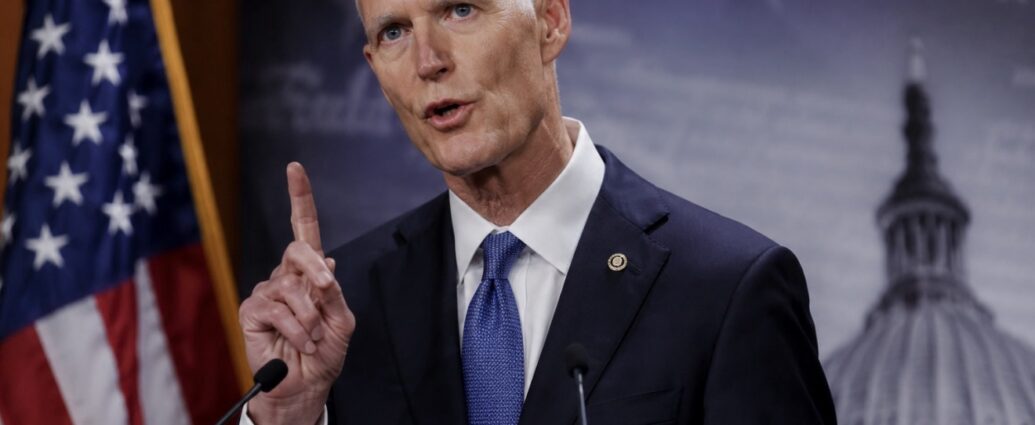
WASHINGTON — U.S. Senator Rick Scott, the Florida Republican, reintroduced legislation earlier this week that would bar American payment companies, currency dealers and even the U.S. Postal Service from handling transactions involving China’s government-issued digital currency, escalating a broader Republican push to block the digital yuan from entering the American financial system.
The legislation, formally titled the Chinese CBDC Prohibition Act of 2026, was introduced on Thursday, May 21, 2026.
CBDC stands for central bank digital currency, essentially a digital form of money issued directly by a country’s central bank rather than by commercial banks or private cryptocurrency networks.
In a Senate release announcing the bill, Scott framed the issue as both an economic and national-security threat.
“The dollar is the reserve currency of the world and the CCP wants to undermine our leadership with a digital currency they can track and manipulate,” Scott said, referring to the Chinese Communist Party.
He added: “The digital Yuan is just another tool used by the Chinese Communist Party to spy on its people and all those who use it. Xi and his thugs have no business playing big brother to American citizens and how they spend their money.”
The bill would make it illegal for American money-services businesses to process, transfer or accept transactions involving a Chinese government-issued digital currency, including the digital yuan, also known as e-CNY.
The practical reach would be broad.
Companies and institutions potentially affected include PayPal, Venmo, Zelle, Western Union, MoneyGram, airport currency exchanges, and even the U.S. Postal Service when handling money orders or certain international payment services. Under the proposal, those entities would be prohibited from facilitating transactions tied to China’s state-backed digital currency infrastructure.
The legislation reflects mounting concern in Washington over China’s rapid progress in digital finance.
Over the past five years, the People’s Bank of China has built what is widely viewed as the world’s most advanced large-scale central bank digital currency system. The digital yuan has already been tested extensively in major Chinese cities including Beijing, Shanghai, Shenzhen and Hangzhou, with Chinese consumers using it for retail payments, transportation, tourism and salary distributions.
Beijing has also openly discussed using the digital yuan for cross-border trade settlement and international commerce, a move American lawmakers increasingly see as a challenge to the dominance of the U.S. dollar.
That dominance remains one of America’s biggest economic advantages. The dollar functions as the world’s primary reserve currency, meaning central banks, commodity markets and international businesses rely heavily on dollars for trade and savings. Oil is largely priced in dollars, global debt markets revolve around dollar financing, and the U.S. government benefits from lower borrowing costs because of persistent global demand for dollar-based assets.
Republican lawmakers argue a widely adopted Chinese digital currency could eventually weaken that position, particularly if countries hostile to Washington begin settling trade outside the dollar system.
The second concern — and the one Scott emphasized most heavily — is surveillance.
Unlike physical cash, transactions conducted through a central bank digital currency can potentially be monitored directly by the issuing government. In China’s case, critics argue that gives the Chinese Communist Party extraordinary visibility into how money moves through the economy.
Scott’s Senate release argued Beijing already uses the digital yuan “as a mechanism to control the lives of its population” and warned authorities could theoretically freeze accounts or restrict access to funds instantly.
The implication for American lawmakers is that U.S. businesses or individuals using the digital yuan for trade with Chinese suppliers could expose financial activity to Chinese state monitoring.
This is not the first congressional effort targeting Chinese digital currencies.
In 2022, Senators Tom Cotton, Mike Braun and Marco Rubio introduced legislation called the Defending Americans from Authoritarian Digital Currencies Act, which sought to block app stores such as Apple’s App Store and Google Play from hosting applications supporting the digital yuan.
That proposal never became law.
Scott himself has introduced earlier versions of similar legislation in prior Congresses. Previous attempts gained Republican backing but stalled before reaching a full Senate vote.
This time, however, the political environment is different.
Republicans now control both chambers of Congress while the Trump administration continues to frame competition with China as a central economic and national-security priority. That combination may give the proposal a stronger chance than previous versions.
The timing is notable.
Just days before the legislation was introduced, President Donald Trump and Chinese President Xi Jinping held high-level discussions aimed at stabilizing U.S.-China tensions surrounding trade and technology. Trump has also publicly encouraged expanded American business engagement with China in select sectors even as Congress simultaneously moves to harden barriers around Chinese financial and technological influence.
For American businesses, the immediate practical impact of the bill would likely be limited because very few U.S. companies currently conduct routine transactions using the digital yuan. Most trade between the United States and China still settles in either U.S. dollars or traditional Chinese yuan through conventional banking systems.
But the legislation is designed less to disrupt existing behavior than to prevent future adoption before the digital yuan gains broader international traction.
The bill also reflects a growing divide in Washington between privately issued cryptocurrencies and government-backed digital currencies.
Many Republicans who support decentralized assets like Bitcoin have simultaneously opposed central bank digital currencies, arguing they could expand government financial surveillance. Scott and several other Republican lawmakers have separately criticized the idea of a potential Federal Reserve digital dollar for similar reasons.
More broadly, the legislation fits into a wider congressional effort to reduce Chinese influence across strategic sectors of the American economy, including technology, pharmaceuticals, real estate, rare earth minerals and electric-vehicle supply chains.
Taken together, the measures point toward a Washington increasingly willing to wall off sensitive parts of the U.S. economy from Chinese financial and technological penetration.
The Chinese CBDC Prohibition Act of 2026 has now been referred to committee for review. If approved by the Senate, it would still need to pass the House before reaching President Trump’s desk.
For now, the digital yuan remains legal in the United States.
Very few Americans use it.
Scott’s bill is designed to ensure that stays true.
Washington — JBizNews Desk
© JBizNews.com All Rights Reserved. Reproduction or distribution without written permission is prohibited.