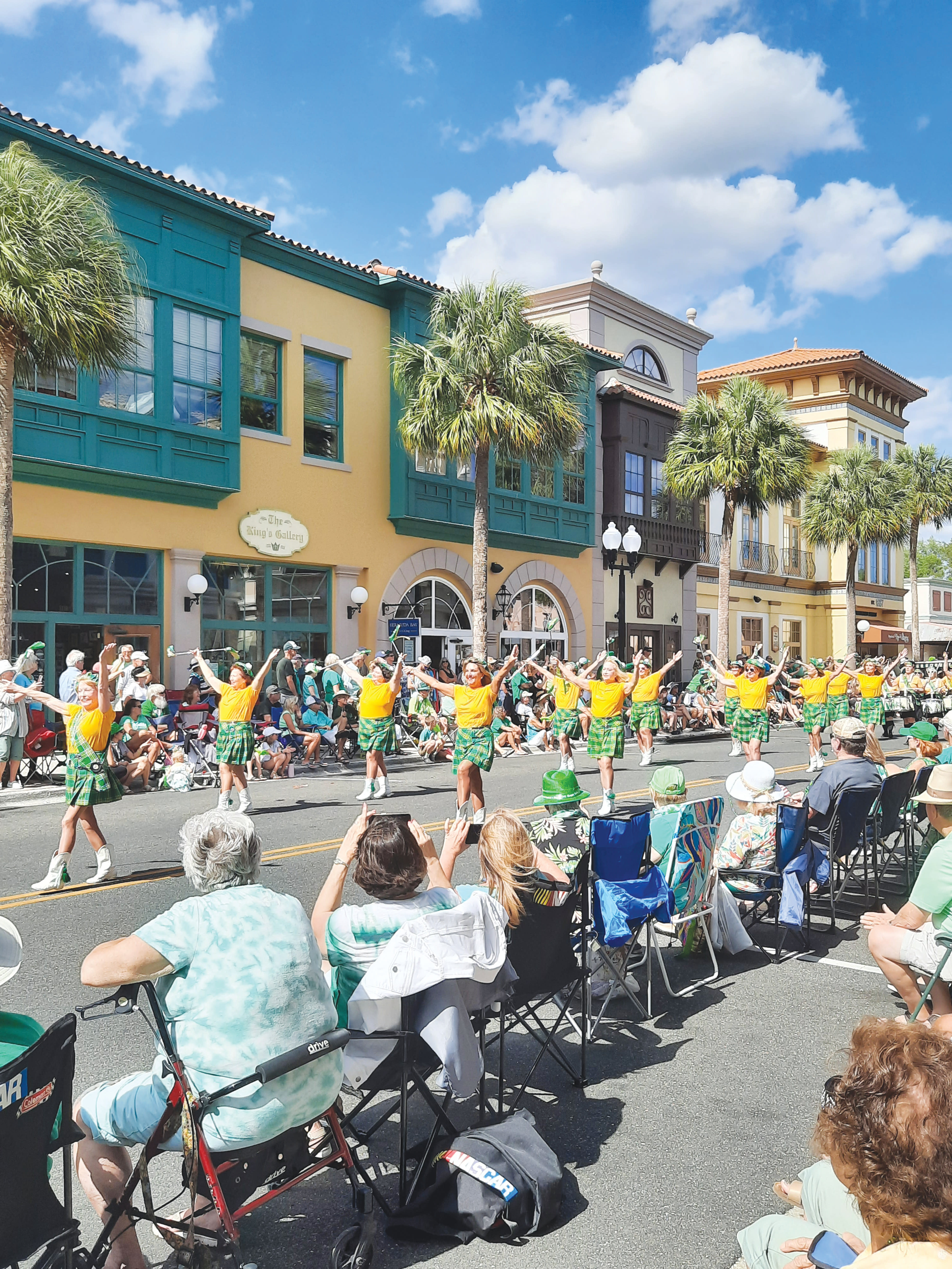
Residing in The Villages, the largest retirement city in the world, is like living in California’s Disneyland or Florida’s Disney World – with its manicured lawns, swimming pools, sports facilities, and smiling people.
But unlike the two exquisitely planned, famous amusement parks (Disneyland covers only 2,000 dunams, Disney World 100,000 dunams) The Villages has 150,000 older adults spread among 148,000 dunams in central Florida.
Prof. Galit Nimrod, an expert in communications at Ben-Gurion University of the Negev’s Faculty of Humanities and Social Sciences, and a research fellow at Beersheba University’s Center for Multidisciplinary Research on Aging, left her family for two months in 2023 to immerse herself in the Villages’ experience.
She wanted to see if “golden agers” in America didn’t mind being surrounded by people their age, what they enjoyed doing, what complaints they had about endless amenities, and whether the city could be a viable alternative for housing the large numbers of older residents in aging societies around the world. Her research led to a better understanding of well-being in later life.
‘I would live there if I were an American Jew’
Nimrod had no trouble persuading England’s Cambridge University Press to publish the ethnographic portrait on the seemingly surprising and distant location. Although she took many color photos of what she saw, the publisher was unfortunately unable to include them and the black-and-white photographs are somewhat disappointing because they don’t show off the splendid scenery.
“The past two decades show that retirement communities have grown exponentially. Surprisingly, even though this is such a significant phenomenon, there has not been much academic research relating to the sociological aspect of this growth. If we’re going to see more communities of this kind, I think it’s important to understand the benefits of residing in such places and the disadvantages,” she told The Jerusalem Post in an interview marking the publication of her book.
Describing the facilities and pleasures of the place, the third chapter almost seems like a public-relations blurb. But then comes Chapter 4, titled “Big Size Fits All?” which brings together all the complaints from a variety of residents she interviewed. These included crowding and queues at some sites, the lack of sidewalks, the need to always take a checkbook for extra fees, too-rapid growth, decline of some infrastructure, and more.
Asked if she would move to The Villages if she weren’t a devoted Israeli, the 57-year-old professor answered with a definitive “Yes! I would live there if I were an American Jew.”
This was her conclusion despite shortcomings she discovered in her interviews of 40 people constituting as close a representative sample of the residents as possible, who are more likely to get around on electric golf carts than in cars.
“I had so much fun. I became fitter so quickly and returned home in excellent physical shape. I would live there if I were an American Jew,” she said.
“It’s a kind of ghetto consisting totally of separate homes – not apartments – costing from $300,000 (including three bedrooms and two baths) to $2 million – without families nearby.
“Those who need geriatric nursing care usually have to leave the city, because the costs at institutions in the city are so high. In Israel, 95% of older people live at home,” Nimrod told the Post.
“And our healthcare system is much better and more accessible,” she added.
Blending sociological insight with real-life stories of residents
NIMROD’S FASCINATING book offers engaging narratives as she blends sociological insight with real-life stories of residents – their clubs, hobbies, volunteerism, leisure activities, mindsets, and fears of being incapacitated and eventually of death.
The city has a full set of its own local media, notably newspapers, two radio stations, a local cable TV network, and an official community website (TheVillages.com) to keep residents informed of thousands of activities from lectures to films to sports competitions – per month.
Pickleball is the fastest-growing sport there at The Villages, Nimrod noted. There are nevertheless, over 110 public swimming pools and nearly 60 golf courses in the city. Pickleball was invented in 1965 by three friends one summer as a fun activity for their families and suitable for the less-fit, it blends elements of badminton, tennis, and table tennis and is played with paddles.
Surprisingly, although there are some 750,000 people who identify themselves as Jewish in the state of Florida (especially in the south near Miami) – making its Jewish population lagging only behind New York and California – there are only about 5,000 Jews in The Villages, and they have only two synagogues: one Reform and the other ultra-Othodox-hassidic.
While Passover and other Jewish observances are marked, Jews tended to stay clear of politics. Israel and its was not a major subject of conversation, and Nimrod met only one Israeli resident during her entire stay. As she her stay was in March and April, 2023, and therefore pre-Oct. 7, Hamas and Gaza were not discussed.
Almost a third of The Villages’ residents identify as being Democrats, 60% as Republicans, and the rest have no party or small-party affiliations.
Ultimately, the book Seniorland is more than a study of a retirement community; it is a window into the social and cultural dynamics of later life.
Nimrod captures the joys and complexities of life in The Villages, offering insights that resonate far beyond Florida. For sociologists, gerontologists, urban planners, and anyone curious about how community shapes the experience of aging, this book is an essential, thought-provoking read.■
SENIORLAND: AGING IN A RETIREMENT METROPOLIS
By Galit Nimrod
Cambridge University Press
216 pages; $30