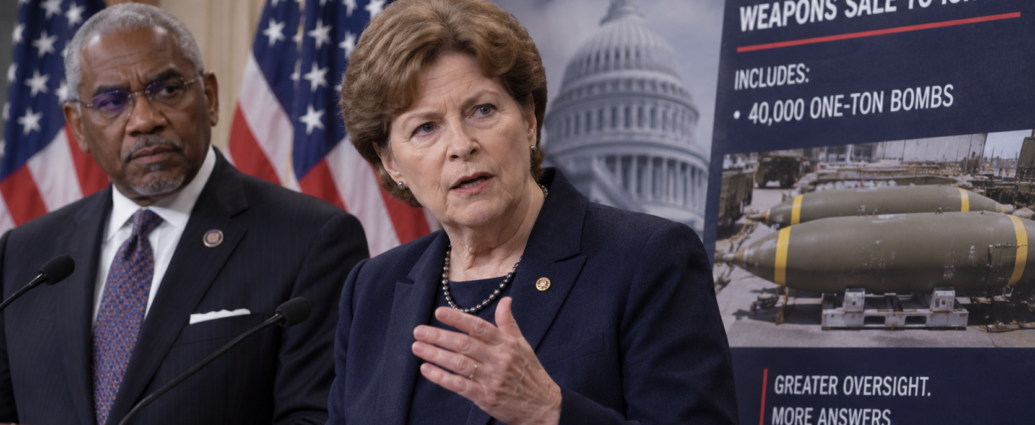
A proposed $2.8 billion U.S. sale of heavy bombs to Israel is facing resistance from the top Democrats on the congressional committees overseeing foreign affairs, raising new questions about how the weapons would be used and whether the Trump administration could ultimately move around congressional objections.
Sen. Jeanne Shaheen of New Hampshire, the ranking Democrat on the Senate Foreign Relations Committee, has withheld her consent for the transaction since July, according to a person familiar with the matter cited by Semafor. Rep. Gregory Meeks of New York, the ranking Democrat on the House Foreign Affairs Committee, publicly announced his own hold this week.
Together, the objections create resistance in both chambers during an informal congressional review process that normally takes place before the State Department formally notifies Congress of a major weapons sale.
But the holds do not amount to an absolute veto.
The State Department traditionally seeks clearance from senior lawmakers during what is known as a tiered review process. An administration can nevertheless decide to proceed despite lawmakers’ objections, and Congress would face a much higher hurdle if it attempted to formally stop a sale through legislation.
40,000 Heavy Bombs
The size of the proposed package is substantial.
The $2.8 billion transaction includes 20,000 MK-84 bombs and 20,000 BLU-117 bombs, both weighing roughly 2,000 pounds, according to Reuters. The package also includes 20,000 I-2000 penetrator warheads.
The powerful munitions have become controversial because of the potential for extensive destruction and civilian casualties when used in densely populated areas.
Meeks said his objection centers on exactly that issue.
The Trump administration has not provided sufficient assurances that the weapons would be used in accordance with U.S. law and with appropriate protections for civilians, Meeks said in announcing his decision not to clear the transaction.
He also stressed that his action should not be interpreted as opposition to Israel’s ability to defend itself.
“I remain firmly committed to Israel’s security,” Meeks said, while describing the proposed shipment as raising unresolved questions about potential use in densely populated areas of Gaza and Lebanon.
Shaheen has raised related questions.
According to Semafor, she has sought information from the administration about how Israeli Prime Minister Benjamin Netanyahu’s government intends to use the weapons, with concerns involving Gaza, Syria, Lebanon and the conflict with Iran.
Why These Bombs Matter
The debate is partly about the sheer destructive power of the weapons.
A 2,000-pound general-purpose bomb carries substantially more explosive force than smaller munitions and can cause extensive damage depending on how and where it is deployed.
Israel has previously received tens of thousands of MK-84 or BLU-117 bomb bodies from the United States.
In February 2025, the Defense Security Cooperation Agency announced approval of a separate possible $2.04 billion sale that included as many as 35,529 MK-84 or BLU-117 bomb bodies and 4,000 I-2000 penetrator warheads.
The Biden administration had earlier paused a shipment of 2,000-pound bombs amid concerns about their potential use in heavily populated areas of Gaza. The Trump administration subsequently reversed that restriction.
The current proposal is considerably larger.
American Taxpayers and Defense Companies
The financing is also significant for U.S. taxpayers and American defense manufacturers.
The proposed transaction would use U.S. Foreign Military Financing, according to reporting on the package. Much of America’s military assistance to Israel through that program is provided as grants rather than conventional loans that Israel must repay.
That creates an unusual financial loop.
The U.S. government provides military financing to Israel, which then uses those funds to purchase eligible American-made defense equipment. Money therefore moves from the federal government through foreign military assistance and ultimately into the U.S. defense industrial base.
For American manufacturers and suppliers, large weapons packages can translate into production orders and work throughout defense supply chains.
For taxpayers, they represent federal spending — one reason congressional oversight of the weapons and their eventual use has become a major part of the dispute.
What Happens Next
Neither Shaheen nor Meeks has permanently stopped the transaction.
Their objections matter because administrations have traditionally respected the informal review process before formally notifying Congress about major arms sales.
But that tradition has limits.
The Trump administration has previously used emergency authority to bypass normal congressional review procedures for arms transfers involving Israel. That means the administration has options if it decides the current sale should move forward despite Democratic objections.
Congress could separately attempt to block an arms transfer through a joint resolution of disapproval, although such an effort would face substantial procedural and political hurdles.
That leaves the $2.8 billion package in an uncertain position.
Shaheen and Meeks are seeking stronger assurances about how the bombs would be used. The administration wants to continue military support for Israel. And Israel continues to face regional security threats alongside international scrutiny over civilian casualties associated with its military operations.
The immediate question is therefore not simply whether Israel will eventually receive the bombs.
It is whether the Trump administration can satisfy congressional concerns sufficiently to move the sale through the traditional process — or decides to move ahead despite those objections.
JBizNews Desk | Washington, D.C.
© JBizNews.com All Rights Reserved. Reproduction or distribution without written permission is prohibited.