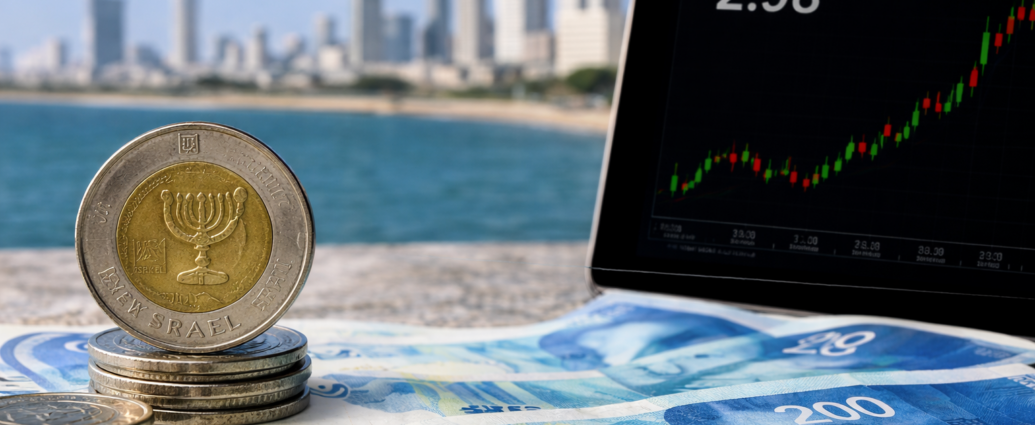
The Israeli shekel is again pressing against historic highs, trading just below the NIS 3-per-dollar threshold after briefly breaking through the level for the first time since the mid-1990s, a move that is reshaping both household purchasing power and investment returns. Bank of Israel data and interbank market pricing on Sunday showed the currency hovering near NIS 2.98 per dollar, capping an appreciation of more than 20% over the past 18 months, even as the U.S. dollar has weakened broadly across global markets.
For Israeli consumers, the stronger currency is translating into tangible gains in purchasing power. Imported goods—from electronics and vehicles to raw materials and energy inputs—are becoming cheaper in shekel terms, easing inflationary pressures and lowering costs for businesses reliant on global supply chains. Travel abroad has also become more affordable, with Israelis effectively getting more value per dollar or euro spent overseas.
“A stronger shekel increases real purchasing power for households and reduces the cost of imports across the economy,” said Ofer Klein, chief economist at Harel Insurance and Finance. “It has a moderating effect on inflation, particularly in categories tied to global pricing such as fuel, consumer goods, and durable imports.”
Yet that same strength is creating a very different reality for investors. While the S&P 500 delivered gains approaching 30% over the past year, Israeli savers invested in unhedged, dollar-denominated vehicles—such as passive ETFs, pension tracks, and retirement funds linked to U.S. indices—have seen those returns significantly reduced once converted back into shekels. Institutional performance data through early 2026 show returns in the low single digits for fully dollar-exposed strategies, compared with roughly 25%–30% in domestically managed equity tracks.
“For many years, I have said this is a problematic path for Israeli savers,” said Tamir Hershkovitz, senior vice president and head of investments at Ayalon Insurance and Finance. “Investing in the S&P 500 is excellent—but linking it fully to the dollar, without managing currency exposure, creates a mismatch. The saver earns and spends in shekels, so currency movements can erase a large portion of the gains.”
He added, “A balanced portfolio with limited foreign-exchange exposure is increasingly necessary in this environment.”
The divergence highlights how currency dynamics have become a dominant factor in portfolio performance. Israeli institutional investors—including pension funds and insurance companies—have been actively rebalancing portfolios by selling dollars after strong gains in overseas markets and reallocating into shekel-denominated assets. These transactions, including spot conversions and hedging strategies, are adding further upward pressure on the currency.
“In the last 12 months, U.S. equities rose by around 30%, but the dollar weakened by roughly 20%, cutting the effective return for Israeli investors dramatically,” said Idit Moskovich, manager of the trading room at First International Bank of Israel. “Investors fully exposed to foreign currency—especially through passive U.S. index products—must factor this in. Currency hedging is becoming essential, not optional.”
Beyond financial flows, structural drivers are reinforcing the shekel’s strength. Israel’s export engine—particularly in technology, defense, and natural gas—continues to generate substantial foreign currency inflows. These revenues are routinely converted into shekels for domestic use, creating sustained demand for the local currency.
“We are seeing a combination of strong export inflows and institutional activity all supporting the shekel,” said Klein. “When you add global dollar weakness and improving geopolitical expectations, you get a powerful alignment of forces.”
Geopolitical sentiment is also influencing the currency’s trajectory. Markets are increasingly pricing in a more stable regional outlook, which has supported continued capital inflows into Israeli assets. Even amid intermittent tensions, analysts note that global investors have maintained exposure to Israel, signaling confidence in the country’s economic resilience.
“Even in periods of uncertainty, capital continues to flow into Israel,” said Hershkovitz. “That reflects long-term confidence in the economy and helps explain why the shekel remains strong despite external challenges.”
At the corporate level, multinational activity is further contributing to demand. Global firms operating in Israel convert foreign earnings into shekels for payroll and local investment, while exporters continue to repatriate revenues. At the same time, importers benefit from lower costs, which can feed through into consumer pricing and corporate margins.
Still, the rapid pace of appreciation is raising concerns, particularly among exporters. A stronger shekel makes Israeli goods more expensive abroad, reducing competitiveness and squeezing profit margins.
“The speed of appreciation is critical,” said Klein. “If a company operates with a 10%–15% margin and the currency strengthens by more than 20%, that margin can effectively be wiped out. That creates real pressure on exporters and could eventually impact growth.”
Despite these concerns, economists do not expect immediate direct intervention from the Bank of Israel. The central bank, led by Governor Amir Yaron, holds more than $200 billion in foreign exchange reserves but has shifted away from frequent currency market intervention.
“The Bank of Israel is more likely to act through interest rate policy rather than direct foreign exchange intervention,” said Klein. “Currency intervention is typically reserved for extreme market conditions, which we are not seeing right now.”
Looking ahead, the outlook for the shekel remains tied to both domestic fundamentals and global developments. Continued export strength, stable geopolitical conditions, and a weaker dollar could sustain the current trend. However, shifts in U.S. monetary policy, global market corrections, or renewed regional tensions could quickly reverse the currency’s trajectory.
“Currency markets can change direction very quickly,” Klein added. “If global markets turn or geopolitical risks increase, the shekel could weaken just as fast as it strengthened. The current levels are not guaranteed.”
For Israeli households, the story is one of mixed outcomes: stronger purchasing power at home and abroad, but diminished returns on global investments. For investors and policymakers alike, the shekel’s rise underscores a broader shift—currency exposure is no longer a secondary consideration but a central factor in economic and financial decision-making.
As the shekel hovers near historic highs, the question is no longer just how strong it can get—but how long the forces behind its rise can remain in place before the cycle turns.
—JBizNews Desk- Tel Aviv