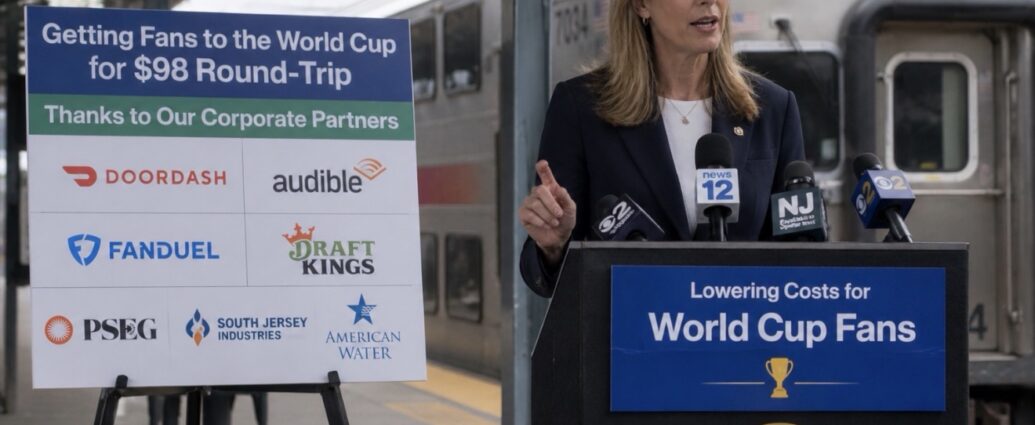
New Jersey Governor Mikie Sherrill has forced down World Cup train fares from an originally proposed $150 round-trip ticket to $98 through a high-profile public standoff with FIFA and a newly assembled group of corporate sponsors.
The fight is becoming one of the clearest examples yet of how American cities and states may handle the growing financial burden of hosting global mega-events.
At the center of the battle was a simple question:
Who should pay to move hundreds of thousands of fans during the 2026 FIFA World Cup?
NJ Transit originally announced plans to charge $150 round-trip fares between New York Penn Station and MetLife Stadium during tournament matches.
The normal cost for the same route is roughly $13.
Transit officials argued the steep pricing reflected enormous operational costs tied to hosting the tournament, including:
- Additional train service
- Security operations
- Staffing
- Equipment upgrades
- Crowd-control logistics
NJ Transit estimated total World Cup transportation costs near $48 million.
Governor Sherrill publicly pushed back almost immediately.
She argued New Jersey taxpayers and commuters should not absorb the burden while FIFA itself is expected to generate approximately $11 billion from the tournament globally.
The disagreement quickly became political.
Compared with other host cities, New Jersey’s pricing looked dramatically higher.
Public transportation costs for World Cup fans in cities like Houston, Atlanta, Philadelphia, and Los Angeles were only a fraction of the proposed New Jersey fare.
That comparison intensified pressure on state officials to find another solution.
The breakthrough came through corporate sponsorships.
On May 12, Sherrill announced the final fare would be reduced to $98 after outside companies agreed to help offset the cost difference.
Sponsors included:
- DoorDash
- Audible
- FanDuel
- DraftKings
- PSE&G
- South Jersey Industries
- American Water
The arrangement effectively created a new public-private financing model for mega-event transportation infrastructure.
Rather than fully subsidizing fares through taxpayers or forcing fans to absorb the full operational cost, the state shifted part of the burden onto corporations seeking visibility and association with the tournament.
The strategy may now influence future host-city negotiations well beyond New Jersey.
Governments hosting major sporting events increasingly face backlash over public spending tied to stadiums, transportation systems, security operations, and tourism infrastructure.
Sherrill’s approach demonstrated that sponsorship-driven cost sharing may provide a politically safer alternative.
The economics behind the move are substantial.
MetLife Stadium will host eight World Cup matches, including the final.
Each match could draw roughly 78,000 spectators.
Reducing transportation costs by more than $50 per fan potentially shifts tens of millions of dollars back into restaurants, hotels, retail shops, and local entertainment businesses instead of transit expenses.
That consumer-spending effect became part of the state’s broader economic strategy.
New Jersey and New York officials have spent months promoting programs designed to push tournament spending toward local businesses rather than concentrating revenue entirely within stadium operations.
The state has also invested heavily in transportation preparation.
NJ Transit approved millions of dollars in additional bus contracts and infrastructure upgrades tied specifically to tournament logistics.
Officials say moving large crowds efficiently will be critical to avoiding major disruptions during the event.
FIFA itself reportedly pushed back privately against the fare controversy, arguing that high transportation costs could discourage attendance and hurt the overall fan experience.
Still, the organization has largely avoided directly funding local transportation operations in host cities.
That tension is likely to continue globally as the costs of hosting major sporting events rise.
For Sherrill politically, the confrontation also delivered valuable visibility.
The governor positioned herself publicly as defending commuters, taxpayers, and small businesses against both FIFA and steep transportation pricing.
The move generated significant national media attention while reinforcing broader economic messaging around affordability and local economic benefit.
Questions remain about whether the final pricing structure will fully cover NJ Transit’s operating costs.
The model depends heavily on high ridership volumes and sponsor participation.
If too many fans rely instead on driving, ride-share services, or private transportation, financial pressure on transit agencies could persist.
Even so, the larger precedent may already be set.
Future Olympic bids, World Cup host agreements, and other mega-event negotiations are likely to study closely what happened in New Jersey during 2026.
The emerging lesson is increasingly clear:
host governments may no longer quietly absorb massive event-related costs without demanding either corporate participation or greater financial contribution from event organizers themselves.
JBizNews Desk — New York
© 2026 JBizNews. All Rights Reserved. Reproduction or distribution without written permission is prohibited.