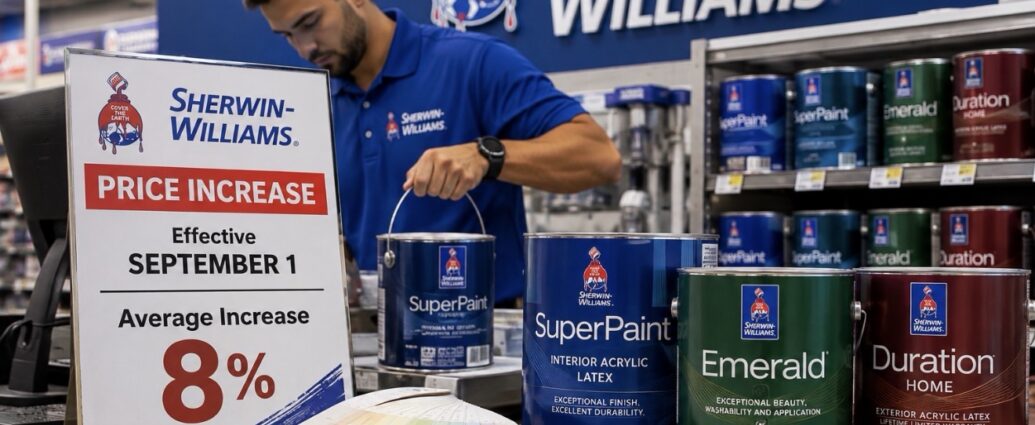
Anyone planning to paint a room this fall should buy the paint in August. Sherwin-Williams is raising prices 8% across its Paint Stores Group effective Sept. 1, 2026, a decision the company announced on July 28 alongside its second-quarter results.
The Paint Stores Group is the company’s own retail network — the stores where both professional contractors and homeowners buy. On a $60 gallon, 8% is about $4.80. A job that takes 15 gallons costs roughly $70 more after Labor Day than before it. For a contractor buying hundreds of gallons a month, the increase runs into real money.
The company attributed the increase to inflation in raw materials, energy, logistics and packaging, with supply-chain pressures intensifying during the continuing U.S. and Israeli conflict with Iran. Paint is a petroleum product at its core — resins, solvents and many pigments trace back to oil and gas feedstocks — so a disruption in energy markets shows up in a paint can with a lag of several months. Sherwin-Williams told analysts it expects raw material inflation to accelerate to a high-single-digit rate in the second half of the year, working out to a mid-single-digit impact across the full year.
The timing is not accidental. The company said the September date was chosen specifically to avoid disrupting the peak paint selling season — the spring and summer months when exterior work gets done. Waiting until after Labor Day means the increase lands when volumes are lower and customers are less likely to shop elsewhere over it.
What makes the move notable is that it comes without any recovery in demand to support it. Chief Executive Heidi Petz said the company outperformed the market despite ongoing global uncertainty and “no meaningful improvement in demand.” She added that demand indicators point to continued softness in the second half. Raising prices into a flat market is a calculated risk: if competitors hold their prices, customers can walk. PPG, the largest rival, reported results just below Wall Street expectations and reaffirmed its full-year guidance — which tells you the pressure on input costs is industry-wide, but not whether PPG will match the increase.
The underlying business is performing. Second-quarter net sales rose 7.5% to $6.79 billion, net income climbed 11.8% to $843.6 million, and adjusted earnings per share reached $3.70. Paint Stores Group sales rose 5.1%, with same-store sales up 4.2%. Consumer Brands sales jumped 21.5% to $983.5 million, helped by the Suvinil acquisition. The company raised its full-year adjusted earnings guidance to $11.80 to $12.20 a share from $11.50 to $11.90, and returned $1.46 billion to shareholders through dividends and buybacks in the quarter. The stock rose as much as 7.8% on the news.
The company also closed 57 stores this year , and told investors it expects to return to the high end of its target of 80 to 100 net new store openings starting in 2027 after this year’s portfolio pruning.
Three practical takeaways for anyone with a project.
Buy before the deadline if the work is already planned. Paint stores well for a year or more in a sealed can kept from freezing, so buying August paint for an October job is a straightforward 8% saving.
Contractors should look hard at any bid already written but not yet purchased. A quote issued in July on a job that buys material in September carries the increase entirely on the contractor’s margin unless the contract has an escalation clause.
And expect this to be one increase in a series rather than a one-time event. The company’s own guidance assumes no broad demand recovery for the rest of 2026 and accelerating input costs — a combination that historically produces another pricing action rather than a rollback.
JBizNews Desk | Cleveland
© JBizNews.com All Rights Reserved. Reproduction or distribution without written permission is prohibited.