Sunday, May 3, 2026
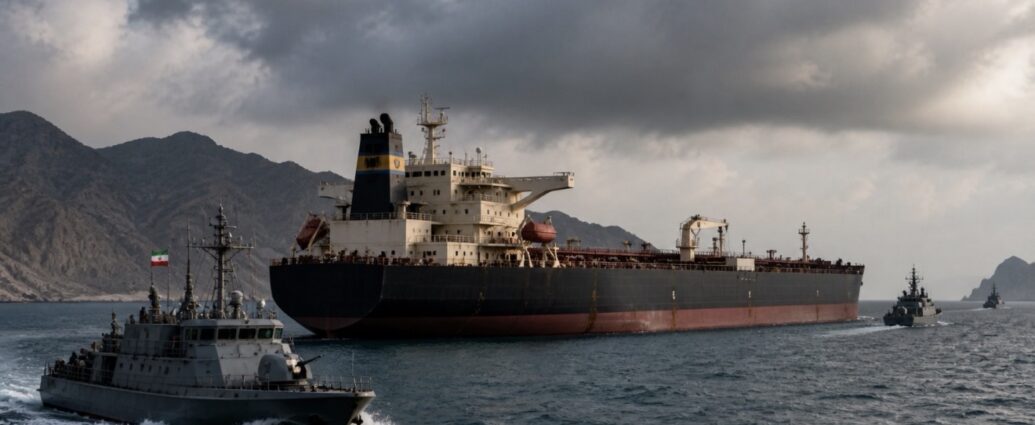
A bulk carrier came under attack Sunday, May 3, near the Strait of Hormuz, marking the latest in more than two dozen assaults on commercial vessels since the United States and Israel launched a war against Iran on February 28 — a conflict that has fundamentally transformed one of the world’s most critical energy arteries from a busy commercial lane into a wartime choke point.
UK Maritime Trade Operations (UKMTO) reported that the northbound vessel was struck by multiple small craft approximately 11 nautical miles west of Sirik, on Iran’s southern coast, at 11:30 a.m. UTC on Sunday, May 3. All crew members were reported safe and no environmental damage was recorded. Maritime tracking firm Pole Star Global identified the likely target as the Liberian-flagged bulk carrier Minoan Falcon, which was transiting northbound toward the strait when its transponder went dark. There was no immediate claim of responsibility. The attack is the first reported in the area since April 22, when Iranian forces seized two container ships — the Epaminondas and the MSC Francesca — before initially guiding both to Sirik.
The attack underscores how dangerous the strait has become for commercial operators since the war began. Iran has effectively restricted or closed the waterway for most traffic, asserting control over the passage and demanding tolls from vessels not affiliated with the United States or Israel. The U.S. Navy, for its part, has maintained a blockade of Iranian ports since April 13, turning the strait into a zone of dual restriction — with roughly 49 commercial ships ordered to turn back by U.S. Central Command as of Sunday. In peacetime, approximately one-fifth of the world’s oil and liquefied natural gas supplies flowed through the strait daily.
On Sunday morning, U.S. Treasury Secretary Scott Bessent appeared on Fox News’ Sunday Morning Futures and delivered the sharpest public assessment yet of Iran’s economic position, describing the American campaign as a full-spectrum economic stranglehold. “We are suffocating the regime, and they are not able to pay their soldiers,” Bessent said. “This is a real economic blockade, and it is in all parts of government — all hands on deck.” Bessent said Iran’s oil storage capacity is “rapidly filling up” and that the country may be forced to begin shutting in oil wells “in the next week,” a development that would further damage an already deteriorating energy infrastructure. He also said the Islamic Revolutionary Guard Corps (IRGC), which has been conducting the small-craft attacks on commercial shipping, had accumulated offshore assets now being tracked and frozen by Treasury. The IRGC has collected less than $1.3 million in transit tolls — a fraction of Iran‘s pre-war daily oil revenues — according to U.S. Central Command. Kevin Hassett, Director of the National Economic Council, echoed that assessment Sunday on CBS, saying Iran had “an economy that’s really on the precipice of extreme calamity” and was experiencing hyperinflation.
Diplomatically, the two sides remain at an impasse even as back-channel negotiations continue. Iran submitted a 14-point response to the U.S. peace proposal on Friday, relaying it through Pakistan, which hosted the first round of direct talks in Islamabad last month. The Iranian proposal demands that all issues — including an end to the naval blockade, withdrawal of U.S. forces from the region, payment of war reparations, release of frozen assets, and lifting of sanctions — be resolved within 30 days, while postponing discussion of Iran’s nuclear program until after the war formally ends. The Trump administration has signaled the proposal is unlikely to be accepted in its current form, with President Donald Trump writing on social media Saturday that Iran had “not yet paid a big enough price for what they have done.” Iran’s Foreign Ministry spokesman Esmail Baghaei confirmed Sunday that Washington was still reviewing Tehran’s proposal, while making clear that “at this stage, we have no nuclear negotiations.”
Iran‘s deputy parliament speaker Ali Nikzad visited strategic Larak Island Sunday and declared that Tehran “will not back down from our position on the Strait of Hormuz, and it will not return to its prewar conditions.” Separately, UKMTO reported that vessels near Ras al-Khaimah, the northernmost emirate of the United Arab Emirates, had received unidentified VHF radio warnings to move from anchorages — a signal that maritime risk is not confined to the strait’s immediate approaches.
For energy buyers, shipowners and insurers, the practical implications remain severe. Commercial operators including Maersk, CMA CGM and Hapag-Lloyd suspended strait transits weeks ago. War-risk premiums have surged. Global food supply chains face added strain because roughly 30 percent of internationally traded fertilizers normally move through the Strait of Hormuz. The International Energy Agency has described the effective closure as “the biggest energy security threat in history,” with one estimate suggesting the disruption is equivalent to a billion barrels of oil missing from the global economy.
Whether the strait reopens depends on two tracks: whether Iran and the United States can bridge the gap in their peace proposals, and whether attacks on commercial vessels — now numbering more than two dozen since late February — continue to escalate or plateau. For now, UKMTO rates the threat level in the area as critical, and Sunday’s attack on the Minoan Falcon offered no sign that either side is prepared to stand down.
JBizNews Desk
© JBizNews.com. All rights reserved. This article is original reporting by JBizNews Desk. Unauthorized reproduction or redistribution is strictly prohibited.