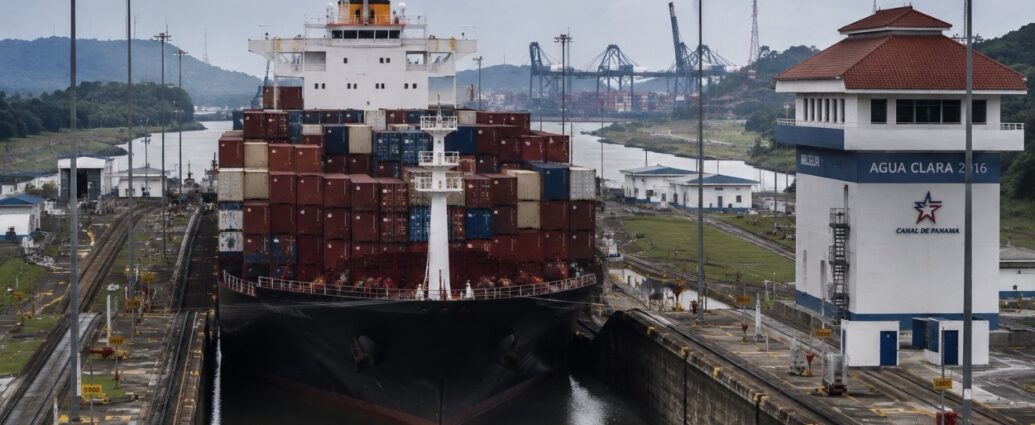
The owner of a container ship handed the Panama Canal $4 million on Monday for one thing: permission to go ahead of everyone else. The vessel, the Seaspan Benefactor, won a near-record auction price to jump the queue at a waterway where large ships are now waiting 10 days to get through, and Seaspan did not respond to a request for comment on Tuesday.
That $4 million is not a toll increase and it is not a fee the canal set. Most ships cross at a flat published rate by booking a reservation in advance. Vessels without one can either sit at anchor or bid in the canal authority’s auction, which sells a small number of daily slots to whoever offers the most. The price is simply what one company decided a week and a half of waiting was worth. It was more than double the average auction price of the previous seven days, according to a document seen by Bloomberg.
Time is expensive at sea for reasons that have nothing to do with the canal. A large gas or container ship costs tens of thousands of dollars a day to run whether it moves or not, cargo is usually sold against a delivery window written into a contract, and missing that window can cost more than the bid. When a buyer in Asia needs a cargo of American propane or liquefied natural gas by a fixed date, paying millions to move up the line can still be the cheaper answer.
The congestion traces back to the Iran war. With traffic sharply curtailed at two Persian Gulf chokepoints — the Strait of Hormuz and, more recently, the Bab el-Mandeb — buyers and sellers of oil, natural gas, fertilizer and chemicals, particularly in Asia, have been rerouting cargoes, and much of that redirected trade is funneling through Panama. The practical effect is that U.S. Gulf Coast export terminals have become the substitute supplier for a lot of Asian demand, and Panama is the shortcut those cargoes take.
Neopanamax vessels — the larger class that carries liquefied petroleum gas, liquefied natural gas, crude and refined products — face a 10-day wait for the Pacific-to-Atlantic direction, the longest since May, according to Argus Media data.
Two problems inside Panama are making it worse. Lock maintenance running until September is affecting the Neopanamax locks, and the canal recently cut the maximum draft allowed in those locks for the weeks ahead after rainfall came in below expectations. Draft limits are not a small technicality: a ship that cannot load to its full depth carries less cargo per trip, so the same tonnage requires more transits through a canal that already cannot handle the traffic it has. Water levels in Gatun Lake have continued to fall, and the authority moved earlier this month to tighten draft limits again. In July it had already begun curtailing some vessel-booking slots because of water supply.
The Panama Canal Authority said auction costs have risen because of shifts in global trade supply and demand and confirmed that some bids have topped $1 million, while declining to comment on the $4 million transaction or the ship that paid it. Its longstanding position is that auction results reflect what customers bid, not what the canal charges.
The scale of the move is easier to see against where prices sat before the fighting started. Auction slots went for roughly $135,000 to $140,000 before the war, then climbed to about $385,000 in March and April. A standard crossing runs somewhere between $300,000 and $400,000 depending on the vessel, and the extra paid for an earlier slot, once $250,000 to $300,000, has averaged around $425,000 during the surge. A $4 million Neopanamax slot had not been seen since the drought of November 2023.
As of Tuesday, the Seaspan Benefactor was sitting on the Pacific side of the canal, apparently waiting to transit northbound.
The fix, such as it is, is already underway and slow. The canal authority says it has increased transit capacity by about 15 percent and credits wetter weather for faster velocities. The lock maintenance is scheduled to finish in September, which should return capacity that the industry badly needs. Beyond that, shippers are doing what shippers do in a squeeze: booking reservations further out, splitting cargoes across more sailings, and pricing the delay into freight rates rather than gambling on the auction.
Whoever ends up buying that cargo pays for it. A $4 million line jump does not stay on one balance sheet — it moves into freight rates, then into the delivered cost of fuel, fertilizer and chemicals, and eventually into the price of things made from them. The number is remarkable because it is public. The pattern it belongs to is not.
JBizNews Desk | New York
© JBizNews.com All Rights Reserved. Reproduction or distribution without written permission is prohibited.