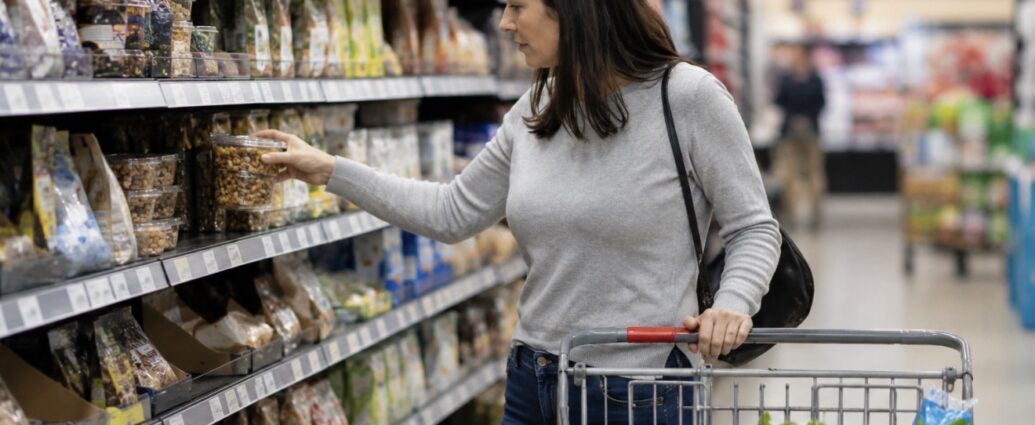
Americans bought fewer groceries in June than they did a year ago — not fewer dollars’ worth, fewer actual things. Grocery units, meaning individual items sold, fell 1.8% in June from a year earlier, a sharp reversal from the 0.1% year-over-year growth recorded in June 2025.
That single number is the most honest read on the American household available right now, and it is worse than the price data suggests.
For four years, the grocery business has been carried by inflation. Volumes were soft, but prices climbed enough to keep overall sales growing, and the industry could tell itself that shoppers were still shoppers. That arrangement has now broken. Prices continue to rise roughly 2% to 3% year-over-year, but that inflation cushion is no longer enough to keep overall sales growing. The math has flipped: people are paying more per item and going home with less in the bag.
The pressure did not arrive from one direction. Grocery prices sit roughly 33% above where they were in 2019, and fuel costs have spiked. On top of that, many lower-income households have cut back after reduced SNAP benefits and tighter program eligibility. A family absorbing all three at once does not write a letter to anyone. It puts the second package of chicken back.
What should worry the industry is who is trimming. This is not confined to households living check to check. Even upper-income consumers are looking at a large enough absolute dollar change that they start to feel sticker shock and begin shopping around, according to Bain’s retail practice. When the shopper who never checked the unit price starts checking the unit price, the behavior tends to stick well past the conditions that caused it.
The suppliers have noticed. PepsiCo spent February cutting prices — Lay’s, Doritos, Cheetos and Tostitos all came down 15% — on the theory that cheaper snacks would bring volume back. It didn’t take. On the company’s July 9 call, chief executive Ramon Laguarta told investors the consumer was “worse than what we had anticipated,” and put the blame not on his own shelf price but on the gas pump. Executives also pointed to lower effective pricing, meaning the company leaned harder on promotions as shoppers grew more price sensitive.
That is a company discovering that its problem is not its product. It is the $70 that left the household budget before anyone got to the snack aisle.
The retailers are running the same play. Walmart announced summer price cuts on beef, ice cream and other items, including products from PepsiCo, Coca-Cola and its own Great Value private label, and retailers including Walmart and Kroger have leaned into price cuts and value promotions to pull shoppers in. Grocers have been pushing suppliers to bring prices down — which means the squeeze is now traveling backward up the chain, from the shopper to the store to the manufacturer.
For the tri-state independent grocer, the read is more pointed than it is for Walmart. A national chain can eat margin on beef for a quarter to hold traffic. A single-store operator in Brooklyn or Passaic cannot. When the shopper’s basket shrinks by two items, the store’s fixed costs do not shrink by anything, and the categories that get cut first — the impulse buy, the premium cut, the second box of cereal — are the categories carrying the margin.
There is also a signal here about what the summer’s price relief actually bought. Headline inflation cooled in June, and grocery inflation ran near 3% for the twelve months through June. Those are numbers a policymaker can stand behind. They are also numbers that describe the rate of change, not the level. A shopper does not experience 3%. A shopper experiences 33% above 2019, permanently, every Sunday, and adjusts accordingly.
The industry has spent two years waiting for the consumer to normalize. June suggests the consumer already has — just not to the baseline anyone was hoping for. The new normal is a smaller cart.
Watch the back-to-school window. It is the next real test of whether households have decided this is a temporary squeeze or a permanent budget, and unlike a snack purchase, it is not optional.
JBizNews Desk | New York
© JBizNews.com All Rights Reserved. Reproduction or distribution without written permission is prohibited.