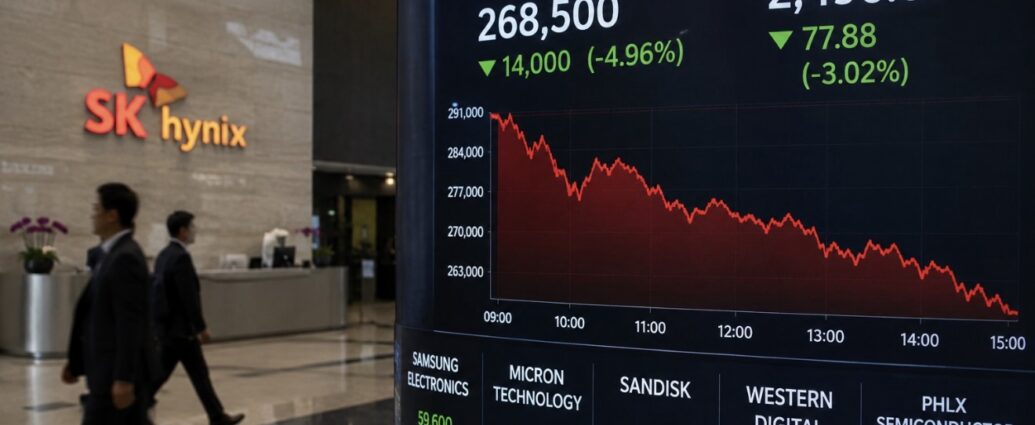
On Tuesday, July 14, shares of SK Hynix fell nearly 5% on the Korea Exchange, deepening a selloff that began the day before, when the chipmaker recorded its worst single session in history. The trigger, according to trading data from the exchange and a widely circulated research note from brokerage Korea Investment & Securities, was a growing fear among investors that this year’s blistering rally in memory-chip stocks had run far ahead of what the underlying business can deliver.
The damage on Monday was severe. SK Hynix closed down 15.4% in Seoul, its steepest drop on record, just three trading days after a celebrated debut on the Nasdaq in New York. The plunge dragged the country’s benchmark Kospi index down roughly 9% and forced a brief, market-wide halt in trading. Rival Samsung Electronics, which along with SK Hynix dominates the Korean market, fell close to 11%. Foreign investors sold about 1.7 trillion won, or roughly $1.1 billion, of Korean shares in a single day, with SK Hynix accounting for most of the selling.
By Tuesday the bleeding had not stopped. The additional 5% slide wiped out an early gain of as much as 4.6%, and the Kospi slipped another 3%. In two sessions, SK Hynix and Samsung each shed at least 30% from the record highs they set only last month. SK Hynix’s market value dropped to about $875 billion, pushing it back out of the elite group of companies worth more than a trillion dollars, a threshold it had crossed less than two months earlier.
The immediate spark was a report from Korea Investment & Securities warning that SK Hynix’s operating profit for the latest quarter could come in about 8% below what the market expected. The brokerage pointed to the company’s heavy reliance on high-bandwidth memory, the specialized chips that sit alongside Nvidia’s artificial-intelligence processors. Prices for that memory are still climbing, the report noted, but more slowly than the sky-high forecasts baked into the stock.
For all the drama, several market watchers described the drop as a healthy purge rather than a warning of collapse. Chan H. Lee, managing partner at Seoul-based Petra Capital Management, called it profit-taking and a classic “sell-the-news” reaction to the Wall Street listing rather than any real change in the company’s outlook. Daniel Yoo, global strategist at Yuanta Securities, put it more bluntly, saying investors are simply confused about where memory demand and a fair share price actually sit now that the same company trades in two countries at once.
That confusion is real money. SK Hynix’s American shares represent one-tenth of a Seoul share, and at Monday’s close they traded at a premium of about 25% to the Korean price, tempting traders to bet on the gap closing. In Hong Kong, a leveraged fund that aims to double SK Hynix’s daily move lost more than a third of its value in one day.
The selling rippled straight into American memory names. Micron Technology fell about 6.4%, Sandisk dropped 8.4%, and Western Digital lost 6.8%, while the broad Philadelphia Semiconductor Index gave up 3.6%. The message was simple: when the biggest supplier of AI memory sneezes, the whole chip aisle catches cold.
Underneath the panic, the business itself is booming. SK Hynix reported that operating profit jumped 405% from a year earlier in the first quarter of 2026, with revenue up 198%, powered by an ongoing shortage of memory as AI companies race to build data centers. That is exactly why the pullback matters to ordinary readers. Memory chips are the raw material of the AI economy, and their price feeds into the cost of everything from cloud computing bills to the servers behind popular chatbots.
Korea’s government is treating the buildout as a national priority. On Monday, President Lee Jae Myung repeated a pledge to speed up hundreds of billions of dollars in new chip-factory projects planned by Samsung and SK Hynix, a reminder that Seoul sees these two companies as pillars of the entire economy.
For now, the question hanging over the market is whether the two-day rout was a pause or a top. The companies are minting record profits, yet their stocks just proved how quickly a crowded bet can unwind. Investors who piled into the AI trade are learning that even the strongest story can be priced for perfection, and that perfection rarely survives contact with a single downbeat forecast.
JBizNews Desk | Seoul
© JBizNews.com All Rights Reserved. Reproduction or distribution without written permission is prohibited.