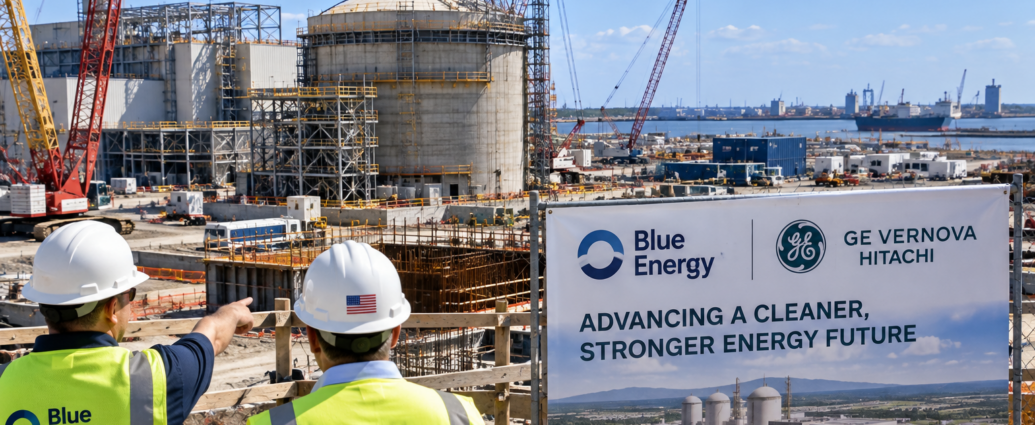
AUSTIN, Texas — A new generation of small nuclear reactors is moving closer to reality in Texas as artificial-intelligence data centers drive an extraordinary increase in demand for electricity.
Nuclear startup Blue Energy has submitted the first part of a federal construction-permit application for a planned gas-and-nuclear power complex at the Port of Victoria on the Texas Gulf Coast.
The project could eventually produce 2.5 gigawatts of electricity, combining about 1 gigawatt from natural gas turbines with as much as 1.5 gigawatts from five small modular nuclear reactors.
The electricity is intended to support a nearby AI data-center campus being developed by Crusoe.
For Texas, the project represents an attempt to solve one of the biggest problems facing the artificial-intelligence boom: where to find enormous amounts of dependable electricity quickly enough to keep new data centers running.
Five Smaller Nuclear Reactors
Blue Energy plans to use the BWRX-300, a 300-megawatt small modular reactor developed by GE Vernova Hitachi Nuclear Energy.
Instead of relying on a single enormous nuclear reactor, Blue Energy could deploy as many as five BWRX-300 units, giving the nuclear portion of the project roughly 1,500 megawatts of generating capacity.
Blue Energy submitted the first portion of its construction-permit application to the U.S. Nuclear Regulatory Commission in September. The filing covers the project’s first nuclear unit and seeks permission for limited construction work, including foundations and shafts associated with the reactor.
The company expects to submit the second part of the application in the second half of 2027 after completing required site-specific data collection.
A final investment decision is also expected in 2027.
Gas First, Nuclear Later
What makes the Texas project unusual is that Blue Energy does not intend to wait for the nuclear reactors before producing electricity.
The company plans to install two GE Vernova 7HA.02 natural-gas turbines capable of supplying approximately 1 gigawatt beginning in 2030.
The nuclear reactors would then begin coming online in 2032, eventually adding as much as 1.5 gigawatts.
In simple terms, natural gas provides a bridge.
Data centers can get large amounts of electricity sooner while the nuclear portion works its way through the longer licensing and construction process.
Blue Energy and GE Vernova Hitachi signed an agreement in August advancing engineering, licensing and safety analysis for the project.
Building Nuclear Plants More Like Ships
Blue Energy is also trying to change how nuclear power plants are constructed.
Traditional nuclear projects require enormous amounts of complicated work to be completed at the power-plant site. That can expose projects to construction delays, labor shortages and cost overruns.
Blue Energy instead plans to manufacture large sections of its plants away from the site, including using shipyard-style fabrication, and then transport those components for final assembly.
The company argues that standardizing and prefabricating much of the plant can make nuclear construction faster and more predictable.
That approach is particularly suited to the BWRX-300, which was designed as a smaller, standardized reactor that can potentially be deployed repeatedly rather than engineering a completely different plant for every location.
AI Is Changing the Power Equation
The ultimate customer illustrates why projects like this are gaining attention.
Crusoe is developing a roughly 1,600-acre AI data-center campus near the Port of Victoria. The company announced its partnership with Blue Energy in October 2025, with Blue Energy securing a site to develop and operate the power project.
Modern AI data centers can consume enormous quantities of electricity because thousands of specialized computer chips must operate continuously to train and run artificial-intelligence models.
Unlike many traditional industrial facilities, those computers need dependable electricity 24 hours a day.
That makes nuclear power particularly attractive to data-center developers. Nuclear plants can operate around the clock without depending on whether the sun is shining or the wind is blowing.
Natural gas can provide similar reliability and can generally be built faster, explaining Blue Energy’s decision to combine the two technologies.
Texas Becomes Nuclear Testing Ground
The project is also part of a broader effort to bring advanced nuclear technology into commercial use in the United States.
Blue Energy’s Texas project would be another major deployment of GE Vernova Hitachi’s BWRX-300 technology. The Tennessee Valley Authority has also pursued the reactor for its Clinch River site in Tennessee.
At the Port of Victoria, Blue Energy secured an option covering approximately 70 acres at the Texas Logistics Center for development of a modular nuclear facility capable of producing as much as 1.5 gigawatts.
The attraction for Texas is straightforward.
As AI data centers, manufacturing plants and a growing population demand more electricity, the state needs generation that can operate when demand is highest.
But the Blue Energy project is still a development project, not a completed power plant.
Federal regulators must review the nuclear construction application, additional permits and engineering work remain, and Blue Energy must make its final investment decision before the entire project can move ahead.
If it succeeds, however, Victoria could become an important test of whether small modular reactors can do something the nuclear industry has struggled to accomplish for decades:
build new nuclear power faster, repeatedly and at a cost that makes economic sense.
JBizNews Desk | Austin
© JBizNews.com All Rights Reserved. Reproduction or distribution without written permission is prohibited.