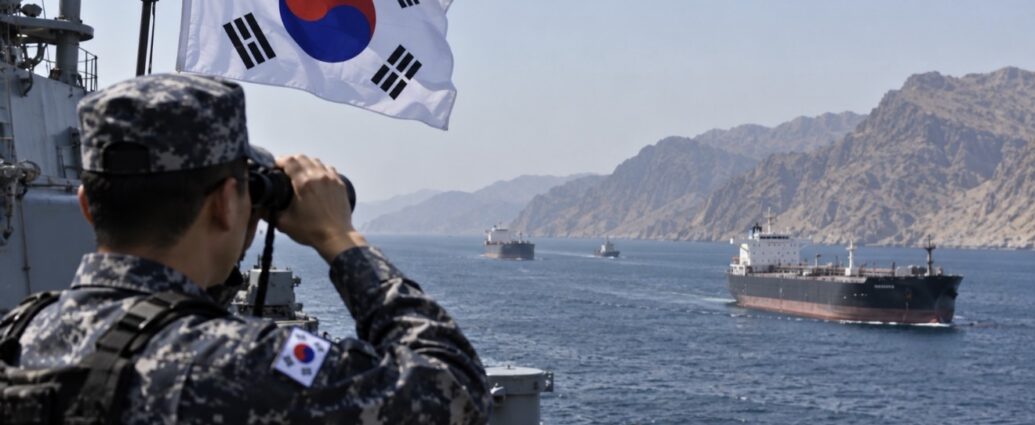
South Korea is moving toward a possible military deployment to the Strait of Hormuz just weeks after President Donald Trump publicly tied reduced U.S.-South Korea military exercises to Seoul’s refusal to assist Washington in the war against Iran.
The timing is difficult to miss.
South Korean media, citing government and military sources, report that Seoul is preparing to seek parliamentary approval for a mission aimed at protecting freedom of navigation through the Strait of Hormuz.
Options under consideration reportedly include a maritime patrol aircraft, a logistics support vessel and a mine-clearing unit.
South Korea has also been discussing the possible mission with the United States, Britain and France.
The government has not made a final deployment decision, and the South Korean presidential office has pushed back against reports suggesting the mission is already approved.
But Seoul is clearly considering a contribution that looks very different from the position it held only weeks ago.
The Message From Washington
Last month, Trump announced that he was reducing the scale of joint U.S.-South Korea military exercises.
He cited his relationship with North Korean leader Kim Jong Un as one reason.
But Trump also specifically pointed to South Korea’s refusal to assist the United States in the conflict with Iran.
That made the decision more than a military scheduling issue.
It became a message about burden-sharing.
The United States has tens of thousands of troops stationed in South Korea and has spent decades providing a major security umbrella against North Korea.
Trump’s position was essentially that allies benefiting from American military protection should also be willing to assist the United States when critical global shipping routes and American interests are under threat.
Now Seoul is considering exactly the kind of maritime contribution Washington had been seeking.
Why Hormuz Matters to South Korea
There is also a powerful economic reason for Seoul to care.
South Korea is one of the world’s largest energy importers.
It depends heavily on oil and natural gas moving out of the Middle East.
The Strait of Hormuz is the gateway for a major share of those supplies.
If shipping through the strait becomes unreliable, South Korea does not simply have a foreign-policy problem.
It has an energy problem.
Higher oil and gas prices hit Korean manufacturers, airlines, shipping companies and consumers.
That gives Seoul a direct economic interest in keeping the waterway open.
This Is Not Yet a Deployment
That distinction is important.
South Korea’s presidential Blue House says discussions are still focused on practical ways to contribute to freedom of navigation.
It has rejected reports that a final decision to deploy forces has already been made.
The government is reportedly considering submitting a consent motion to parliament after a cabinet review.
So the next step is political.
Seoul has to decide whether it wants to formally commit military assets and then secure the necessary domestic approval.
Why the Mine-Clearing Option Matters
One of the most important options being discussed is a mine-clearing unit.
That is not symbolic.
Mines can close or severely restrict commercial shipping without requiring Iran to directly attack every vessel passing through the strait.
Clearing them requires specialized ships, equipment and trained personnel.
A South Korean contribution in that area could therefore have real operational value for maintaining commercial traffic.
The same is true of maritime patrol aircraft, which can monitor shipping lanes and identify potential threats.
What It Means for Businesses
For global businesses, this is ultimately about keeping one of the world’s most important energy corridors functioning.
Oil markets do not need the Strait of Hormuz to be completely closed before prices rise.
Even the threat of disruption can increase:
- Oil prices
- Marine insurance
- Freight costs
- Shipping delays
- Energy prices
South Korea has more at stake than most countries because of its dependence on imported energy and its enormous manufacturing economy.
That makes participation in a Hormuz mission both a military decision and an economic one.
The Bigger Alliance Message
The broader lesson may be even more important.
Trump has repeatedly argued that American allies should contribute more directly when U.S. forces are carrying the burden of protecting shared economic and security interests.
South Korea initially stayed out of the Iran conflict.
Washington responded by reducing military cooperation.
Now Seoul is actively discussing sending assets toward the very region where the United States wanted help.
South Korean officials have not said the two decisions are directly connected.
But the sequence is clear.
Washington applied pressure. Seoul heard the message. And South Korea is now considering putting military assets into the Strait of Hormuz.
For America’s other allies, that sequence will be closely watched.
JBizNews Desk | Seoul
© JBizNews.com All Rights Reserved. Reproduction or distribution without written permission is prohibited.