By JBizNews Desk | Monday, May 4, 2026
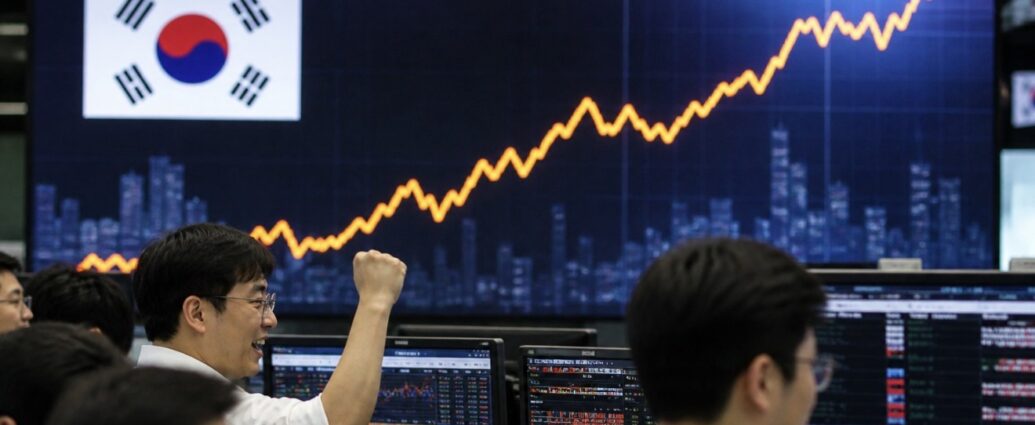
South Korea’s stock market opened the new week with another record, extending one of the most remarkable rallies any major market has delivered in decades. The KOSPI — South Korea‘s benchmark index — climbed Monday to fresh all-time highs, building on an April surge of nearly 31% that marked the index’s strongest monthly gain since January 1998, when South Korea was clawing its way out of an IMF bailout.
South Korean stocks rose Monday to hit a fresh record as investors weighed ongoing tensions between Iran and the U.S. and Washington’s announcement that it would attempt to reopen shipping in the Strait of Hormuz through its “Project Freedom” operation beginning Monday. 
The move added to a year of extraordinary gains. The KOSPI has jumped almost 60% this year — the strongest performance among major global indexes — and the total market value of all listed companies in South Korea has now surpassed that of the United Kingdom, making it the world’s eighth-largest equity market with a combined market capitalization of $4.2 trillion. 
AI Chips Are Driving Everything
The rally has one dominant engine: artificial intelligence. South Korea’s outsized gains have been driven largely by optimism around the AI boom, with semiconductor giants SK Hynix and Samsung Electronics leading the charge — rising 60% and 35%, respectively, in April alone. 
The earnings have justified the enthusiasm. Samsung Electronics posted a 755% increase in profit in the March quarter, powered by robust demand for AI-related chips.  SK Hynix alone surged 7.8% in a single session last week to hit an all-time high, as high-bandwidth memory chips used for AI workloads remain in chronically short supply, with prices forecast to rise another 40% through the second quarter of 2026. 
The KOSPI’s record-breaking April performance comes as the broader Asia-Pacific market, including the KOSPI, saw some sessions pulled lower by oil price spikes tied to Middle East uncertainty pushing Brent crude above $111 per barrel — yet the index shrugged off those pressures and closed the month near its highs. 
Wall Street Is Taking Notice
Global institutions are repositioning aggressively. HSBC last week upgraded South Korea to “neutral” from “underweight,” saying recent foreign outflows had helped unwind crowded positioning and reduced downside risks from geopolitical volatility. Beyond the heavyweight chipmakers, HSBC said broader growth themes in energy storage, shipbuilding, defense and nuclear power are also supporting the rally. 
For ETF investors, much of this momentum is being accessed through the iShares MSCI South Korea ETF, which has jumped around 59% this year, drawing inflows of roughly $6.4 billion so far in 2026. 
The Risk Beneath the Rally
Not everyone is purely bullish. Stock lending balances in South Korea — a leading indicator of short-selling pressure — have climbed above 175 trillion won ($118 billion), while margin loan balances reached a record 35 trillion won ($23.6 billion). Lee Hyo-sup, a senior research fellow at the Korea Capital Market Institute, warned that if geopolitical uncertainty around the Iran war intensifies or enthusiasm around AI stocks cools, accumulated short-selling volume could hit the market quickly. “If stock prices plunge, the risk of forced liquidation will also increase for retail investors who borrowed to invest,” he said. 
For now, those risks remain in the background. With AI chip demand showing no signs of slowing and Project Freedom raising hopes that oil prices could ease, South Korea’s market is betting the good times have further to run.
— JBizNews Desk
© JBizNews.com. All rights reserved. This article is original reporting by JBizNews Desk. Unauthorized reproduction or redistribution is strictly prohibited.