By JBizNews Desk
Starbucks Strips Down to Rebuild: What It Means for Workers, Franchises, and Your Morning Coffee
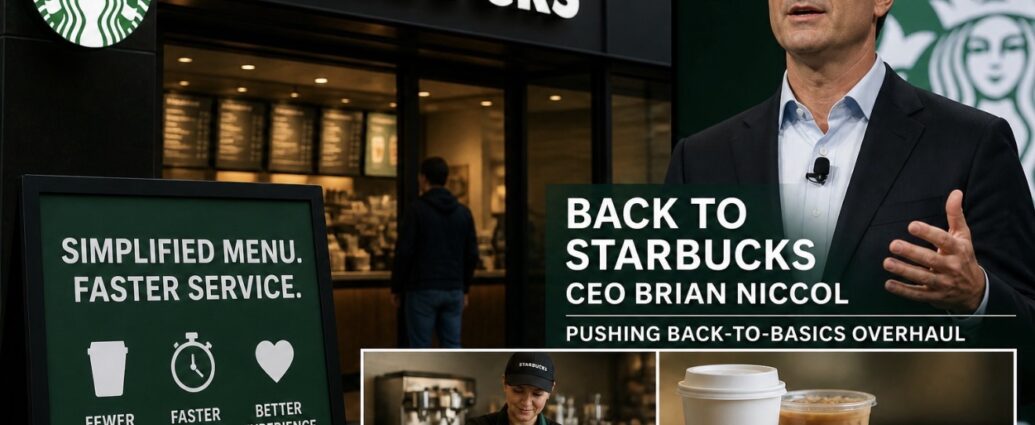
Starbucks is accelerating one of the most ambitious corporate turnarounds in the coffee chain’s history. As of late April 2026, CEO Brian Niccol confirmed the company has trimmed roughly 30% of its menu items since late 2024 and is actively restructuring store operations to reduce wait times — changes that are already being felt by baristas, suppliers, and the millions of customers who rely on the chain daily.
The announcement, confirmed by Starbucks leadership during its most recent earnings call on April 29, 2026, signals that Niccol — the architect of Chipotle’s operational resurgence — is doubling down on simplicity as the primary engine for recovery after years of declining customer satisfaction and sluggish traffic.
What Is Actually Changing on the Ground
The changes go well beyond pulling drinks off a menu board. According to company disclosures, the operational overhaul includes:
• Eliminating hundreds of customization combinations that were slowing down peak-hour throughput
• Reintroducing ceramic mugs and a more café-like experience for in-store customers
• Redesigning mobile order workflows to reduce congestion at pickup counters
• Cutting roughly 1,100 corporate support roles announced in February 2026 to redirect resources toward store-level investment
• Renegotiating supplier agreements to reflect a leaner, more focused product lineup
Economist Diane Swonk of KPMG noted on April 30, 2026, that large consumer-facing companies like Starbucks are increasingly being forced to choose between complexity and speed. “Consumers have shorter patience thresholds post-pandemic,” Swonk said. “When a brand promises convenience and fails to deliver it consistently, the customer walks — and they don’t always come back.”
Why This Matters Beyond the Latte
For small-business owners and independent café operators, the Starbucks pivot is a real-world case study in operational discipline — and a potential opening.
Holly Wade, Executive Director of Research at the National Federation of Independent Business (NFIB), pointed out in late April 2026 that independent coffee shops have consistently reported stronger customer loyalty metrics in markets where Starbucks has reduced its presence or shifted its format. “When a dominant player pulls back on experience, local operators have a real window,” Wade said.
For Starbucks employees — the company calls them partners — the changes carry mixed signals:
• Baristas report fewer complex drink orders during morning rushes, reducing stress and error rates
• However, corporate layoffs have created uncertainty around support infrastructure that store managers rely on
• New labor scheduling tools are being rolled out to align staffing with revised peak-traffic patterns
• Union organizing efforts, which intensified in 2022 and 2023, remain active at hundreds of locations, adding a layer of labor complexity to the turnaround timeline
Rick Gomez, a consumer retail analyst at Edward Jones, said in an April 29, 2026 client note that the operational improvements are measurable but still early. “Niccol has the right blueprint. The question is execution at scale across 16,000 U.S. locations. That is a supply chain, training, and culture challenge all at once,” Gomez said.
Supply Chain and Vendor Ripple Effects
The menu reduction is already reshaping Starbucks’ supply chain relationships. Ingredient suppliers for discontinued items — including several specialized syrup and dairy component vendors — have been notified of contract changes, some as recently as March 2026. Smaller regional suppliers are particularly exposed.
Shawn DuBravac, Chief Economist at the Consumer Technology Association and a regular commentator on retail supply chain dynamics, noted that large chain simplification events tend to send disproportionate shocks down to mid-tier vendors. “A 30% menu cut at a chain of this size is not just a customer experience decision — it is a procurement earthquake for dozens of businesses in the supply network,” DuBravac said in late April 2026.
Outlook
Starbucks’ back-to-basics strategy under Brian Niccol is arguably the most closely watched retail turnaround of 2026. The early data — faster service times and marginally improved customer satisfaction scores — suggests the approach is gaining traction. But the road ahead includes resolving active labor tensions, managing supplier disruption, and convincing a fatigued customer base that the brand has genuinely changed.
For everyday consumers, the practical takeaway is simpler: fewer options, faster lines, and a renewed push for the in-store experience that built the brand in the first place. For small businesses watching from the sidelines, the lesson is equally clear — operational complexity is a slow drain on growth, whether you run 16,000 locations or just one.
JBizNews Desk