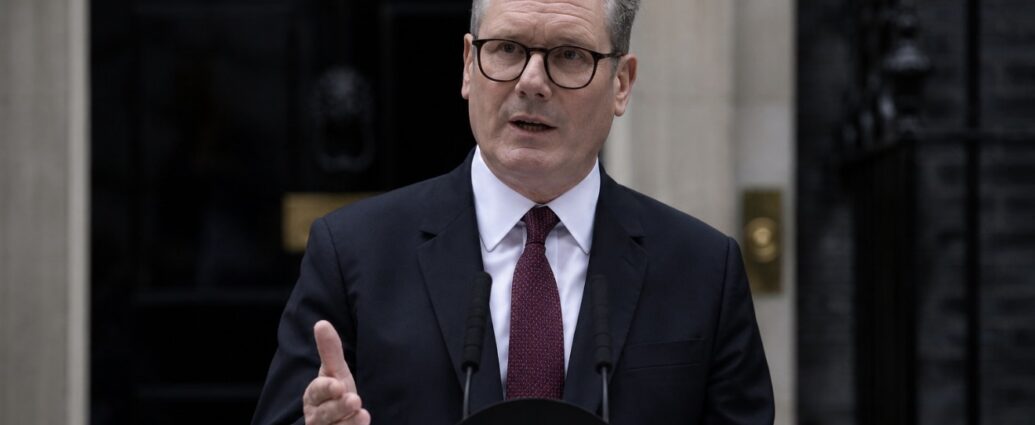
British Prime Minister Keir Starmer is facing the gravest political crisis of his premiership after Labour suffered catastrophic local election losses that have triggered an open revolt inside his own party, intensified pressure in financial markets, and raised the prospect that Britain could soon install its sixth prime minister in just seven years.
In a high-stakes speech Monday morning in central London, Starmer vowed to “face up to the big challenges” confronting the United Kingdom and insisted he would continue leading Labour despite mounting calls for his resignation following what many political analysts described as the party’s worst local election collapse in modern times.
The political shockwave began Thursday night when Labour lost more than 1,100 local council seats across England and Wales while the insurgent right-wing populist party Reform UK, led by Nigel Farage, gained more than 1,400 seats, reshaping Britain’s political map and devastating Labour strongholds that had remained loyal for generations.
The scale of the defeat stunned Westminster.
In Wigan and Leigh, two historic Labour strongholds in northwest England, Reform UK captured 24 of 25 contested seats. Nearby Tameside, controlled by Labour for nearly half a century, also swung dramatically away from the governing party. In Wales, Labour lost overall control for the first time, with the nationalist Plaid Cymru finishing first and Reform UK emerging as the second-largest force.
Farage called the results “a truly historic shift in British politics,” declaring that Labour was being “wiped out by Reform in many of their traditional areas.”
The fallout inside Labour was immediate and severe.
By Sunday evening, at least 42 Labour MPs were publicly demanding Starmer’s resignation, according to multiple British media tallies, pushing the party toward a potential leadership crisis less than two years after returning to power.
The rebellion quickly spread beyond backbench lawmakers.
Deputy Prime Minister Angela Rayner, long viewed as one of Labour’s most influential internal figures, posted a sharply critical message online warning that “what we are doing isn’t working, and it needs to change,” adding that the current moment “may be the Labour Party’s last chance.”
Rayner is now widely viewed as a possible leadership contender alongside Health Secretary Wes Streeting and Greater Manchester Mayor Andy Burnham if a formal challenge proceeds.
Labour MP Catherine West publicly urged cabinet ministers to “move quickly” to replace Starmer, while MP Paulette Hamilton warned the party “may as well hand in the keys to No. 10 now if we don’t change our leader soon.”
Under Labour Party rules, challengers would need the backing of 81 Labour MPs to formally trigger a leadership contest.
Starmer attempted to project defiance.
Speaking Monday, he acknowledged the election results were “very tough” and admitted “some people are frustrated with me,” but argued that “incremental change won’t cut it” and insisted he would lead Labour into the next general election due before May 2029.
He pointed to reductions in National Health Service waiting lists, falling child poverty figures and lower immigration levels as evidence that “the fundamentals are sound.”
Starmer also doubled down on strengthening Britain’s relationship with the European Union, drawing a sharp contrast with Reform UK and the Conservative Party.
“Those parties are defined by breaking our relationship with Europe,” Starmer said. “This government will be defined by rebuilding it.”
But financial markets appeared unconvinced.
During and after the speech, yields on British government bonds — known as gilts — climbed sharply, with benchmark yields approaching the psychologically critical 5% threshold, reflecting rising investor anxiety over political instability and Britain’s already fragile fiscal position.
The United Kingdom currently faces some of the highest borrowing costs in the G7, with persistent inflation, weak economic growth, elevated energy prices tied partly to the Iran conflict, and unresolved post-Brexit trade uncertainties continuing to weigh heavily on the economy.
According to British fiscal watchdog estimates, every 0.25 percentage point increase in government borrowing costs adds approximately £2.5 billion annually to Britain’s debt-servicing burden.
Market analysts warned that a prolonged leadership struggle — or a shift toward a more left-leaning Labour leadership — could intensify those pressures further.
Both Angela Rayner and Andy Burnham are viewed by some investors as more willing to support higher public spending and expanded borrowing, raising fears in bond markets about fiscal discipline.
“The longer doubts persist over the government’s stability, the greater the risk that market anxiety perpetuates the problem,” one London-based strategist said Monday.
The roots of Starmer’s political collapse are complex and politically combustible.
His government’s controversial decision to reduce winter fuel assistance for many pensioners during a prolonged cost-of-living crisis generated widespread anger among older working-class voters. Labour also faced growing backlash from progressive supporters who believed Starmer governed too cautiously on economic issues while simultaneously alienating some centrist voters with tougher rhetoric on immigration.
Additional controversy surrounding U.S. Ambassador Peter Mandelson’s reported ties to convicted sex offender Jeffrey Epstein further damaged public confidence in the government in recent months.
The broader implications now extend far beyond party politics.
Britain has cycled through five prime ministers since 2019 — Boris Johnson, Liz Truss, Rishi Sunak, and now Starmer — creating an extraordinary period of political instability rarely seen in a major Western democracy outside wartime or constitutional crisis.
For businesses and global investors, another leadership collapse would deepen concerns over Britain’s long-term policy direction at a moment when the country is already struggling with elevated debt costs, slowing growth and geopolitical economic shocks.
Whether Starmer survives may now depend on two critical questions: whether Labour rebels can gather enough parliamentary support to formally challenge him — and whether a single credible alternative can unify the increasingly fractured party behind one successor.
For now, Starmer remains in office.
But across Westminster, financial markets and Labour’s own parliamentary ranks, the question dominating British politics is no longer whether the prime minister is weakened.
It is whether his premiership is already entering its final chapter.
JBizNews Desk
© JBizNews.com. All rights reserved. This article is original reporting by JBizNews Desk. Unauthorized reproduction or redistribution is strictly prohibited.