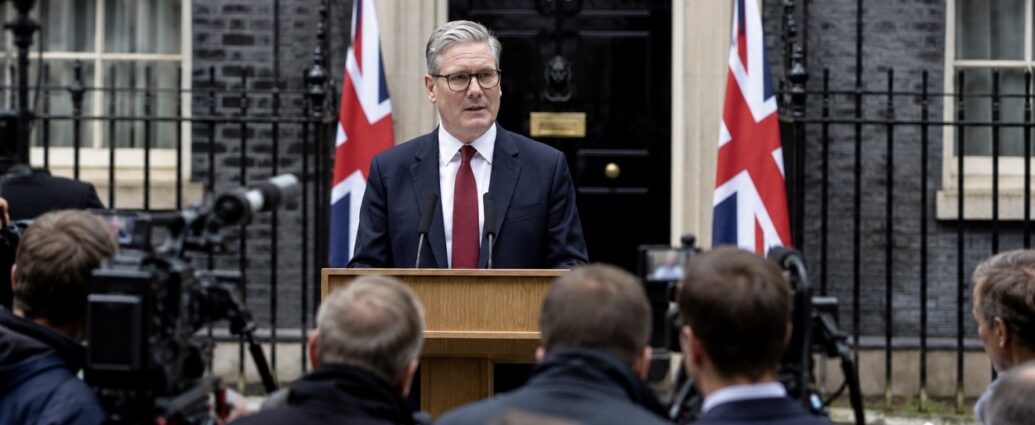
Standing outside 10 Downing Street on Monday, Keir Starmer announced he will step down as Britain’s prime minister and leader of the governing Labour Party, ending a turbulent run less than two years after a landslide election win. Starmer said he had informed King Charles III of his decision and would stay in office until Labour chooses a successor, with nominations opening July 9 and the contest completed by the summer recess on July 16. “I have heard the answer of my parliamentary party,” he said, acknowledging he had lost its confidence.
His exit sets up a familiar scene: another handover at the top of British government. Whoever wins is set to become the United Kingdom’s seventh prime minister in a decade — a churn that has defined the country’s politics since the 2016 vote to leave the European Union.
The clear front-runner is Andy Burnham, the popular mayor of Greater Manchester, who returned to Parliament by winning a June 18 special election in suburban Manchester. With former Health Secretary Wes Streeting dropping out and backing him, Burnham could take the Labour leadership uncontested and enter office in late July. A Labour MP under former Prime Ministers Tony Blair and Gordon Brown, Burnham built his reputation as mayor by steering growth into once-blighted post-industrial areas.
The timing is striking. Starmer’s resignation landed on the eve of Tuesday’s 10th anniversary of the Brexit referendum, and the reckoning over that vote is again front and center. The pressure that toppled him built for months: Labour was hammered in May’s local elections by the rising anti-immigration Reform UK party, led by Nigel Farage, and Starmer’s approval ratings had sunk to record lows as voters complained they had felt no real change.
That stalled progress is rooted partly in the economy. A new analysis drawing on Bank of England corporate data, led by Stanford economist Nicholas Bloom, estimates Brexit reduced UK GDP by 6% to 8% by 2025, with investment down 12% to 18%, and productivity and employment each off 3% to 4%. Bloom tied the damage to elevated uncertainty, reduced demand, diverted management time, and misallocation from a protracted Brexit process. Britain’s official forecaster, the Office for Budget Responsibility, assumes Brexit will permanently cut both imports and exports by about 15%.
Not every economist agrees on the size of the hit, and the figure is genuinely contested. The OBR’s official working assumption is that Brexit leaves UK output about 4% lower than it would have been — a number it reached by averaging earlier studies rather than producing its own research. Economist Jonathan Portes puts the realistic range at 4% to 5% of GDP, or roughly £120 billion to £150 billion a year, calling Brexit a “slow-burning drag” rather than a catastrophe. Others argue the costs have been overstated, noting that UK growth since 2016 has matched France and run at double the rate of Germany.
For ordinary Britons, the effects show up in prices. A weaker pound after the referendum pushed up import costs, with consumer prices estimated to have risen about 2.9% as a direct result. The promised upside has been modest: new trade deals with Australia, New Zealand, India, and Japan are trivial next to UK-EU trade, which was worth about £856 billion last year.
The backdrop for Burnham, should he take over, is an economy still under strain. The Bank of England held its key interest rate at 3.75% on June 18, declining to raise it even as inflation stayed elevated, lifted partly by higher energy prices from the recent U.S.-Iran conflict. That leaves Britain’s next leader facing the same knot that frustrated his predecessors: weak growth, stubborn prices, and a public running short on patience.
Whether Burnham can break the cycle — or simply becomes the seventh name on a long list — will hinge on whether he can lift growth in a way voters actually feel. That, more than any leadership contest, is the test that has defeated nearly everyone who has held the job since 2016.
JBizNews Desk | New York
© JBizNews.com All Rights Reserved. Reproduction or distribution without written permission is prohibited.